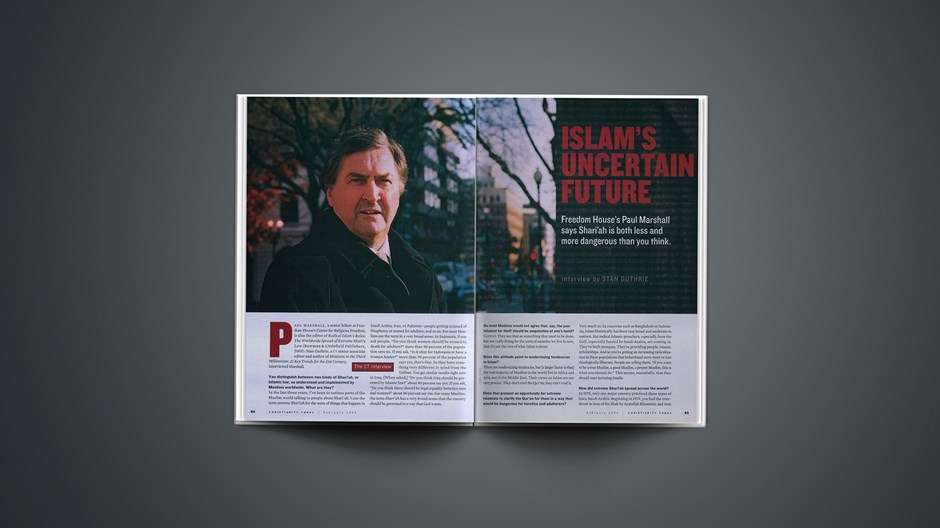
Paul Marshall, a senior fellow at Freedom House's Center for Religious Freedom, is also the editor of Radical Islam's Rules: The Worldwide Spread of Extreme Shari'a Law (Rowman & Littlefield Publishers, 2005). Stan Guthrie, a CT senior associate editor and author of Missions in the Third Millennium: 21 Key Trends for the 21st Century, interviewed Marshall.
You distinguish between two kinds of Shari'ah, or Islamic law, as understood and implemented by Muslims worldwide. What are they?
In the last three years, I've been to various parts of the Muslim world talking to people about Shari'ah. I use the term extreme Shari'ah for the sorts of things that happen in Saudi Arabia, Iran, or Pakistan—people getting accused of blasphemy or stoned for adultery, and so on. But most Muslims use the term in a very broad sense. In Indonesia, if you ask people, "Do you think women should be stoned to death for adultery?" more than 80 percent of the population says no. If you ask, "Is it okay for Indonesia to have a woman leader?" more than 90 percent of the population says yes, that's fine. So they have something very different in mind from the Taliban. You get similar results right now in Iraq. [When asked,] "Do you think Iraq should be governed by Islamic law?" about 80 percent say yes. If you ask, "Do you think there should be legal equality between men and women?" about 80 percent say yes. For many Muslims, the term Shari'ah has a very broad sense that the country should be governed in a way that God wants.
So most Muslims would not agree that, say, the punishment for theft should be amputation of one's hand?
Correct. They see that as something that used to be done, but not really fitting for the sorts of societies we live in now, that it's not the core of what Islam is about.
Does this attitude point to modernizing tendencies in Islam?
There are modernizing tendencies, but [a larger factor is that] the vast majority of Muslims in the world live in Africa and Asia, not in the Middle East. Their views on Islam are not very precise. They don't read the Qur'an; they can't read it.
Does that present an opportunity for extreme Islamists to clarify the Qur'an for them in a way that would be dangerous for heretics and adulterers?
Very much so. In countries such as Bangladesh or Indonesia, Islam historically has been very broad and moderate in outlook. But radical Islamic preachers, especially from the Gulf, especially funded by Saudi Arabia, are coming in. They've built mosques. They're providing people, imams, scholarships. And so you're getting an increasing radicalization in these populations that beforehand were more or less theologically illiterate. People are telling them, "If you want to be a true Muslim, a good Muslim, a proper Muslim, this is what you should do." This means, essentially, that they should start imitating Saudis.
In 1975, only one major country practiced these types of laws: Saudi Arabia. Beginning in 1979, you had the overthrow in Iran of the Shah by Ayatollah Khomeini, and Iran began to institute similar laws. There are differences: Iran is Shiite; Saudi Arabia is Sunni. But in terms of the hudud laws, the criminal laws, which involve amputation, crucifixion, stoning, and so on, they're very similar in outlook. In both cases, the status of women is very, very poor. The status of minorities is very, very poor.
Within Pakistan, the growth of such laws has been gradual. Through the 1980s, [we've seen] the increased influence of Shari'ah law, especially under General [Muhammad] Zia-ul-Haq, and the introduction of blasphemy laws for anybody insulting God, the Qur'an, or the Prophet Muhammad.
Beginning in 1983 in Sudan, the National Islamic Front, an offshoot of the Muslim Brotherhood in Egypt, came into power. It instituted an extremely draconian form of Shari'ah. It executed people who opposed these laws on the grounds that opposing its type of Shari'ah was itself against Shari'ah. That was one of the factors that precipitated the civil war between the largely Arab, Muslim northern Sudan and the largely black, African Christian south. In Chechnya, southern Russia, rebels have been trying to imitate the Sudanese legal code.
How did it come to Nigeria?
Beginning in 1995, the state of Zamfara began to institute these types of laws. Of 36 states in the country, 12 of them now have these types of laws on the books. Some are much more severe than others. But essentially this has happened right across the northern swath of Nigeria, and there's increased pressure in the central areas of Nigeria.
In nearly all of these countries [Iran, Pakistan, Sudan, and Nigeria], some form of Islamic law had been operating already … laws governing marriage, divorce, inheritance, and family law. But when I talk about the spread of Shari'ah, I mean that they changed the criminal code. They changed the law of evidence within the courts so that evidence from men and women was given different weight. They segregated public transportation systems so that unmarried men and women could not travel together, and so on. It's a quantum leap in the expression of Islam.
Article continues below
Has this extreme form of Islam spread elsewhere?
No other countries have adopted it wholesale. In fact, Malaysia has resisted these types of Shari'ah. In the last ten years, the two northern states tried to institute these laws. Because Malaysia is a federation, the federal government has the power to strike down these laws, and it has. But still, people in those two states have been arrested for blasphemy. Even though [such treatment] is strictly illegal, [local] governments can usually find a way to put someone in prison. Similarly, in Indonesia, there has been strong resistance at the national level to these types of laws. But at a town level or a county level, more extreme groups are starting to implement the laws. Indonesia is a big, sprawling country, and in lots of pockets around the country, people carry out the laws in their own way. You get vigilantes operating. In parts of western Java, someone driving a car on a Friday afternoon, Muslim or Christian, may get [his or her] car stoned.
You'll also find this going on in Bangladesh. It's not the government doing this, but if you're in poor, remote areas, you'll often find yourself subject to these laws.
What has been the impetus to spread extreme Shari'ah over the last 30 years?
In many of these countries, economically they have not been doing well. There's also extremely widespread corruption. Islamist parties, when they have campaigned, have spoken of poverty. They've also pointed out, correctly, the tremendous corruption. They've said, "The reason for our poverty, the reason our country is not doing well, is that we are not good Muslims. If we were truly faithful, if we were strict Muslims, we would do much better." They also say, "We're very committed Muslims. We will not be corrupt." And a lot of the support for more extreme forms of Islam comes from people who think, While they may be much too strict for me, at least they're going to be honest. I won't have to pay a bribe for every single thing I need in life.
Another reason is, again, the export of Muslim missionaries and literature from Saudi Arabia and Iran.
What percentage of the Muslim world supports extreme Shari'ah?
The percentages are very hard to come by. In Indonesia, people who support more radical Islamist parties make up about 13 percent or 14 percent of the population. Back in 1983, the National Islamic Front received about 12 percent of the vote in Sudan. In Pakistan, the numbers are similar. In Nigeria, support has been much higher, but mainly, I think, because of anti-corruption motivations. You're probably looking worldwide at 10 percent to 15 percent of the population.
Article continues below
Would that include support for Al Qaeda?
Not necessarily. Certainly, some of those people would. Perhaps 10 percent or 15 percent—that's a broad estimate, a guess—want to institute the type of society that Al Qaeda wants. Think of the Taliban. Think of Iran. Think of Saudi Arabia. Many of them push for that peacefully. The 10 percent or 15 percent are people who share the goal, but not the means. They may applaud Al Qaeda. If you ask them if they like [Osama] bin Laden, very often the answer is yes. He's widely admired. If you say, "Do you support the killing of prisoners by Zarqawi in Iraq?" they'll say no. And they might add there's no evidence that Al Qaeda does those things. So there's broad sympathy. The number who would actively engage in and give money to such movements would be a couple of percent.
What is the ultimate goal of the Islamists?
There are four points. One is to unite Muslims, who are fragmented into different countries and faiths, as one political unit. Two is that they will be governed by a caliph—one political and religious ruler of the united Muslim world. Three, the area controlled by Muslims will be ruled by forms of extreme Shari'ah law. A fourth point, which certainly the terrorists share with some others, is that the reunited Muslim political grouping would organize to wage war, jihad, against the rest of the world to continue the expansion of Islam until it has conquered the whole world.
But while all would like to export it, not all believe in trying to spread it by war. For the moment, they just want to control their own area, the places where they live, and try to make sure it's the form of Islam they feel is right.
Is Islam a religion of peace?
Islam was often warlike in its first centuries. Islamic rule was spread by military conquests, so it's certainly not true that Islam is a religion of peace in the same way that Quakers or the Amish is a religion of peace. Conflict and war go back a long way in Islamic history. But I wouldn't say that war is a necessary feature of Islam, that whenever you have Islam, you're going to have war. Islam has often been a warlike religion. That does not mean it has to be a warlike religion now.
Article continues below
Is militant Islam the real Islam?
I speak of existing Islam. That is, what is Islam like now, what are Muslims like now? I'm not in a position to say what authentic Islam is. I will say that if you go through the Bible, you will also find the death penalty for idolatry. You'll find draconian punishments for adultery. You will find war in the name of God. I know of almost no Christians, even the most conservative, who believe that it's necessary to do those things in order to be a true Christian. We need to be careful not to have a double standard. There are certain things within Christianity, within Judaism, that were for a particular time. We need to allow Muslims to say the same thing.
Is extremist Islam growing in Europe and North America?
Certainly in Europe. One of the frightening things about Europe is that the second- and third-generation immigrants are much more radical than their parents. You're not getting assimilation; you're getting the opposite. In places such as England, the first generation of immigrants from Pakistan 30 or 40 years ago came in, got menial jobs, opened shops, and were sort of marginalized but relatively peaceful. They wanted to make a success of life. The radicals are their children and in some cases even their grandchildren. As time goes on in Europe, the Muslim populations are becoming more radical, and, of course, the total numbers of Muslims are increasing. This is a frightening phenomenon for Europeans.
In the United States, the sociology of the Muslim population is very, very different. In Europe, many Muslim immigrants are low income, very poor, brought in to do menial jobs. In some ways within the society, they fill the slot that illegal immigrants fill in the United States. But in the U.S., our Muslim population tends to be highly educated. I think more than 60 percent have degrees, and, in general, they do not live in separate neighborhoods. Whether radicalism is growing, I don't know. There are indications it is among African Americans and in prison populations.
Are Islam and democracy compatible?
Yes, they are. Indonesia and Turkey are among the largest Muslim populations in the world. They've got great problems. Often their elections have not been that clean. But they are functioning democracies. Mali in Africa is a very poor country, 99 percent Muslim. It's very free and has free and fair elections. Islam and democracy, as a practical matter, do coexist in the world. The big problem tends to be in the Arab world. Democracies are very hard to come by [there].
Article continues below
How does extreme Shari'ah affect Christians when Islamists gain control?
Almost immediately, there are restrictions on the building or repair of churches or the expansion of Christianity. You must stay where you are; you must stay in a subordinate position. Second, churches built without permits get destroyed. Third, Christians are often accused of blasphemy against Islam or of criticizing Islam. The pressure becomes very bad indeed. You get a community that is isolated and marginalized. Preaching the gospel to a Muslim is very strongly forbidden. That can get you killed. Or, if a Muslim decides to convert to Christianity or, indeed, to any other religion, there's a good chance that he or she will be killed as an apostate.
How should Christians under such pressure respond?
It will depend on the situation. If you're in a situation of severe threat, such as in Iran or Afghanistan, you keep your head down and simply manage the best you can. In situations where there are greater possibilities for change, such as Pakistan or Egypt, the Christian community becomes more outspoken. In Nigeria, there has been violent resistance by Christian bodies. Much of the violence consists of attacks by Muslims on Christians, but there are attacks the other way around as well. Then you have Sudan, in which—partly because of Shari'ah—the Christians and others have waged war to resist control by radical Islam. You see quite a range of options going on, and which one is right will very much depend on the circumstances. You have to make a judgment on what is possible.
So is taking up arms sometimes justifiable for Christians in your view?
Oh, yes, very much so. The Armenians have a long history of doing that, also the Ethiopians. These are areas where Christians still control territories and have often fought to maintain them. The defense through arms of a community and territory may well be a legitimate option, and that was the case in southern Sudan. The government was, in fact, waging a genocidal war, and the result could very likely have been the extermination of the Christian community. That's happened in many other places, such as Central Asia. I think on just-war grounds that can certainly be defended.
What should Western Christians do?
Develop strong relations with the Christian communities in those areas and find out what they need. Also, cultivate relations with Muslims in those countries and elsewhere to raise these questions. But remember that it's much more important for Muslims and Christians to talk locally. Muslims in the Middle East should talk to Christians in the Middle East.
Article continues below
As you look at the spread of extreme Shari'ah law and some of the tensions within Islam, are you hopeful or pessimistic?
If we're talking about the next few decades, I'm pessimistic. The influence of extreme forms of Islam and Shari'ah appear to be growing. Radical sentiment as a whole seems to be on the increase in the Muslim world. It's still a minority, but the people pushing for it are committed, organized, well funded, and have clear goals. The people who are opposed to them are often not well funded, organized, or committed, and they don't have a clear goal. When you have small, committed groups and a fairly amorphous majority group, the small, committed groups can make headway. I see that happening around the world. Regarding the struggle against radical Islam, to the degree that it's a war of ideas, it's a war that so far the radicals are winning.
Paul Marshall recently commented on the Mohammed cartoon controversy at the Weekly Standard, saying Western governments have nothing to apologize for.
Marshall's book, Radical Islam's Rules: The Worldwide Spread of Extreme Shari'a Law is available from Amazon.com and other book retailers.
Freedom House's Center for Religious Freedom has more information on religious freedom around the world as well as further publications on Shari'ah law.
More Christianity Today articles on Shari'ah include:
Christian History Corner Legacy of an Ancient Pact | Why do Christians still chafe under restrictions in some Muslim nations? It all started with Umar. (July 26, 2002)
Where Adultery Means Death | Political and religious leaders clash in Nigeria over the increased use of Islamic law. (May 8, 2002)















 While we pray for peace, we need moral clarity about this war.
 As my doubts about his teachings grew, so did a secret fascination with Jesus.
 The plan would organize UMC churches in four global regions, with each given more leeway around same-sex marriage and other theological issues.






