Michael and Jana Novak have written a book that will probably displease nearly everyone. Some evangelicals will be outraged because the Novaks do not claim that George Washington was a committed and devout Christian. Other evangelicals will be uncomfortable that they are even discussing the question at all because it’s just such a fundamentalist thing to do. And of course committed agnostics will be outraged that Washington is being turned into some kind of Christian by the Catholic Novaks, when he was obviously a Deist who was no Christian, or very great supporter of organized religion.
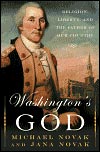 WASHINGTON’S GODBy Michael and Jana NovakBasic Books256 pp; $26 |
The real question, of course, is what Washington actually thought. But is this knowable? Stephen Vincent Benet wrote of Robert E. Lee “the heart he kept always to himself,” yet Lee was loquacious compared to Washington; reading his letters to his daughters gives immense insight into Lee’s emotional qualities. No such letters exist from Washington. As the Novaks observe, it is possible that Washington communicated his emotional life to Martha, his wife, but she burned these letters after his death. Still, the Novaks contend that there is sufficient evidence to be certain that Washington was “Not a Deist, but Judeo-Christian” as one of their chapter titles declares, albeit “a very private Christian.”
The Novaks’ central argument, following several chapters recapitulating Washington’s life, is based upon Washington’s incessant appeals to and observations of the ways of Providence. This is something ignored or dismissed by many biographers, which is foolish; Washington used “Providence” so often that it can be characterized as one of his three ruling ideas of how the world works or should work (the other two, I believe, are “West” and “Union”). His idea of Providence was that it was the intervention of an all-powerful and all-merciful God in the events of mankind. This Providence was often seen as working the near-miraculous, such as in the Continental Army’s escape through night and fog from Brooklyn past the British fleet. Washington’s “Providence,” the Novaks convincingly demonstrate, is not impersonal fate; moreover, Washington does not view Providence as always being on his side. While he often describes Providence as benevolent and God as merciful, his favorite description of Providence is “inscrutable.” Providence is not the leader of America’s team; It does what It does, and is not always understood by a humanity that is being done unto. In the face of Providence, Washington is both thankful and resigned. Indeed, Washington’s very last words as he died, “‘Tis well,” reflect the most important belief of his life.
For Washington, Providence had a personality. Thus it is difficult, as the Novaks further argue, to describe Washington as a Deist in the classic 18th-century sense. Many if not all Deists would accept the concept of Providence in general terms, as the overarching care of the Creator-God for the world that He had established. However they would be quick to deride any idea that this God would intervene in the world using anything that seemed even vaguely miraculous; in theological terms, they denied the need for special providence. Washington, however, often appeals precisely to special Providence. Moreover, as in his letter to the Hebrew Congregation in Savannah, Washington identifies that special Providence as being none other than Jehovah, “who long since delivered the Hebrews from their Egyptian oppressors” and whose “agency has lately been conspicuous, in establishing these United States as an independent nation.”
However, the Novaks’ argument suffers when they make much of little, or fail to give proper weight to evidence that does not support their thesis. As an example of the first flaw, they write of the two paintings with Christian subjects that Washington purchased for the main dining room at Mount Vernon, speculating that these portraits of the Virgin Mary and St. John must have meant something to Washington, given his attention to symbolism; yet if religious portraits are an indication of their owner’s Christian spirituality, than Thomas Jefferson must have been a crypto-Catholic, given the numerous religious paintings on display in the main salon at Monticello. Likewise the Novaks mention that Washington was the recipient of numerous sermons but give the somewhat mistaken impression that he “often enough” responded to the author regarding the content of a sermon; in fact, it was relatively rare for Washington to do anything other than acknowledge the receipt of the gift and offer gracious yet perfunctory thanks to the minister. They place great emphasis on Washington’s role as a member of the Fairfax parish vestry; yet it would have been impossibly scandalous for a prominent member of the parish not to serve in such a capacity, such was the nature of the established church in colonial Virginia. Moreover, the Novaks pass over other evidence that should trouble the most ardent proponents of “Washington a Christian.” They do not mention the testimony of the pastor of Christ Church in Philadelphia that while Martha Washington was a regular communicant, the president never once received the Lord’s Supper during all the years he spent in residence there. Nor do the Novaks pay any attention to Jefferson’s exultant recollection of how the “Old Fox” had fooled some ministers who wished to pin him down on doctrinal points. Given Jefferson’s own inclinations, one has to take his evidence with more than a few grains of salt. But these opposing opinions of Washington’s contemporaries are just the point. Washington was enigmatic because by being an enigma he preserved himself above all factions, both political and religious, and remained the very personification of American union and continental purpose.
Did the Anglicanism that was a part of the intellectual culture of Virginia influence Washington? Certainly. Did he have religious ideas? Yes, absolutely, so many that in any Western country outside the United States Washington would be regarded as very religious. Did he believe that religion, and in particular Christianity, was a necessity for the life of the American republic? Again yes, with certain qualifications. But as for the yearnings of his own heart, that “he kept always to himself / away from the picklocks of biographers.” If the Novaks ultimately fail in their task, it is because Washington himself did not want them or any other observer to succeed.
Al Zambone is doctoral candidate at Oxford University. His thesis is entitled, “Anglican Enlightenment: Intellectual Culture in Virginia, 1690-1750.”
Copyright © 2006 Christianity Today. Click for reprint information.
Washington’s God is available from Amazon.com and other book retailers.
The book was recently featured on C-SPAN’s Book TV.
Michael Novak defended his book in National Review Online against a New York Sun review. NRO also had a Q&A with the Novaks.
More about the book is available from Michael Novak’s website and from Basic Books.
Books & Culture Corner and Books & Culture‘s Book of the Week, from Christianity Today sister publication Books & Culture: A Christian Review (want a free trial issue?), appears regularly on Tuesdays at Christianity Today. Earlier editions include:
The Mystery of the Numbers | B&C’s annual baseball preview, 2006 edition. (March 21, 2006)
Passionately Ambivalent | Christians in the art world. (Feb. 14, 2006)
Worship—What We’ve Learned | A report from the Calvin Symposium. (Jan. 31, 2006)
Making—and Breaking—Vows | A compelling memoir from the son of a priest and a former nun. (Jan. 17, 2006)
Coming to a Bookstore Near You | Marsden and Hart, Noll and Stout, and more (Jan. 10, 2006)
Ring Out the Old Year | Some highly subjective awards for 2005. (Jan. 4, 2006)
Not Just Looking | Books for the eye. (Dec. 27, 2005)
The Top Ten Books of 2005 | A charming bedside miscellany, a new novel by P. D. James, and much more. (Dec. 20, 2005)
How to Survive a Bookalanche | >Some more keepers from 2005. (Dec. 13, 2005)
‘Tis the Season for Books (And Lists of Books) | Part one of our 2005 roundup. (Dec. 6, 2005)
Taizé in the Fall | A parable of community. (Nov. 29, 2005)
‘Have Mercy on Me, O God’ | A report from AAR/SBL. (Nov. 22, 2005)
For book lovers, our 2005 CT book awards are available online, along with our book awards for 2004, 2003, 2002, 2001, 2000, 1999, 1998, and 1997, as well as our Books of the Twentieth Century. For other coverage or reviews, see our Books archive and the weekly Books & Culture Corner.