"I've just been told that I'm too Atonement-centered."
My sister in Christ was serious, humble, and a little confused. I said, "What do you mean 'too Atonement-centered'?" I had never heard the charge.
A Christian friend told her that she talked too much about Christ's death, which dealt with our guilt due to sin. I responded that knowing and accepting this truth was the only way to a relationship with God, and that I didn't think it was possible to be "too Atonement-centered."
Few other doctrines go to the heart of the Christian faith like the Atonement. Congregations sing at the top of their lungs: "My sin, not in part but the whole, has been nailed to the cross, so I bear it no more, praise the Lord, praise the Lord, O my soul!" ("It Is Well with My Soul"). The priestly work of Christ separates Christianity from Judaism and Islam. Not surprisingly, the Cross has become the symbol for our faith.
Still, God's work on the Cross leaves us with plenty of questions. In fact, there have always been a few Christians who question whether we need the Atonement, including, in recent years, some evangelicals who have challenged the dominant understanding of Christ's death on the Cross as the substitute for our sins.
At stake is nothing less than the essence of Christianity. Historically understood, Christ's Atonement gives hope to Christians in their sin and in their suffering. If we have any assurance of salvation, it is because of Christ's Atonement; if any joy, it flows from Christ's work on the Cross. The Atonement protects us from our native tendency to replace religion with morality and God's grace with legalism. Apart from Christ's atoning work, we would be forever guilty, ashamed, and condemned before God. But not everyone these days sees it that way.
Different Crosses
Christians have understood the Bible's abundant Atonement language and imagery by means of various theories. J. I. Packer, in his classic 1973 lecture, "The Logic of Penal Substitution: What Did the Cross Achieve?" outlined three sets of theories, or visions. Each vision sees humanity's main problem differently, and each theory explains how Christ's death solves that problem.
The first set of theories argues that humanity's main problem is that we are trapped and oppressed by spiritual forces beyond our control. Christ's death, then, is seen as a ransom that frees us from captivity. His death and resurrection defeats the evil spiritual forces. These theories are generally summarized under the heading of ransom theory or Christus Victor (Christ the Victor).
The second set of theories deals with the subjective need of all people to know God's love for us. These theories emphasize that Christ's death on the Cross demonstrates God's love so dramatically that we are convinced of his love and are now able to share it with others. This set includes the moral-influence theory of Abelard, among others.
A third set of theories assumes that our main problem is God's righteous wrath against us for our sinfulness, which puts us in danger of eternal punishment. These theories argue that Christ's perfect sacrifice for our sins is necessary to satisfy God's righteousness. Christ's death bore a divine penalty that we deserved. By taking our penalty upon himself, God satisfied his own correct and good wrath against us. Theories in this set, such as the satisfaction theory and the penal-substitution theory, emphasize how Christ represents us.
The new wave of criticism has targeted this last set of theories, especially the view of Christ as a penal substitute—a theory long central for most Protestant groups, especially evangelicals. The criticism follows a path laid by others throughout history, from Abelard to Socinus to Schleiermacher to C. H. Dodd. In 1955, English Methodist theologian Vincent Taylor noted the "clearly marked … tendency to reject theories of substitutionary punishment." Roman Catholic dissenters have turned from emphasizing the cultic rituals of sacrifice to the ethics of imitating Christ's sacrifice. In Lutheran circles, Gustav Aulen's Christus Victor (1931) led the charge to replace a substitutionary understanding of the Atonement with what he called the "classical" understanding—Christ as liberating us from spiritual forces who have enslaved us.
Hearing the Critics
Critics, past and present, usually raise four main objections to substitutionary Atonement.
1. Not Enough? Many current mainline Christians—such as William Placher, "Christ Takes our Place" (Interpretation, Jan. 1999), and Peter Schmiechen, Saving Power (Eerdmans, 2005)—say penal substitution is, at best, inadequate. They say the true focus of Atonement doctrine lies beyond achieving forgiveness.
For example, Stephen Finlan represents the stream of Christian thought following Abelard and Schleiermacher that stresses the Incarnation rather than any particular understanding of the Atonement. In his dissertation, The Backgrounds and Content of Paul's Cultic Atonement Metaphors (Brill, 2004), and in his book Problems with Atonement (Liturgical Press, 2005), he sees the whole framework of "satisfaction" as medieval, coming to us not from Paul, but from Anselm. Finlan acknowledges that "sacrifice" and "scapegoat" are images rooted in the Old Testament, images which Paul and the writer of Hebrews use, but he says only later theologizing led Christians to theorize about the Atonement. In the end, Finlan concludes that Christians should realize that the Atonement is secondary to the Incarnation. He argues that we should think about Atonement as theosis, as growing in God-like spirituality and conduct, thus sharing in the life of God.
Article continues below
The Eastern Orthodox have long accepted theosis as the main result of Christ's death. Reflecting on 2 Corinthians 3:18, Ephesians 4:13, 2 Peter 1:4, and other passages, many have suggested that God's work in us through Christ is best understood not by language of penalty, payment, ransom, and satisfaction, but by language of love, inclusion, growth, and deification. Seen this way, the church becomes an extension of the incarnation of God in Christ, and biblical images of the church as the body of Christ take on a more realistic hue.
2. Irrelevant? Other critics, concerned with clearly communicating the gospel, charge that substitution does not make sense to modern cultures, does not mesh with most of what is in the Gospels, and glorifies unforgiving, abusive behavior. Joel Green and Mark Baker, in Recovering the Scandal of the Cross (InterVarsity Press, 2000), say, "We believe that the popular fascination with and commitment to penal substitutionary Atonement has had ill effects in the life of the church in the United States and has little to offer the global church and mission by way of understanding or embodying the message of Jesus Christ." Such critics argue that modern cultures, which are far removed from religions that offer blood sacrifices, find substitutionary theory irrelevant and distasteful.
3. Individualistic? Green and Baker also argue that penal substitution has encouraged individualism, because it seems to focus on individual guilt and forgiveness. As such, say these critics, it has blinded the church to social issues like materialism, racism, and nationalism. British scholar James D. G. Dunn has argued, "[Substitution] smacks too much of individualism to represent Paul's thought adequately."
4. Too Violent? Perhaps the most powerful criticism of penal substitution has come from a swelling chorus of scholars who decry its violence. Inspired by French scholar René Girard, many modern theologians have denied the need for divine violence as part of redemption. They reject God's apparent double standard in doing what he forbids others to do—take life.
Article continues below
Roman Catholics have debated this last point for 30 years. But only recently has this concern penetrated evangelicalism, steeped as it is in the substitution-rich language of Watts's and Wesley's hymns. Some evangelicals have taken to the work of Anthony Bartlett, J. Denny Weaver, Steve Chalke, and Alan Mann, who decry the language of violence in substitutionary Atonement. Two years after publishing his controversial book The Lost Message of Jesus (Zondervan, 2004), Chalke wrote, "The church's inability to shake off the great distortion of God contained in the theory of penal substitution, with its inbuilt belief in retribution and the redemptive power of violence, has cost us dearly." Chalke and others say that substitution, at worst, produces a twisted justification of violence and encourages selfish, individualistic abuses of power.
Green and Baker warn against suggesting that God the Father did something to God the Son. In popular church discourse, sermon illustrations of Christ's sacrifice on the Cross have fueled complaints about substitution. For example, there is the story of the railroad operator who learns that the bridge ahead is out, so he prepares to switch the tracks to save the lives of hundreds on a fast-approaching train. But at that moment, he sees his son playing in the gears, and he pauses to reconsider. Here, many a preacher has meditated on God's love in ways that border on the grotesque—we're told that the man decided to go ahead and sacrifice his son's life in order to save those on the train. Such an unwitting sacrifice has led to the charge that the Atonement is divine child abuse.
Substitutionary Scriptures
Substitutionary Atonement has indeed been misapplied. The railroad analogy above, for example, is inadequate because it does not include the Holy Spirit. But even more to the point, Christ willingly offered up his life; he was not blindsided by the Cross. And the Bible does include many different ways of talking about Christ's death. But it remains odd how many writers these days downplay or even deny the doctrine of penal substitution, because it is the dominant Atonement imagery used in the Bible. The following paragraphs may be a bit Bible heavy for a magazine article, but I include them to suggest how central this theme is to the scriptural witness—and I'm barely scratching the surface.
Article continues below
The regulations for Israel laid out in the Book of Exodus, for example, frequently mention atonement being made for the people by means of sacrificial bloodshed. The regulations assume that God is holy and that people owe God obedience. Thus, action is needed to facilitate a peaceful, reconciled relationship. But these atonements were things that people did, following God's command.
The writer of Hebrews referred to these sacrifices and said that the law "can never, by the same sacrifices repeated endlessly year after year, make perfect those who draw near to worship. If it could, would they not have stopped being offered? For the worshipers would have been cleansed once for all, and would no longer have felt guilty for their sins. But those sacrifices are an annual reminder of sins, because it is impossible for the blood of bulls and goats to take away sins" (Heb. 10:1-4).
Against this background, God says to his people in exile, "Then, when I make atonement for you for all you have done …" (Ezek. 16:63). How would God do that?
In Hebrews 2:17 we read, "For this reason [Jesus] had to be made like his brothers in every way, in order that he might become a merciful and faithful high priest in service to God, and that he might make atonement [hilaskesthai in the Greek original] for the sins of the people."
Paul's statement in Romans 3:25 is another crucial Atonement text: "God presented him as a sacrifice of atonement, through faith in his blood." Again, the word "atonement" is related to the verb for "propitiate" or "atone," hilasterion. Recent commentators have continued to differ over the best interpretation of the word, but all agree that some sort of substitution is indicated. Douglas Moo of Wheaton College Graduate School affirmed that "sacrifice of atonement" is a good rendering—neither too restrictive, nor too vague. Thomas Schreiner of Southern Baptist Theological Seminary prefers "propitiation" in order to retain a clear reference to God's wrath, which is alluded to in the preceding chapters of Paul's argument.
Such language is not limited to Paul. The apostle John, too, refers to Christ's death as an hilasmos (1 John 2:2 and 4:10), an atoning sacrifice or propitiation.
The New Testament also includes bloody images of sacrifice and religious ritual (Eph. 2:13; Col. 1:20; Rom. 5:9-10). Such images remind us that Christ accomplished something with his physical death. Other Atonement language borrows economic images from the marketplace and the prison, where something is purchased or redeemed for a price (Luke 24:21; Gal. 4:5; Titus 2:14).
Article continues below
The language of propitiation specifically implies God's hatred of sin and emphasizes the gracious work of Christ as sin-bearer (Rom. 3:25). The Bible further includes the forensic, legal language of justification (Rom. 3:20-26, 4:25, 5:16-18). These images make clear the reality of our guilt and the required penalty.
Yes, relational language is also used to describe the effects of Christ's death (Rom. 5:8-10), but often with substitutionary overtones: God has reconciled us, dealing with the barrier of hostility between himself and humanity by means of Christ's death (2 Cor. 5).
Even the language of warfare and victory (John 16:33; Col. 2:15) is imbued with substitutionary overtones. These passages recognize the reality of the spiritual struggle that we are involved in and present Christ's death on our behalf as a crucial element in God's victory.
Problems with Problems
Many critics of substitution get around this "problem"—that such language and imagery is found everywhere in the Bible—by downplaying its importance or reinterpreting it in ways that I believe do violence to the plain meaning of the text. Scot McKnight, for example, in his recent Jesus and His Death (Baylor, 2005), does lots of careful work with the Gospel text. Nonetheless, he assumes that the last phrase in Mark 10:45—"For even the Son of Man did not come to be served but to serve, and to give his life as a ransom for many"—reports not Jesus' original words but Mark's theologizing. And while admitting that the idea of substitution is strongly suggested here, he finally rejects it.
Further, McKnight uses Christ's words to interpret Atonement passages in Paul, Peter, and Hebrews—even though the Epistles provide the most sustained discussions of Christ's Atonement. He again acknowledges that such passages might carry along with them "the notions of penal substitution and satisfaction," but in the end says, "[they] need not." Thus he goes to what seem to be great lengths to avoid the plain meaning of these passages. At one point, he says that Jesus is "both representative and substitute," but his interpretation so transforms the idea of substitute as to rob it of its traditional theological meaning.
Stephen Finlan also seems to pit one portion of Scripture against another. He writes in Problems with Atonement, "It is a mistake to identify Atonement as the central Christian doctrine, although it is central to the Pauline tradition, to First Peter, Hebrews, First John, and Revelation. But these books in their entirety compose only 39 percent of the New Testament."
Article continues below
Even if one were to grant Finlan's premise (which I certainly don't), 39 percent of the New Testament can hardly be swept away or ignored. For those of us who maintain that the apostles' writings bear equal authority to Jesus' words in the Gospels—and that they are themselves inspired by the Spirit of Jesus (see John 16:12-15)—substitutionary, sin-bearing language must be accepted as the dominant Atonement metaphor in the Bible.
Many-Splendored Atonement
Still, why pit these theories against each other and discount, ignore, or diminish biblical language that describes the death of Christ? While a victor may have moral influence on those for whom he conquered, may he not also be a substitute? While Christ's example of self-giving love may also defeat our enemies, may he not, by the same act, propitiate God's wrath? Each of the theories conveys biblical truth about the atoning work of Christ.
I don't doubt that we have more to learn from Christ's death than simply the fact that he died as a substitute for us, bearing our grief and carrying our sorrows (Isa. 53:4). Peter, for instance, teaches that we should follow Christ's example of suffering for that which is good (1 Pet. 3). Any biblical understanding of the Atonement must take into account our having been united to Christ by faith, adopted and regenerated in him. As those who belong to him, as his temple and his body, we expect the fruit of his Spirit to be evident in us. Because of the Atonement, we expect a new quality to our lives (Rom. 6; 2 Cor. 5; Gal. 5; 2 Pet. 1). The Atonement is not merely moral influence, but it surely results in moral improvement.
Rather than pitting these theories against one another, couldn't they be evaluated together? A Christ who wins victory over the powers of evil, whose death changes us, and whose death propitiates God is not only conceivable, he seems to be the Bible's composite presentation. Frank Thielman of Beeson Divinity School states a traditional view of the Atonement in his recent summary, Theology of the New Testament (Zondervan, 2005). But Thielman, a scholar who has focused his work more on Paul than on the Gospels, also presents the Cross as a defeat of those cosmic powers opposing God—Christus Victor. As Hans Boersma wrote of Atonement theories in Books & Culture (March/April, 2003), "By allowing the entire choir to sing together, I suspect we may end up serving the interests of God's eschatological shalom."
Article continues below
Still, when we give attention and authority to all parts of the New Testament canon, substitution becomes the center and focus of the Bible's witness to the meaning of Christ's death, and the measure of God's redeeming love. As New Testament theologian George Eldon Ladd said, "The objective and substitutionary character of the death of Christ as the supreme demonstration of God's love should result in a transformation of conduct that is effected by the constraining power of that love." Theologian Donald Bloesch is in line with this when he insists: "Evangelical theology affirms the vicarious, substitutionary Atonement of Jesus Christ. It does not claim that this theory does justice to all aspects of Christ's atoning work, but it does see substitution as the heart of the Atonement."
No Sacrifice Too Great
And what about that charge of being "too Atonement-centered"? We must center our lives around Christ's Atonement. We don't want to encourage violence, marginalize the gospel, or promote individualistic passivity. But I haven't seen sinners who are gripped by Christ's substitutionary death respond that way. Instead, I've more often observed responses like C. T. Studd's famous statement: "If Jesus Christ be God, and died for me, then no sacrifice can be too great for me to make for him." Charles Spurgeon put that point well: "It is our duty and our privilege to exhaust our lives for Jesus. We are not to be living specimens of men in fine preservation, but living sacrifices, whose lot is to be consumed."
In C. J. Mahaney's new book, Living the Cross Centered Life (Multnomah, 2006), he shares with us his advice to his young son, Chad. "This is what I hold out to my young son as the hope of his life: that Jesus, God's perfect, righteous Son, died in his place for his sins. Jesus took all the punishment; Jesus received all the wrath as he hung on the Cross, so people like Chad and his sinful daddy could be completely forgiven." Like Chad, we would do well to accept our guilt and admire God's grace, to let the Holy Spirit encourage us by the Savior's self-denying love to follow his example, and to savor God's love to us in this almost incredible sacrifice.
Mark Dever is senior pastor of Capitol Hill Baptist Church, Washington, D.C., and executive director of 9Marks (www.9marks.org), a ministry for pastors and local churches.
Stephen King's Redemption | The master of horror's latest novels show a rich appreciation of the atonement. (March 6, 2000)
Our sister publication, Books & Culture, ran a series on the atonement:
Violence and the Atonement | Perhaps no doctrine has been more central to evangelical theology, yet today among evangelicals, as among orthodox Christians more generally, one often hears that the classical understanding of this doctrine is deeply flawed, that we must "rethink the atonement." Is that really so? By Richard J. Mouw (January 1, 2001)
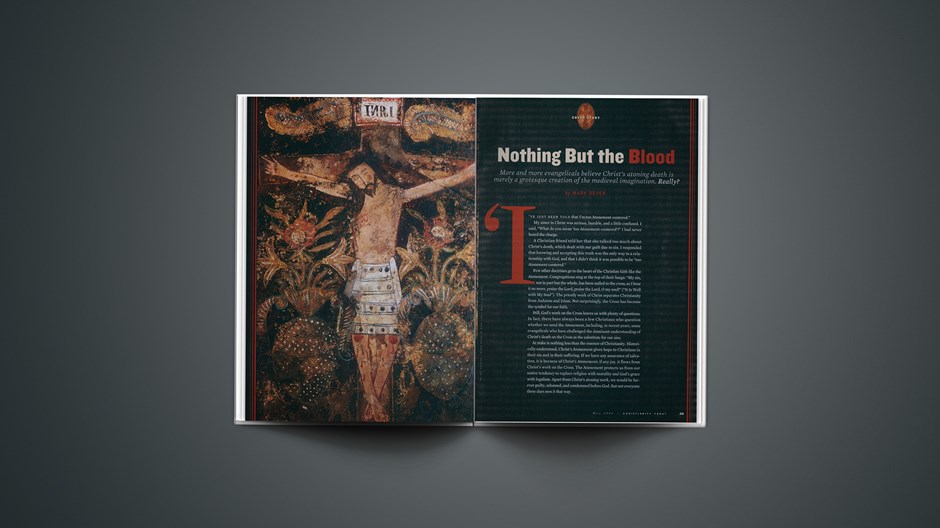
The Meaning of Christ's Suffering | Graphic meditation on Christ's suffering doesn't appear before the late medieval era, approximately the 14th century. Before that, the presentation is more in accord with the way Christ appears in the Gospel of John. In iconography, he reigns serene from the Cross, a victorious conqueror who has rescued us from Death. By Frederica Mathewes-Green (March 1, 2004)
Antonement: The Penal View? | Toward a trinitarian theology of atonement. By Stephen N. Williams (January 1, 2005)

















 While we pray for peace, we need moral clarity about this war.
 We’ve got little information on Jesus’ appearance and personality. But that’s the way God designed it.españolFrançais
 How groups like Hillsong learned to let go of the literal in favor of creative collaboration.españolPortuguês






