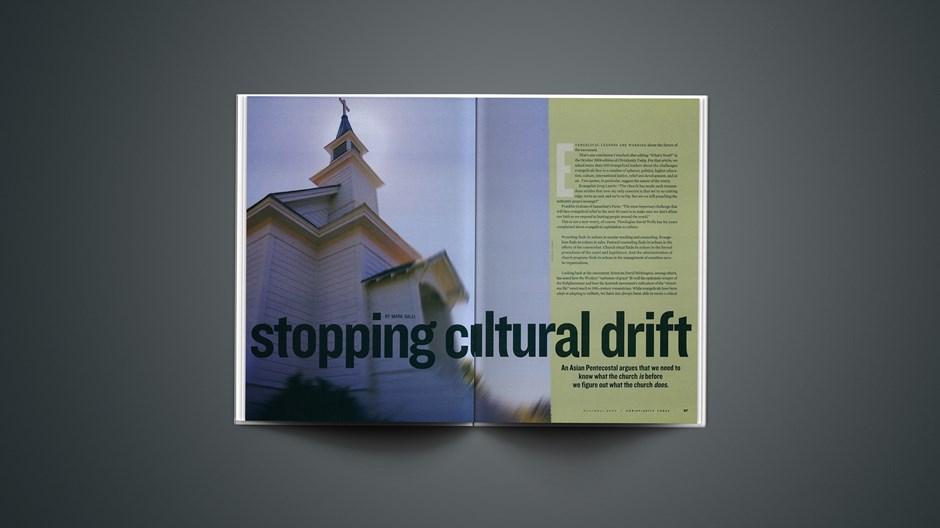
Evangelical leaders are worried about the future of the movement.
That's one conclusion I reached after editing "What's Next?" in the October 2006 edition of Christianity Today. For that article, we asked more than 100 evangelical leaders about the challenges evangelicals face in a number of spheres: politics, higher education, culture, international justice, relief and development, and so on. Two quotes, in particular, suggest the nature of the worry.
Evangelist Greg Laurie: "The church has made such tremendous strides that now my only concern is that we're so cutting edge, we're so cool, and we're so hip. But are we still preaching the authentic gospel message?"
Franklin Graham of Samaritan's Purse: "The most important challenge that will face evangelical relief in the next 50 years is to make sure we don't dilute our faith as we respond to hurting people around the world."
This is not a new worry, of course. Theologian David Wells has for years complained about evangelical capitulation to culture:
Preaching finds its echoes in secular teaching and counseling. Evangelism finds its echoes in sales. Pastoral counseling finds its echoes in the efforts of the caseworker. Church ritual finds its echoes in the formal procedures of the court and legislature. And the administration of church programs finds its echoes in the management of countless secular organizations.
Looking back at the movement, historian David Bebbington, among others, has noted how the Wesleys' "optimism of grace" fit well the optimistic temper of the Enlightenment and how the Keswick movement's cultivation of the "victorious life" owed much to 19th-century romanticism. While evangelicals have been adept at adapting to culture, we have not always been able to retain a critical distance from it—being in the world, but not of it.
The reasons are many. Wells, for instance, says evangelicals have lost "their capacity to think theologically." Historian Mark Noll says it has a lot to do with the "scandal of the evangelical mind," which "may be addressed by the scandal of the cross" and by "an alteration of attitudes."
To such admonitions, many evangelicals say a hearty amen. Theologian Simon Chan is one such evangelical. But while applauding the analysis and suggestions of such thinkers, he asks, "How are evangelicals to change their attitudes? How are the essentials to be recovered?"
To answer these questions, Chan outlines a theology of the church that appears to have great potential for stopping evangelical cultural accommodation in its tracks.
Chan is Earnest Lau Professor of Systematic Theology at Trinity Theological College in Singapore and author of a number of books, most recently Liturgical Theology: The Church as Worshiping Community (InterVarsity, 2006), in which he outlines his ecclesiology.
Chan is not the first to zero in on ecclesiology. From the Chicago Call of 1977 to recent compendiums—like John Stackhouse's Evangelical Ecclesiology: Reality or Illusion? (Baker) and The Community of the Word: Toward an Evangelical Ecclesiology (InterVarsity), edited by Mark Husbands and Daniel J. Treier—a number of evangelicals have suggested that our theology of the church lies at the root of many evangelical problems. But Chan's book is not a complaint. Rather, it presents a sustained argument from a single, coherent point of view, biblically and historically grounded, which can enable the church to withstand the temptation of cultural accommodation.
Chan says we must first "probe the ontology of the church"—that is, what the church is in its essence. Chan believes most evangelicals have an "instrumentalist view of the church," in which the church's basic identity "can be expressed in terms of its functions: what it must do to fulfill God's larger purpose." In this view, "the church is only a subspecies of creation and must discover the clue to its identity within the created order."
The supreme example, Chan notes, is Richard Niebuhr's classic Christ and Culture, where culture—not the church—is the all-embracing reality. The church's role is to figure out how it fits into that larger reality: Christ against culture, Christ transforming culture, and so forth. "This implies," says Chan, "that the church derives its basic identity from the larger world."
A better way to view the Bible's narrative is "to see creation as forming the backdrop for God's elective grace and covenant relationship." That is, Chan says, God created the world in order to enter into a covenanted relationship with his people, beginning with Abraham and culminating in Jesus Christ and the church.
Chan continues: "The church does not exist in order to fix a broken creation; rather, creation exists to realize the church. To be sure, the church's coming into being does require the overcoming of sin, but that is quite different from saying that the problem of sin is the reason for the church's being. God made the world in order to make the church, not vice versa."
Article continues below
This idea is not a figment of Chan's theological imagination, but, as he points out, is grounded in revelation: "[God] chose us in him before the foundation of the world to be holy and blameless before him in his sight (Eph. 1:4)." We must always remember that the church as the people of God is not an afterthought or a means to an end, but the end itself.
Not Reinventing the Church
Chan outlines a number of implications from this line of theology. First, the church cannot be understood as the creation of the devout, something that is merely the most efficient and effective way to organize ourselves to do mission. With this insight, Chan challenges a widely held evangelical presupposition. As the late Stanley Grenz has noted, the evangelical movement is largely parachurch-oriented in its self-conception. Its "non-ecclesiology" is the "voluntary society," formed by the creative will of the members to accomplish some greater purpose.
Recent examples of such thinking abound. George Barna in Revolution (Tyndale, 2005) proclaims, "We should keep in mind that what we call 'church' is just one interpretation of how to develop and live a faith-centered life. We made it up." And later, "Growing numbers of young adults, teenagers, and even adolescents are piecing together spiritual elements they deem worthwhile, constituting millions of personalized 'church' models."
Michael Frost and Alan Hirsch are two Australian thinkers who are gaining an increasing following among pastors and other church leaders intrigued with "the missional church." In The Shaping of Things to Come (Hendrickson, 2003), they argue that we need to "reinvent the church" in "revolutionary" ways so that we can "incarnate the gospel within a specific cultural context."
Ironically, while Barna, Frost, Hirsch, and others believe they are doing something revolutionary, they are conceiving the church largely in a traditional evangelical way, a way that unfortunately permits the church to uncritically repeat a pattern of cultural engagement that has historically compromised its integrity. They assume the church is first and foremost a human creation that must be adapted to culture to continue to be relevant. Their passion for the church and its mission, and many of their creative ministry suggestions, are bringing new enthusiasm for the church's mission. But it is difficult to conceive a "revolution" founded on such a mission-driven ecclesiology that won't succumb to cultural accommodation, as has every similar evangelical revolution.
Article continues below
Instead, Chan argues, we need to begin our thinking about the church with the truth that our names have been written from the foundation of the world in the Book of Life (Rev. 13:8)—meaning that the church is not our work, but a gift of God, something that comes from him and into which he calls us. It is not our creation, but something prior to creation, and "it is prior to creation precisely because it is the body of Christ, the Second Person of the Trinity."
Chan takes very seriously the biblical language here: "The expression body of Christ is more than a metaphor for some intimate social dynamic between Christ and his church. It is an ontological reality, as Christ is ontologically real."
He quotes theologian Anders Nygren, among others, for support: "Christ is present in his church through his Word and sacrament, and the church is, in its essence, nothing other than the presence of Christ."
Chan acknowledges, however, that "we must not so conceive of the church's identity with Christ as to deny that the church is also not Christ but distinct from Christ." Indeed, the church lives in submission to its head. But Chan concludes that the church is not primarily something we create and periodically reinvent to handle certain missional and cultural challenges. It is the body of Christ, a reality in existence before culture ever was.
Digging into Barren Ground
Chan also says: "The people of God are a 'peculiar people,' chosen by God from eternity and distinguished by their 'core practices,' or what is traditionally called 'the marks of the church'"—practices and marks that are not so much invented as given to the church by the Spirit. While these marks are variously described, most Christians over time and over cultures have included two crucial ones (usually among others): the preaching of the Word and administration of the sacraments—baptism and the Lord's Supper.
These core practices are not our invention, created to offer meaningful and culturally relevant spiritual rituals to the surrounding culture. Instead, Chan argues, they've been given and shaped by the Holy Spirit, who, as Jesus promised, guides the church into all truth (John 14:26). The same Spirit who guided the church into the recognition of the biblical canon and the doctrine of the Trinity has been guiding the church in its core practices.
This recognition cuts right to the heart of another evangelical habit that has led into unthinking cultural accommodation. Because we pay little attention to church history, we fail to gain critical distance from our own time and culture. Again, a typical example comes from the newest evangelical revolutionaries. In their book, Frost and Hirsch summarily dismiss all of church history from Constantine to the 1990s with a sweep of the hand as merely an experiment in "Christendom," a way of thinking that is now irrelevant. It is difficult to imagine how evangelical missional thinking of this sort, despite its many keen insights, is going to avoid the traps of previous evangelical "revolutions," since it ignores the work of the Spirit in the body of Christ through time and culture.
Article continues below
From the chapter on the ontology of the church, Chan moves to worship, the shape of liturgy, the catechumenate, and, yes, even mission. Everything he says after chapter one grows out of his ontology. Evangelicals will certainly disagree with some of it, since it sounds increasingly Anglican. But they would do well to dig into the ground out of which his liturgical theology grows. For it is in this ground more than anywhere that evangelical theology has been barren.
Mark Galli is managing editor of Christianity Today and author of Jesus Mean and Wild: The Unexpected Love of an Untamable God (Baker).
















 While we pray for peace, we need moral clarity about this war.
 As my doubts about his teachings grew, so did a secret fascination with Jesus.
 Beyoncé’s right. Whether listening to Cowboy Carter or reading theology, diversity is a good thing.






