
In the middle of our meeting, Jackie, a Kenyan woman who had recently lost her husband to aids, asked us directly, “Have any of you lost a loved one to AIDS?” “Do any of you know anyone with AIDS?” We feebly answered, “No.”
“How do you expect to be relevant here?” she asked.
We were in Nairobi, where a group from my church was meeting for the first time the Kenyans with whom we would join in responding to Nairobi’s AIDS epidemic. Jackie had inadvertently touched on both our deepest fear and our primary reason for coming to Kenya. We feared there was no way to express how we cared for Kenyans awash in the flood of AIDS.
Yet we earnestly desired to give voice to God’s hope. We were to learn that despite our inexperience and insecurity, we could show God’s love to suffering people and make a difference in their lives.
A Resurrected Calling
Shortly before AIDS was first identified, I lived for two years in the Congo, bringing malnourished children back to health. I saw how infectious diseases precipitated malnutrition and even killed already weakened children. I began to know when a starving child was rounding the corner back to health, when the look in his or her eyes became sharper.
I remember one child we nourished to this point, only to watch him lose his slim grip on life after acquiring an infectious diarrhea. He died suddenly from dehydration.
When I returned to the U.S., I earned a graduate degree in epidemiology to learn how to prevent or slow the spread of infectious diseases. I had intended to return to Africa, but marriage, children, and other events led to an academic career and roots in Chapel Hill, North Carolina.
When a friend gave me an issue of Time magazine featuring a cover story on AIDS, I felt an undertow pulling me back to Africa. How could I use my knowledge of epidemiology and Africa to benefit the continent most affected by AIDS? How could I not? But with the needs of our family, my wife and I felt we needed to stay in Chapel Hill. How could we be involved there, but live here?
The answer was through my church. The Chapel Hill Bible Church is a nondenominational, evangelical church with about 1,500 attendees on a Sunday morning. The young adults pastor, Tim Conder, has made missions the driving force in the young adults ministry. Tim was not only receptive to working with AIDS victims in Africa, but excited.
For many years, our church had worked with a church in Nairobi. We approached the pastors of Nairobi Chapel with the idea of forming a joint young adults team to respond to AIDS together. Although their passion was principally for church planting, they agreed to walk with us through this experiment with AIDS ministry. Tim and I were determined that Chapel Hill Bible Church would listen to and learn from the Kenyans. We would not come with answers and plans. We would learn how to convey God’s love on their terms. After forming a team of young adults, we began meeting regularly, despite our uncertainty regarding what we would actually do in Africa.
A Beacon of Hope
A few months before our departure for Kenya, we learned about Jane Wathome, who attended Nairobi Chapel and who was beginning a ministry among women infected with or affected by HIV/AIDS. She was already working in Kware, a slum just outside of Nairobi, where poverty is lethal. It is virtually impossible to feed, clothe, and shelter a family, much less buy medicine, on the meager income most of these women earn. As a result, many residents of Kware face death. The money that comes from sexual favors is an enormous and ever-present temptation.
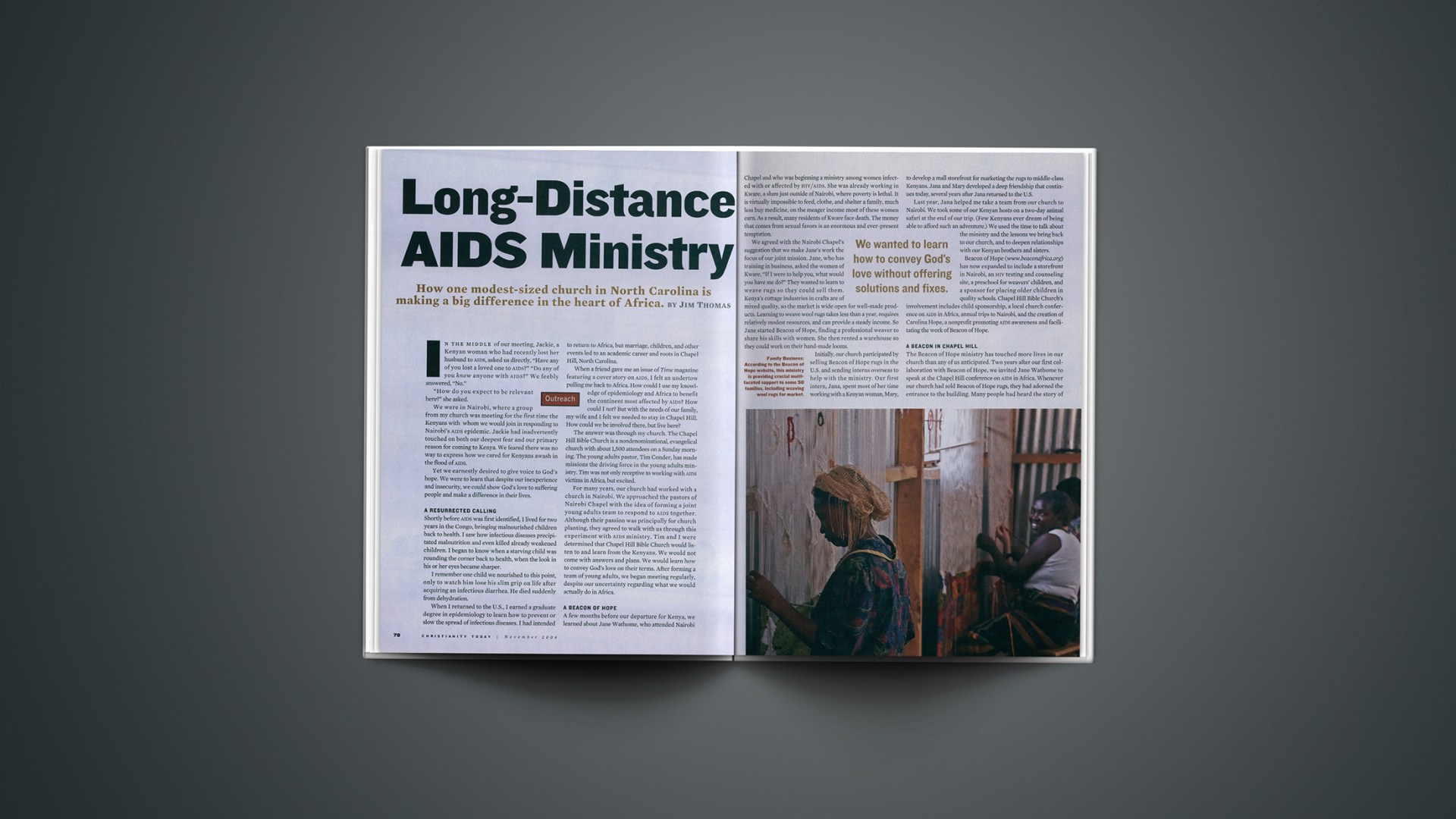
We agreed with the Nairobi Chapel’s suggestion that we make Jane’s work the focus of our joint mission. Jane, who has training in business, asked the women of Kware, “If I were to help you, what would you have me do?” They wanted to learn to weave rugs so they could sell them. Kenya’s cottage industries in crafts are of mixed quality, so the market is wide open for well-made products. Learning to weave wool rugs takes less than a year, requires relatively modest resources, and can provide a steady income. So Jane started Beacon of Hope, finding a professional weaver to share his skills with women. She then rented a warehouse so they could work on their hand-made looms.
Initially, our church participated by selling Beacon of Hope rugs in the U.S. and sending interns overseas to help with the ministry. Our first intern, Jana, spent most of her time working with a Kenyan woman, Mary, to develop a mall storefront for marketing the rugs to middle-class Kenyans. Jana and Mary developed a deep friendship that continues today, several years after Jana returned to the U.S.
Last year, Jana helped me take a team from our church to Nairobi. We took some of our Kenyan hosts on a two-day animal safari at the end of our trip. (Few Kenyans ever dream of being able to afford such an adventure.) We used the time to talk about the ministry and the lessons we bring back to our church, and to deepen relationships with our Kenyan brothers and sisters.
Beacon of Hope (www.beaconafrica.org) has now expanded to include a storefront in Nairobi, an HIV testing and counseling site, a preschool for weavers’ children, and a sponsor for placing older children in quality schools. Chapel Hill Bible Church’s involvement includes child sponsorship, a local church conference on AIDS in Africa, annual trips to Nairobi, and the creation of Carolina Hope, a nonprofit promoting AIDS awareness and facilitating the work of Beacon of Hope.
A Beacon in Chapel Hill
The Beacon of Hope ministry has touched more lives in our church than any of us anticipated. Two years after our first collaboration with Beacon of Hope, we invited Jane Wathome to speak at the Chapel Hill conference on AIDS in Africa. Whenever our church had sold Beacon of Hope rugs, they had adorned the entrance to the building. Many people had heard the story of Jane and Beacon of Hope though personal conversations we had with customers.
I underestimated the power of those conversations. Few church members had met Jane, so when I introduced her, I expected no more than polite appreciation from the church. But no sooner had she been introduced as “Jane Wathome, the founder of Beacon of Hope,” than the entire congregation rose to its feet and gave an ovation that seemed to go on forever.
I believe the applause also reflected the confidence Jane had given our church in our ability to show God’s love in some of the world’s most challenging places. We have since developed another relationship with a church in South Africa, where AIDS affects even more people than in Kenya.
That church’s pastor, Vincent Nyathi, has worked for several years with one of our church’s missionaries. Much of Vincent’s ministry occurs during funerals for AIDS victims. Vincent’s church, the Powerhouse, is smaller than Nairobi Chapel and the congregation much poorer. So as we build this relationship, we are once again stepping forward with inadequate experience, but with a desire to learn and a commitment to join another church in manifesting God’s love.
Fostering Relationships
Our overseas commitment has had another unexpected benefit. It has prompted us to share God’s love in seemingly impossible places next door. For instance, we have committed ourselves to the well-being of an impoverished neighborhood of Durham, a city next door to Chapel Hill, and we have developed a relationship with an African American church in that neighborhood, Antioch Baptist Church. Our churches have formed a nonprofit organization, Antioch Builds Community, to benefit families affected by incarceration. The pastor of that church, Michael Page, accompanied us on a trip to Kenya last year. He was inspired by our time with the children of Beacon of Hope and Kware, and he, too, returned home with ideas for new ministries to offer the children of his neighborhood.
While development and relief organizations can put our cash donations to good use, nothing can shorten the distance to another continent like a relationship, and few things can nurture a relationship as well as mutual learning and commitment to a common goal.
We’ve discovered that making a difference in people’s lives, including those affected by AIDS or other world tragedies, grows out of fostering those relationships.
Jim Thomas is an associate professor of epidemiology at the University of North Carolina and pastor for cross-cultural mission at Chapel Hill Bible Church. He is working with others to develop a track on “Mission Through the Lens of AIDS” for the December 2006 Urbana mission conference.
Copyright © 2006 Christianity Today. Click for reprint information.
Related Elsewhere:
Beacon of Hope‘s website tells more about the ministry.
UNAIDS released its 2006 AIDS epidemic update and announced that the epidemic continues to spread in Africa.
The Christian Science Monitor has an article on some encouraging data from Africa and an editorial on the church’s role in influencing the spread of AIDS in Africa.
Christianity Today’s 2006 articles on AIDS include:
The AIDS Team | Principled collaboration by churches is urgently needed to help defeat HIV. (August 1, 2006)
Rift Opens Among Evangelicals on AIDS Funding | Dobson targets Global Fund, which helps Salvation Army, Youth for Christ, and World Vision. (June 2, 2006)
Finally, Some Overdue Good News in the Battle Against AIDS | “Global slowing” is about as good as it gets when you’re talking about this disease. (June 1, 2006)
Close Encounters with HIV | Local churches should network in the war against the virus.—A Christianity Today editorial (Jan. 19, 2006)