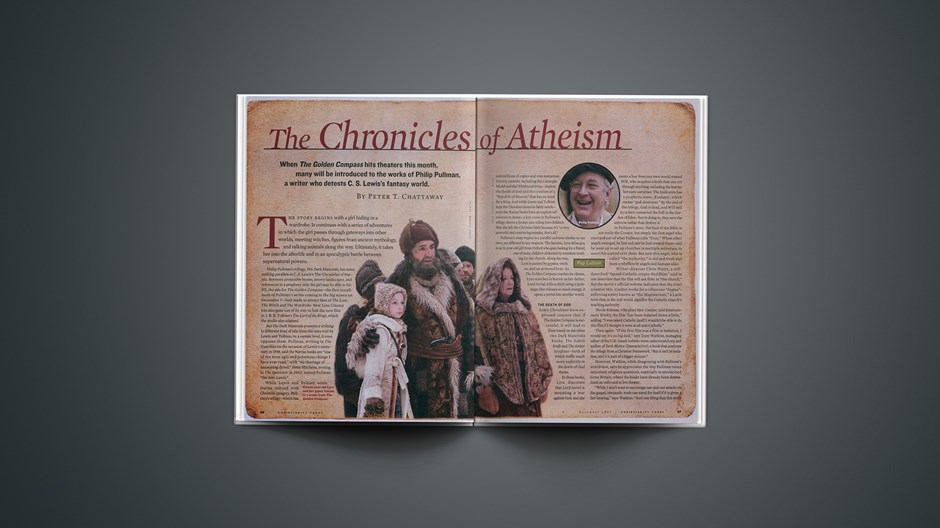
When The Golden Compass hits theaters this month, many will be introduced to the works of Philip Pullman, a writer who detests C.S. Lewis's fantasy world.
The story begins with a girl hiding in a wardrobe. It continues with a series of adventures in which the girl passes through gateways into other worlds, meeting witches, figures from ancient mythology, and talking animals along the way. Ultimately, it takes her into the afterlife and to an apocalyptic battle between supernatural powers.
Philip Pullman's trilogy, His Dark Materials, has some striking parallels to C.S. Lewis's The Chronicles of Narnia. Between protective beasts, snowy landscapes, and references to a prophecy only the girl may be able to fulfill, the ads for The Golden Compass—the first installment of Pullman's series coming to the big screen on December 7—look made to attract fans of The Lion, The Witch and The Wardrobe. New Line Cinema has also gone out of its way to link the new film to J.R.R. Tolkien's The Lord of the Rings, which the studio also adapted.
But His Dark Materials presents a strikingly different kind of tale from the ones told by Lewis and Tolkien; on a certain level, it even opposes them. Pullman, writing in The Guardian on the occasion of Lewis's centenary in 1998, said the Narnia books are "one of the most ugly and poisonous things I have ever read," with "no shortage of … nauseating drivel." Peter Hitchens, writing in The Spectator in 2003, named Pullman "the Anti-Lewis."
While Lewis and Tolkien wrote stories imbued with Christian imagery, Pullman's trilogy—which has sold millions of copies and won numerous literary awards, including the Carnegie Medal and the Whitbread Prize—depicts the death of God and the creation of a "Republic of Heaven" that has no need for a King. And while Lewis and Tolkien kept the Christian elements fairly subtle—even the Narnia books have no explicit references to Jesus—a key scene in Pullman's trilogy shows a former nun telling two children that she left the Christian faith because it's "a very powerful and convincing mistake, that's all."
Pullman's story begins in a parallel universe similar to our own, yet different in key respects. The heroine, Lyra Belacqua, is an 11-year-old girl from Oxford who goes looking for a friend, one of many children abducted by scientists working for the church. Along the way, Lyra is assisted by gypsies, witches, and an armored bear. As The Golden Compass reaches its climax, Lyra watches in horror as her father, Lord Asriel, kills a child using a technique that releases so much energy, it opens a portal into another world.
Some Christians have expressed concern that if The Golden Compass is successful, it will lead to films based on the other two Dark Materials books, The Subtle Knife and The Amber Spyglass—both of which traffic much more explicitly in the death-of-God theme.
In these books, Lyra discovers that Lord Asriel is mounting a war against God, and she meets a boy from our own world named Will, who acquires a knife that can cut through anything, including the barrier between universes. The knife even has a prophetic name, Æsahættr, which means "god-destroyer." By the end of the trilogy, God is dead, and Will and Lyra have reenacted the Fall in the Garden of Eden—but in doing so, they save the universe rather than destroy it.
In Pullman's story, the God of the Bible is not really the Creator, but simply the first angel who emerged out of what Pullman calls "Dust." When other angels emerged, he lied and said he had created them—and he went on to set up churches in multiple universes, to assert his control over them. But now this angel, who is called "the Authority," is old and weak and faces a rebellion by angels and humans alike.
Writer-director Chris Weitz, a self-described "lapsed-Catholic crypto-Buddhist," said in one interview that the film will not refer to "the church." But the movie's official website indicates that the cruel scientist Mrs. Coulter works for a villainous "dogma"-enforcing entity known as "the Magisterium," a Latin term that, in the real world, signifies the Catholic church's teaching authority.
Nicole Kidman, who plays Mrs. Coulter, told Entertainment Weekly the film "has been watered down a little," adding, "I was raised Catholic [and] I wouldn't be able to do this film if I thought it were at all anti-Catholic."
Then again: "If the first film was a film in isolation, I would say it's no big deal," says Tony Watkins, managing editor of the U.K.-based website www.culturewatch.org and author of Dark Matter (Damaris/IVP), a book that analyzes the trilogy from a Christian framework. "But it isn't in isolation, and it is part of a bigger picture."
However, Watkins, while disagreeing with Pullman's worldview, says he appreciates the way Pullman raises important religious questions, especially in secularized Great Britain, where the books have already been dramatized on radio and in live theater.
"While I don't want to encourage out-and-out attacks on the gospel, obviously, truth can stand for itself if it is given a fair hearing," says Watkins. "And one thing that this story does is it gets the [Christian] story into the public sphere. [In the U.K.], that has often been a bit of a challenge. But when there's some clear opposition, that's often when the Christian voice gets heard."
Article continues below
'A transcendent spiritualism'
Several observers argue that the books of atheist and materialist Pullman point in a more spiritual direction.
One of the trilogy's main narrative devices is the "daemon." In The Golden Compass's universe, every human being is accompanied by an animal that reflects that person's soul. The daemons of young children constantly change shape, from one animal to another, because the children have not yet settled into their adult personalities.
Watkins writes that the relationship between humans and their daemons—"united yet distinct"—ironically models the Trinity. And in Shedding Light on His Dark Materials (Tyndale), Kurt Bruner and Jim Ware argue that this device underscores, however unintentionally, the Christian belief that "personality and relationship" stand at the center of the universe.
"Our intention from the beginning was to say, well, here's a guy who on the surface, overtly, is attacking Christianity and the church and the idea of God—and even saying that he wants to kill God," says Ware, "yet we can see ways in which I think he pays homage to Christian truth, maybe without intending to or even knowing what he's doing."
Another central device in the trilogy is "particles of consciousness," or "Dust," which coalesces to form angels and human souls. In the final book, the spirits of the dead are freed from the afterlife; their particles disintegrate and are reabsorbed into the universe. Just as their physical bodies decompose when they die, so too do their spirits return to the earth.
"Pullman the writer is creating a world filled with the reality of a transcendent spiritualism, even though he rejects that cognitively," says Bruner. "And that spiritualism is much more in line with Spinoza and New Age mysticism, or Eastern pantheism."
Some have gone even further and pointed to Dust as a sign that the trilogy is "a Christian classic." In Killing the Imposter God (Jossey-Bass), theologians Donna Freitas and Jason King argue that Dust is a better symbol for God than the traditional image of a man "who rules from the clouds." They say Dust acts within the novels as "a divine force that desires, desperately so, to be in communication with its creation."
Pullman says Christians may be reading too much into his books. In an e-mail to Christianity Today, he said Dust is just a metaphor "for human wisdom, science, and art, and all the accumulated and transmissible achievements of the human mind."
Article continues below
Materialists do need to account for consciousness in the real world, says Pullman, so he subscribes to "panpsychism," which holds that "consciousness, like mass, is a normal and universal property of matter." In this view, all physical matter is conscious, to different degrees. "But without matter, it wouldn't be there at all."
Spiritual is 'delusional'
Pullman says he avoids words like spirit and spirituality—and even feels "a slight revulsion" when he hears them—because, at best, they don't seem to correspond to anything "real," and at worst, they signify people who are seeing visions or undergoing other experiences he regards as "delusional."
"So the word spiritual, for me, has overtones that are entirely negative," Pullman says. "And when I hear it, or see it in print, my reaction is one of immediate skepticism."
While Pullman acknowledges the influence of his Anglican upbringing—his grandfather was a parish priest—he also rejects the idea that the values communicated in his books, such as love and self-sacrifice, are particularly Christian or indicative of any latent Christianity on his part.
"The Church of England is so deeply embedded in my personality and my way of thinking that to remove it would take a surgical operation so radical that I would probably not survive it," he says. "But that doesn't prevent me from pointing out the arrogance that deforms some Christian commentary, and makes it a pleasure to beat it about the head. What on earth gives Christians [the] right to assume that love and self-sacrifice have to be called Christian virtues? They are virtues, full stop."
Borrowing from Milton
His Dark Materials borrows many elements, including its title, from John Milton's epic poem, Paradise Lost, which describes the failed rebellion of Lucifer. The trilogy also borrows from Gnostic mythology, which holds that the God of the Old Testament was actually a usurper who created the physical world to trap the spirit, the essential self. However, Watkins notes that Pullman opposes even Gnosticism in crucial ways, by depicting physical pleasure as a liberating alternative to religious faith.
"He's such an arch-materialist, and so he completely rejects the Gnostic rejection of the material as being evil and the Gnostic embrace of the spiritual as the only thing which is good," says Watkins. "He's rejecting that and drawing on these Gnostic stories for inspiration and turning them absolutely on their head.
Article continues below
"Pullman says he's just a storyteller," continues Watkins. "I think he's really slippery at this point. Because it's all very well saying, 'It's just a story, just a fantasy, some of the characters say what I believe and some of them don't'—but in his Carnegie Medal speech, he said stories create the morality we live by.
"The trouble is, he blurs the line between fantasy and reality by giving interviews and talking about the Republic of Heaven in the world. And because he's got all of this anti-God rhetoric in the real world that is even stronger than what's in the book, I think he can't get away with saying, 'It's just a story and you can read into it whatever you like.' Because he does understand what he's saying."
Peter T. Chattaway, a film critic for ChristianityTodayMovies.com, lives in Vancouver.















 While we pray for peace, we need moral clarity about this war.
 We’ve got little information on Jesus’ appearance and personality. But that’s the way God designed it.españolFrançais
 The rage of the mob is a poor substitute for real community.






