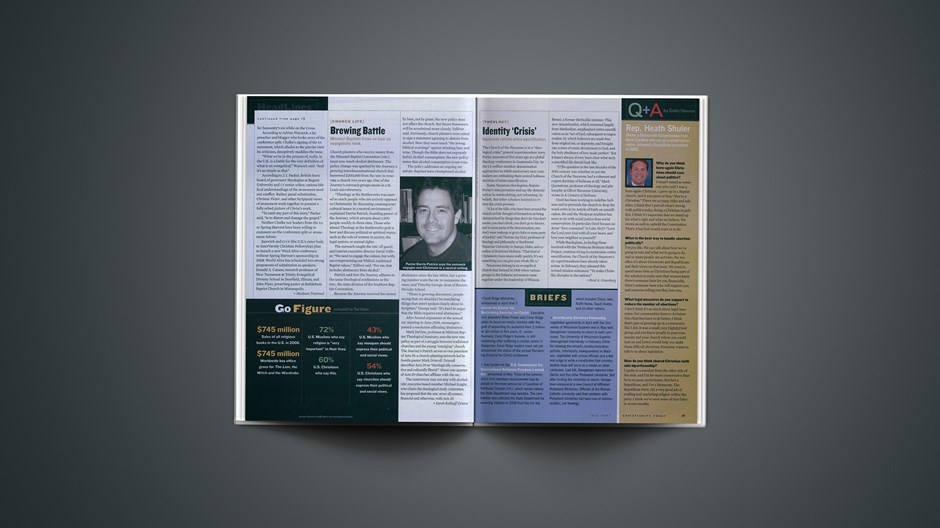
Church planters who receive money from the Missouri Baptist Convention (MBC) must now teach alcohol abstinence. The policy change was sparked by the Journey, a growing interdenominational church that borrowed $200,000 from the MBC to renovate a church two years ago. One of the Journey's outreach groups meets in a St. Louis microbrewery.
"Theology at the Bottleworks was started to reach people who are actively opposed to Christianity, by discussing contemporary cultural issues in a neutral environment," explained Darrin Patrick, founding pastor of the Journey, which attracts about 1,500 people weekly to three sites. Those who attend Theology at the Bottleworks grab a beer and discuss political or spiritual topics, such as the role of women in society, the legal system, or animal rights.
The outreach caught the MBC off guard, said interim executive director David Tolliver. "We need to engage the culture, but without compromising our biblical, traditional Baptist values," Tolliver said. "For me, that includes abstinence from alcohol."
Patrick said that the Journey adheres to the same theological confessions as the MBC, the state division of the Southern Baptist Convention.
Because the Journey received the money by loan, not by grant, the new policy does not affect the church. But future borrowers will be scrutinized more closely, Tolliver said. Previously, church planters were asked to sign a statement agreeing to abstain from alcohol. Now they must teach "the strong biblical warnings" against drinking beer and wine. Though the Bible does not expressly forbid alcohol consumption, the new policy states that alcohol consumption is not wise.
The policy addresses an ongoing SBC debate. Baptists have championed alcohol abstinence since the late 1800s, but a growing number want the SBC to reexamine the issue, said Timothy George, dean of Beeson Divinity School.
"There is growing discontent, people saying that we shouldn't be mandating things that aren't spoken clearly about in Scripture," George said. "It's hard to argue that the Bible requires total abstinence."
After heated arguments at the annual SBC meeting in June 2006, messengers passed a resolution affirming abstinence.
Mark DeVine, professor at Midwest Baptist Theological Seminary, sees the new MBC policy as part of a struggle between traditional churches and the young "emerging" church. The Journey's Patrick serves as vice president of Acts 29, a church-planting network led by Seattle pastor Mark Driscoll. Driscoll describes Acts 29 as "theologically conservative and culturally liberal." About one-quarter of Acts 29 churches affiliate with the SBC.
The controversy may not stop with alcohol. MBC executive board member Michael Knight, who chairs the theological study committee, has proposed that the MBC sever all contact, financial and otherwise, with Acts 29.
Beer and the Bible | In December Baptist leaders began questioning the church's methods of attracting worshippers, specifically its use of alcohol (St. Louis Post-Dispatch)
Churches oppose mix with alcohol | An exemption in Tavares allows serving booze near places of worship downtown (The Orlando Sentinel)
















 While we pray for peace, we need moral clarity about this war.
 We’ve got little information on Jesus’ appearance and personality. But that’s the way God designed it.españolFrançais
 How groups like Hillsong learned to let go of the literal in favor of creative collaboration.españolPortuguês






