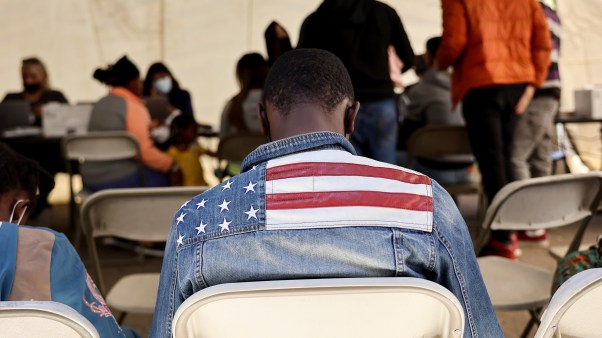
It is 6 P.M. on a sunny Saturday, and the men of Onesimus House, a transitional home for ex-offenders, look forward to an evening of fellowship and food.
The group leader looks around at the 20 or so people now living at this home in rural Chesapeake, Virginia. Surprised, he notices three familiar T-shirts. Those shirts were his—until he donated them recently to the ministry’s clothes closet. Nothing sits still for very long. Everything is in transition here. Worn-out clothes, and people, get a dream-come-true second chance at life.
Each week, at least one bus from nearby Powhatan Correctional Center pulls up to the front door of Onesimus House—named after the repentant slave chronicled in the epistle to Philemon. The bus’s arrival means Powhatan is discharging more inmates to this aftercare program. In a typical week, about 100 inmates seek admission to Onesimus, looking for more help than the $25 cash the state provides following release.
The ones whom Onesimus welcomes are the fortunate few. Onesimus staff and volunteers feed, clothe, and shelter these ex-offenders. More importantly, they give them a fighting opportunity to beat the odds for going back to prison.
Epidemic of Recidivism
Christians need to study more carefully the chapter in the handbook of outreach on prison ministry and aftercare. Prisons are a huge “growth industry” in 21st-century America.
Some 2.2 million people (one in every 136 U.S. residents) are doing time in prison, according to FBI statistics. Add to that number another 4 million or more on probation, parole, or awaiting trial in local jails. This past year, prison populations grew 4.7 percent—the largest annual growth spurt in nearly ten years.
This up-trend in incarceration has been developing for decades, though. Since the late 1970s, the population in U.S. prisons has nearly quadrupled. No other nation, relative to its size and population density, incarcerates more individuals than the United States. A 2006 study by the Pew Charitable Trust entitled “Public Safety, Public Spending: Forecasting America’s Prison Population 2007-2011” projects continued growth in the prison population for years. By 2011, the number of women prisoners will have grown by 16 percent. The male prison population will have increased 12 percent. These numbers are at least twice the projected growth rate for the overall U.S. population by 2011.
With tens of thousands of new prison beds added in recent years, one might expect that crime would be down. That’s not universally the case. During 2005 and 2006, the FBI says violent crimes in some regions rose. Robbery, for example, rose 10 percent in the Midwest, according to half-year statistics for 2006.
As prison populations have soared, the number of prisoners who are freed has also increased significantly. Prisons free at least 600,000 each year.
But most freed inmates have few marketable job skills. The lack of a job is a major risk factor for an ex-offender to commit a new crime. Researchers say the repeat-offense rate nationally is stubbornly high, at more than 60 percent.
The Justice Department also recently noted that black men make up 41 percent of all inmates, and Hispanic women are 1.6 times more likely than white women to be imprisoned.
Nationwide, churches and Christian ministries have responded to the steady growth in the prison population. Some 3,500 organizations now do prison outreach. These groups range from single, church-based outreaches to global organizations such as Prison Fellowship. PF has more than 24,000 people on its volunteer rolls worldwide.
Unfortunately, demand is still outstripping supply. “I don’t think that the need is met,” Mark Earley, president of Prison Fellowship and former attorney general of Virginia, told Christianity Today.
Pat Nolan, head of Justice Fellowship (a PF-affiliate), told CT, “Locking up prisoners without doing anything to change their moral perspective or give them skills to live crime-free when they are released has made us less safe rather than more.
“The very skills inmates develop to survive inside prison make them antisocial when they are released. Prisons are, indeed, graduate schools of crime.”
Before, During, and Aftercare
One unexpected voice for reform of the criminal justice system comes from a convicted murderer—someone now serving a life sentence in Lawrenceville, Virginia.
Jens Soering, an inmate at Brunswick Correctional Center, is serving a double-life sentence for the 1984 murder of his then-girlfriend’s parents. (Elizabeth Haysom, his former girlfriend, is serving a 90-year sentence in connection with the murders.)
The author of three books, Soering has spent nearly half his life in prison. Prison ministry has provided this convert to Catholicism with a spiritual center as well as a network of support. In The Convict Christ, Soering examines what the gospel teaches about justice and society’s treatment of criminals.
Soering told Christianity Today that Americans, insulated from the realities of prison life, often respond with fear when considering ministry inside a prison. “The biggest misconception is that prisoners attending [worship] services are a ‘tough’ audience,” Soering said.
“There are many reasons not to go to religious services, so those who do go really want to be there, and they’re not hard to please. [People on the outside] really have no clue who is in prison. They are definitely not all monsters by a long shot.”
PF’s Earley told CT that he believes new approaches are required to attack the chronic problem of repeat offenders. Worship services in prisons are not enough. “What is increasingly needed today,” he said, “is a one-on-one relationship and helping them with their life.”
Earley has years of experience working in the criminal justice system. At the start of his legal career, he served as a criminal defense attorney, sometimes as court-appointed legal counsel.
He said local churches have a crucial role to play in helping offenders before, during, and after their incarceration. “The church needs to embrace prisoners in the same way that they reach out to the hungry,” Earley said.
New research indicates that well designed, faith-based programs can lead to fewer re-arrests among the newly released—and to fewer arguments and physical fighting among prisoners. By instilling hope, these programs provide greater motivation for prisoners to “make it” after their release back into society.
In a University of Pennsylvania study released in 2003, Prison Fellowship’s InnerChange Freedom Initiative graduates were 50 percent less likely to be re-arrested. The two-year re-arrest rate among InnerChange program graduates in Texas was 17.3 percent, compared with 35 percent of the matched comparison group, according to the study.
There are similar success stories overseas. Inmates involved in Brazil’s faith-based Humaita program had a 16 percent rate of re-arrest, while those involved in the vocation-based Braganca program had a 36 percent rate. Brazil’s national average is 60 to 70 percent.
Last December, the Journal for the Scientific Study of Religion published research findings of criminologist Kent Kerley of the University of Alabama at Birmingham. Kerley’s research suggests that faith-based ministry has a positive effect on prisoners’ behavior during incarceration.
The study surveyed 386 inmates at the Mississippi State Penitentiary. Inmates were asked about family and criminal histories, religious beliefs, participation in prison ministries, and the frequency of arguments and physical fighting.
The research found that religious beliefs and participation in religious services or faith-based programs significantly reduced inmates’ chances for getting into arguments with other inmates, resulting in less fighting. Inmates who believed in a “higher power” were 74 percent less likely to engage in arguments than non-believers were.
Getting Out, Staying Out
The most common criticism of faith-based outreach to prisoners and ex-offenders is: “Everyone gets religion in prison.” The interest, enthusiasm, and fervor for religion among prisoners is only temporary, critics charge. Inmates themselves use the expression, “You fake it to make it.” Regardless of the religious devotion behind bars, critics say once inmates regain their freedom, they are likely to join the majority of ex-offenders who are re-arrested within three years.
But Bill Twine, founder and executive director of Onesimus House, says this is simplistic. Twine is also a chaplain supervisor with the Chaplain Service of the Churches of Virginia and serves as chaplain-in-residence at St. Bride’s Correctional Institute in Chesapeake, Virginia.
Twine, pointing to many New Testament examples, believes time in prison sets the stage for personal transformation. He told CT, “Surely we can say John the Baptist used his incarceration to ask some insightful theological questions concerning the messianic claims of Christ and his place in the scheme of things. We could also say Paul plumbed new spiritual depths while locked up. Did he not write several of his epistles from jail?”
Twine believes the value of prison ministry comes in guiding the downtrodden inmate to a new level of self-examination. “Isn’t it our human nature that when we find ourselves in a crisis situation that we all of a sudden get theological?” he said. “Would not a change in direction be an appropriate reaction?”
It is the time right after the jail cell that Mark Earley says is most critical. He supports a new model of community- and church-based prison outreach that breaks the stereotypical approach of Christians going inside a local prison to do ministry.
Release from prison is when the hard work begins. “The first 60 to 90 days is the real tipping point as to whether they’re going to make it or not,” said Earley.
“Inmates aren’t returning to functional families. You can have people doing well in prison. They just need someone to walk with them [after their release], and they can make it [outside], too.”
If there’s a common denominator among the incarcerated, it is a troubled home environment. From the broken home in an inner-city housing project to the troubled neighborhood on the wrong side of the tracks or the hollow halls of drug dens and back-street gang clusters, the environment from which a convict comes is often the one to which he returns.
In many instances, there is also a church on the corner of that troubled neighborhood into which an ex-offender is released. But often churches lack specific programs, staffed by trained volunteers, to address the complex needs of ex-offenders. Many pastors and church leaders just don’t know where to begin.
If there is a glimmer of hope in meeting the spiritual needs of the incarcerated and transforming their lives before, during, and after their incarceration, it lies in that church on the corner.
For example, the prison in Redlands, California, had a recidivism rate of 82 percent. Leaders at Redlands United Church of Christ took notice and formed the Step-by-Step coalition to partner with police, corrections officials, and local service agencies. Redlands volunteers now provide housing, health care, job training—and hand-written notes of encouragement—to ex-offenders.
This year, California governor Arnold Schwarzenegger named Justice Fellowship’s Nolan, a former state legislator who served time in prison for political fraud, to a new Rehabilitation Strike Team to reform prison policies and practices. Nolan told CT, “If inmates leave prison better prepared for life on the outside, we’ll have safer communities and fewer victims. That is the focus of our group.”
Second Chances
In Congress, there is a new awareness of the role local service organizations, including churches, play in keeping ex-offenders out of prison.
Rep. Danny Davis, a Democrat from Chicago, drafted the Second Chance Act of 2007, which provides up to $200 million to fund programs to assist prisoners during re-entry. His bill, awaiting a vote from the full House, includes $30 million in mentoring grants that local organizations would use to match volunteer mentors with ex-offenders.
Nolan says better relationships, not more programs, are required. “Inmates need healthy relationships even more than they need programs,” he said. “The greater the density of relationships with loving, moral people, the better the chance they will successfully make the transition from prison to the community. Many of these relationships [should be] with people not involved in the corrections system.”
Meanwhile, New York Congressman Charles Rangel has proposed another Second Chance Act. The Democrat’s bill helps remove the stigma that ex-offenders confront when they apply for a job. Under his measure, nonviolent, first-time offenders who finish out their sentences could perform community service for a year and thereby prove their rehabilitation. Judges could then review their cases and expunge their criminal records. (This expungement could be revoked if necessary.)
Both bills promise to raise the profile of community-based outreach to ex-offenders. Chaplain Bill Twine believes locally based mentoring helps ex-offenders to confront their deepest spiritual needs.
“My understanding of the word repentance involves both a change of mind and a change in direction,” Twine said. “It would be great if we all would contemplate repentance without having to come to some crisis in our lives.
“But for most of us, it doesn’t work that way, so God bless the jail cell.”
Jim Romeo is a freelance writer based in Chesapeake, Virginia. He leads two prison ministry groups, at Indian Creek and St. Bride’s.
Copyright © 2007 Christianity Today. Click for reprint information.
Related Elsewhere:
Onesimus Ministries has a training center and two houses with bed space for 18; its waitlist is 6—12 months.
Onesimus, as well as Prison Fellowship and Justice Fellowship, is a member of the International Network of Prison Ministries.
Pew Charitable Trust‘s study on “Public Safety, Public Spending: Forecasting America’s Prison Population 2007—2011” predicts that the “incarcerated population in just five years will outnumber the residents of Atlanta, Baltimore and Denver combined.”
Previous articles on prisoners and prison ministries include:
Book Bust | U.S. prisons cull hundreds of religious books from libraries. (July 10, 2007)
Rx for Recidivism | Prison Fellowship president Mark Earley talks about challenges the ministry faces. (November 21, 2006)
Bad Judgment | Ruling imperils faith-based programs around the country. (Charles Colson, August 1, 2006)
Imprisoned Ministry | The future of Prison Fellowship’s rehabilitation program, and other faith-based social services, are in the hands of an appeals court (July 14, 2006)
Breaking Into Prison | A gospel invasion helps bring peace to one of the nation’s most violent penitentiaries. (May 1, 2004)
New Life in a Culture of Death | Hope for Colombia dwells inside its most lethal killing field—Bellavista Prison. (Feb. 02, 2004)
‘I Was Looking for Peace and Found it in Christ’ | A converted felon in Colombia reflects on life in the guerrilla ranks. (Feb. 02, 2004)
Study Lauds Prisoner Program | Prison Fellowship releases InnerChange research at a White House roundtable. (June 1, 2003)
Suing Success | Prison Fellowship says its Inner Change program is clearly constitutional (April 1, 2003)
The Legacy of Prisoner 23226 | Twenty-six years after leaving prison, Charles Colson has become one of America’s most significant social reformers. (July 29, 2001)
Prison Ministry in Mozambique | Missionary says women suffer grave injustices. (Aug. 4, 2000)
Setting Captives Free | It takes more than getting a woman inmate out of jail to turn her life around (Jan. 10, 2000)
A Healthy Cult | A lively response by one unusual audience shows how God’s power transforms culture. (Charles Colson, June 12, 2000)
Prisons: Unique Prison Program Serves as Boot Camp for Heaven (February 9, 1998)