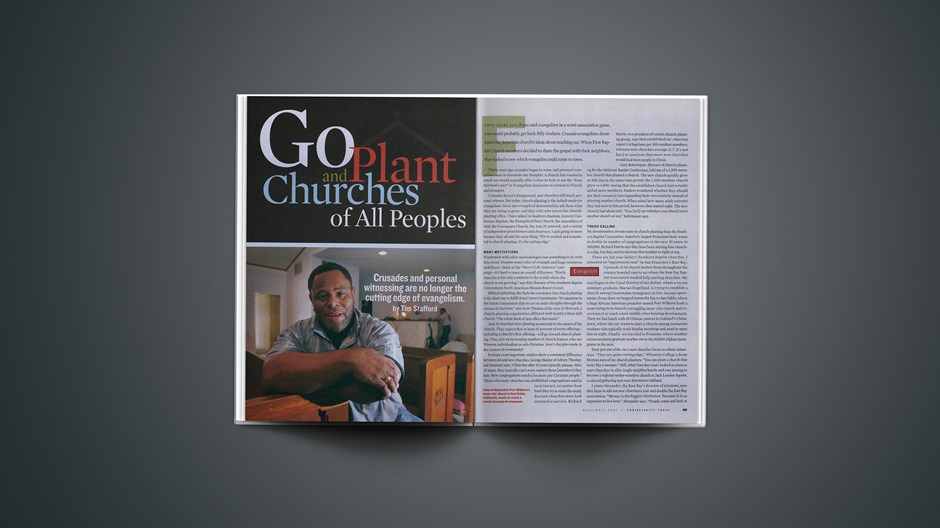
Fifty years ago, if you said evangelism in a word-association game, you would probably get back Billy Graham. Crusade evangelism dominated the American church's ideas about reaching out. When First Baptist Church members decided to share the gospel with their neighbors, they looked to see which evangelist could come to town.
Thirty years ago, crusades began to wane, and personal evangelism came to dominate our thoughts. A church that wanted to reach out would typically offer a class on how to use the "Four Spiritual Laws" or Evangelism Explosion to witness to friends and strangers.
Crusades haven't disappeared, and churches still teach personal witness. But today, church planting is the default mode for evangelism. Go to any evangelical denomination, ask them what they are doing to grow, and they will refer you to the church-planting office. I have talked to Southern Baptists, General Conference Baptists, the Evangelical Free Church, the Assemblies of God, the Foursquare Church, the Acts 29 network, and a variety of independent practitioners and observers. I quit going to more because they all said the same thing: "We're excited and committed to church planting. It's the cutting edge."
Many Motivations
Frustration with other methodologies has something to do with this trend. Despite many tales of triumph and huge resources mobilized—think of the "Here's Life America" campaign—it's hard to trace an overall difference. "North America is the only continent in the world where the church is not growing," says Eric Ramsey of the Southern Baptist Convention's North American Mission Board (NAMB).
Biblical rethinking also fuels the conviction that church planting is the ideal way to fulfill Jesus' Great Commission. "It's apparent in the Great Commission that we are to make disciples through the avenue of churches," says Scott Thomas of the Acts 29 Network, a church-planting organization affiliated with Seattle's Mars Hill Church. "The whole Book of Acts offers that model."
Acts 29 churches view planting as essential to the nature of the church. They expect that at least 10 percent of every offering—including a church's first offering—will go toward church planting. They join an increasing number of church leaders who see Western individualism as sub-Christian. Aren't disciples made in the context of community?
Perhaps most important, studies show a consistent difference between old and new churches. George Hunter of Asbury Theological Seminary says, "Churches after 15 years typically plateau. After 35 years, they typically can't even replace those [members] they lose. New congregations reach a lot more pre-Christian people." Those who study churches say established congregations tend to turn inward, no matter how hard they try to resist the trend. But new churches must look outward to survive. Richard Harris, vice president of NAMB's church-planting group, says that established SBC churches report 3.4 baptisms per 100 resident members, whereas new churches average 11.7. It's not hard to conclude that more new churches would lead more people to Christ.
Gary Rohrmayer, director of church planting for the Midwest Baptist Conference, told me of a 1,200-member church that planted a church. The new church quickly grew to 200, but in the same time period, the 1,200-member church grew to 1,600. Seeing that the established church had actually added more members, leaders wondered whether they should put their resources into expanding their own ministry instead of planting another church. When asked how many adult converts they had seen in that period, however, they named eight. The new church had about 100. "You [tell] me whether you should start another church or not," Rohrmayer says.
Tough Calling
No denomination invests more in church planting than the Southern Baptist Convention. America's largest Protestant body wants to double its number of congregations in the next 20 years, to 100,000. Richard Harris says they have been starting four churches a day, but they need to increase that number to eight or ten.
These are not your father's Southern Baptist churches. I attended an "opportunity tour" in San Francisco's East Bay. Upwards of 60 church leaders from throughout the country boarded vans to see where the East Bay Baptist Association needed help starting churches. My tour began in the Canal District of San Rafael, where a recent seminary graduate, Marian Engelland, is trying to establish a church among Guatemalan immigrants in low-income apartments. From there we hopped across the bay to San Pablo, where a huge African American preacher named Port Wilburn leads a team trying to re-launch a struggling inner-city church and re-envision it to reach a new middle-class housing development. Then we had lunch with 18 Chinese pastors in Oakland's Chinatown, where the SBC wants to start a church among restaurant workers who typically work Sunday mornings and need to meet late at night. Finally, we traveled to Fremont, where another recent seminary graduate reaches out to the 60,000 Afghan immigrants in the area.
Article continues below
Sixty percent of the SBC's new churches focus on ethnic minorities. "They are quite cutting edge," Wheaton College's Scott Moreau says of SBC church planters. "You can plant a church that looks like a mosque." Still, other East Bay tours looked at plans to start churches in elite Anglo neighborhoods and one aiming to become a regional seeker-sensitive church at Jack London Square, a cultural gathering spot near downtown Oakland.
Lyman Alexander, the East Bay's director of missions, says they hope to add ten new churches a year and double the East Bay association. "Money is the biggest hindrance, because it is so expensive to live here," Alexander says. "People come and look at the cost of living, and they say, 'I'll starve.' God definitely has to call them here."
Niche Audiences
In years past, evangelism didn't necessarily motivate church planting. Southern Baptists, for example, planted churches as they moved out of the South, taking the comforts of home with them. Methodists started churches in the suburbs that attracted their upwardly mobile church members who migrated out of the inner city. Such churches still get planted, but their number has declined along with denominational loyalty.
Today's church plants often target immigrants, which means adjusting church traditions to diverse ethnic cultures. "Any denomination that has an aggressive church-planting program and doesn't have a bias toward the white community will be largely ethnic," says David Ripley, who leads ethnic ministries at the Billy Graham Center in Wheaton, Illinois. "If we are challenging people to reach their neighbors, the reality is that the neighborhood is changing." As an example, he notes that 25 languages are spoken at Wheaton North High School, formerly dominated by WASP students.
So-called emerging churches also plant churches, since the kind of ministry they espouse doesn't exist in traditional bodies. "Looking at churches today, are they likely to reach the next generation for Christ?" asks Eddie Gibbs of Fuller Theological Seminary. "So many of our churches are the product of Christendom: Open the door and let them come in."
Article continues below
Many emerging churches prefer the term missional, and though it's a hard term to pin down precisely, its affinity with missionary captures an adventurous, unconventional, and non-institutional spirit that focuses outward. Their audience may be largely Anglo, but it knows as little about Christianity as Thai Buddhist immigrants.
Church plants also frequently arise out of the seeker-sensitive models pioneered by churches like Willow Creek Community Church in South Barrington, Illinois. "When they say they are reaching the unchurched, often they are reaching the de-churched," Gibbs says. Many Americans have family memories of church as an important place for spiritual development and comfort, but they have lost their connection to it. Church plants can offer a smaller, more relational, or less conventional approach that lures them back. Church planters may refer to this as an "attractional" ministry, as distinct from missional.
Insights from Overseas
So church planting actually involves quite different strategies for evangelism: immigrant, missional, and attractional, for a start. Some are launched by pioneer missionaries, sent out into new territory or toward a new target group. Others grow from cuttings. A team of 100 or more deliberately leave a mother church to start a new one. Sometimes, large churches start satellite operations that gradually grow independent. Or multiple congregations inhabit the same building, reaching out to different audiences. The many strategies help church planters reach diverse audiences, from Cambodian immigrants to latte-sipping, rap-listening hipsters in a Southern California beach community.
Church planters in all these environments see America as a mission field. The missionary surge that took the gospel from America and Europe to Africa, Asia, and South America is now washing back over the West. Lesslie Newbigin predicted it decades ago. On returning to England from a lifetime of missions in India, he wrote that the greatest missionary challenge in the world was the West.
Church-planting insights learned on the mission field have penetrated American church leaders, partly because they know how churches in the developing world have grown. Success-oriented Americans love to hear stories from Africa and China. Developing-world churches, once treated with patriarchal condescension, have a new status. Missionary thinking has a new status, too.
Church planting is a missionary approach, typical of the apostle Paul and of most missionaries since. Where there is no church, you have to plant a church. You have to find ways to penetrate the culture with the gospel, and then you have to provide a secure place for disciples to grow and to explore their new identity. A short while ago, we didn't think this way in North America. Now we do.
Article continues below
Furthermore, missionaries become attuned to social barriers that keep the gospel from reaching everybody—barriers of religion, language, tribe, caste, and socioeconomic status. A church may thrive among one group and miss a neighboring group entirely. You have to target each group separately, or you won't reach everybody. Missionaries who go overseas learn to think sociologically because they stand outside the culture looking in. That same sociological perspective has penetrated church planting at home.
Planters Persevere
Despite what some say, the United States is not a post-Christian nation. It's more half Christian and half post-Christian, trying to make up its mind. A sizeable share of Americans describe themselves as Bible-believing Christians. In many places and contexts you can still reach people simply by opening the doors and offering a worship service.
There are also places and contexts where Buddhism is better understood and more admired than Christianity. Pockets of Sonoma County, California, where I live, certainly fit the description. It's deep-blue America, defined by organic veggies, fine wines, and high tech.
"Sonoma County is a tough nut," church-planting pastor Dan Boyd of Hope Chapel told me. "America is a tough nut. We've seen it all and done it all. In America, we don't need God."
Sonoma County has many fine, well-established churches that preach the gospel and welcome any and all. By and large, though, they don't reach the post-Christian pockets. Most don't really try. They have enough to do just meeting the pastoral needs of people already in their care.
The church plants try hard to reach those pockets. In my years living here, I've seen many new churches pop up like mushrooms after a rain, and just as suddenly disappear. They meet in schools and industrial parks, struggling to get their numbers above 100. Though nobody keeps an exact tally, it seems safe to say that the majority of attempts fail. It doesn't help that available land for church buildings hardly exists, and desirable meeting places are scarce. Also, because housing is so expensive, the population isn't growing fast, least of all with the young families that typically populate growing churches. "You don't have the demographics working for you," Presbyterian church-planting pastor Jeff Johnson says. Finally, as church-planting pastor Adam Peacock told me, "People [in Sonoma County] are indifferent to the church at best, and sometimes adversarial."
Article continues below
That's missions. It is not easy. Many first-term missionaries give up and go home. Only the entrepreneurial, independent, and stubborn personalities who want so badly to plant churches stick with it. Nonetheless, a church that seeks to obey the Great Commission will keep sending out missionaries. And missionaries plant churches—even when they never leave home.
















 While we pray for peace, we need moral clarity about this war.
 We’ve got little information on Jesus’ appearance and personality. But that’s the way God designed it.españolFrançais
 Beyoncé’s right. Whether listening to Cowboy Carter or reading theology, diversity is a good thing.






