Before I became a Christian, I had the worst lunch breaks in the world. They went like this:
Every day I would take my bowl of rice and beans into the noonday sun and sit on the tailgate of my '87 Ranger, which commanded a billion-dollar view. Armed with the painfully earnest idealism of a new college graduate, I had scored a job at a nonprofit organization located in a house-cum-office just off the southern foot of the Golden Gate Bridge. I'd sit there in the parking lot, humming Otis Redding, literally at the dock of the bay, watching the tide roll away. As I ate, I'd take in the bridge, the Marin headlands, Alcatraz and the East Bay, and the stunning Mediterranean sweep of the San Francisco skyline.
And every day the scenery was swept clean, in my mind's horrified eye, by the merciless white flash of a nuclear airburst.
Dust and Ashes
I was then an irreligious religion major, raised in a secular home and employed straight out of college by Alan Cranston, a four-term warhorse of the U.S. Senate who dedicated his retirement to advancing the global abolition of nuclear weapons. The crash course in nuclear policy I received my first two weeks on the job was nothing short of traumatic. My imagination had become a bit zingy from eating only rice, beans, and lettuce, and sleeping every night under my desk. (It was the height of the dot-com boom; rentals, especially for impoverished, nonprofit employees like me, were impossible to find.)
As just one example of the things that kept me awake at night: We had in 1999, and inexplicably still have today, thousands of nuclear-tipped warheads on hair-trigger alert. This is a holdover from the Cold War, when policy wonks were afraid that a preemptive nuclear attack by the Reds would destroy our ability to strike back. So we, like the Soviets, developed launch-on-warning procedures to have thousands of intercontinental ballistic missiles airborne in 15 minutes—i.e., before missiles from the other side would hit our silos. In the event of a suspected attack, we would fire back instantly, and in a half-hour, the urban centers of two continents would be burning ruins, with hundreds of millions dead.
There's not a lot of time for double-checking analysis in 15 minutes. On the multiple recorded occasions when American and Soviet early-warning radars confused a flock of arctic geese, a weather satellite, and the rising moon for a nuclear attack, it was only the sheer disbelief of each side's nuclear commanders that kept us all alive.
It's this sort of thing, along with the less apocalyptic but far more probable prospect of a terrorist bomb, that haunted me. It's this sort of thing that turns a spoonful of rice and beans to dust and ashes on the tongue.
Grim Details
Here's what was behind the white flash I saw each day from my perch on the dock of the bay:
A one-megaton nuclear explosion releases an unfathomable, unstoppable amount of energy. What happens in the time it takes you to read the next word—a millisecond— is that from that core explosion, a fireball as hot as the core of the sun envelops 19 square miles of one of the most densely populated cities in America. Instantly, more than 300,000 sons and daughters die—and maybe double that, given all the people who have commuted in to work.
In the next seconds, a blast wave roars outward from the explosion's center at the speed of sound, accompanied by radioactive heat that causes second-degree burns at a distance of 6 miles. Fifty percent of people within 2.5 to 4 miles of the explosion die then; 10 percent of those in the 4- to 6.5-mile ring. Given the circumstances, 10 percent somehow starts to sound pathetically, perversely hopeful, until you realize that's 10 percent of everyone in a ring covering more than 80 square miles, or the entire northern section of the San Francisco peninsula. The view from the heavens would look like the Devil's cigar had been stubbed out on the earth.
All in all, a minimum of 700,000 lucky souls die in the first moments, more than all the combatants killed on both sides of the American Civil War, the costliest in U.S. history. I say lucky, because nearly twice that number are desperately injured, but all the hospitals are destroyed—as are the ambulances, paramedics to drive them, and roads to drive them on. Hundreds of thousands more die from burns as firestorms spring up everywhere, and the firefighters are already dead. Many who survive being burned die of asphyxiation as all the oxygen is consumed. Radiation, a patient killer, will claim its share as well over the coming weeks and years: for decades, the death toll will be recorded in pencil, not ink. And the psychological and spiritual impact is unimaginable. We will never be over this. Never.
That's what I saw each day from the dock, in physical terms. Spiritually speaking, though I didn't know it yet, what I saw was Satan laughing fit to burst.
Stripped of Excuses
Wrestling daily with omnicide takes its toll. As the summer wore on, I became darker, quieter, and rapidly spoiled for polite company. New friends would ask about my job, turn gray as I spilled tale upon tale of nuclear horrors, and never invite me out again. After I finally got an apartment, during my morning drive I'd see animated bones in the place of fellow commuters, school buses full of tiny, chattering skeletons. Going to bed at night, I'd wonder if there'd be a dawn to see. I'd wonder if that half-hour countdown had started. I'd wonder if we had any time left at all.
Article continues below
But by the time September rolled around, I had started to employ the inhuman lingo of the nuclear policy wonk. Jargon and numerals sterilize and insulate: I could dip my fingers into nuclear weapon statistics without touching the horror they represented. In order to go to work every morning, I began to occupy an imaginary world where nuclear weapons seemed reasonable, comprehensible, and tolerable. I stopped having visions during my lunch breaks. Saving the world started to become bearable—all the more so as I slipped into the welcome distraction of 14-hour workdays during the ramp-up to a major international conference hosted by my employer.
The conference featured scores of speakers at various venues over several days, with staff spread thin between them. On the second night, I was the sole staffer on hand to oversee a panel at a satellite location that included Patch Adams, the eccentric physician-activist. During his remarks, he unexpectedly asked the crowd what they would personally be willing to do to rid the world of nuclear weapons. Would this group of aging, northern Californian ex-hippies get naked and march in the street, he asked?
I froze in the middle of my restless prowling at the back of the auditorium, paralyzed with a sort of detached terror.
It was like the audience members had been waiting decades for just such an invitation. Moments later, I stood ashen in the doorway, unable to stem the flood of nudes streaming to my right and left. And 10 minutes later, fully garbed in a clothing-strewn lobby, I watched hundreds of baby boomers chanting, "Nudes not Nukes!" outside the building, directly opposite City Hall.
O San Francisco, how I love thee: one bemused news crew rolled by, but no police bothered to show up. As minutes passed and no emergency global summit was called in response to the naked protest, people began slipping back into the lobby in ones and twos. They dressed with as much dignity as they could muster in that wide-open space and gradually dispersed with a peculiarly sheepish defiance. The final handful to leave clearly just enjoyed being naked in public.
Article continues below
A Consoling Voice
The conference proceeded the next day as if nary a toggle had been loosened on anyone's indigenously woven Guatemalan vest. But Patch Adams's question still rang in my head. His solution had been ludicrous: nudity seemed obviously ineffective as an organizing tactic. But that challenge! What would you do, Tyler?—it haunted me.
My idealistic imagination went ballistic. A hunger strike in front of the White House! Strap myself to the top of a silo! But each mental scenario led to the same place: I could die an emaciated death at 1600 Pennsylvania Avenue and the nuclear weapons system would consume my sacrifice without leaving a trace.
What would I do? I would do anything, Patch Adams! But what could I do? Nothing. March naked up Van Ness Boulevard or starve in the capital—there were a thousand ways to accomplish nothing. I have seen all the works that are done under the sun; and behold, all is vanity and vexation of spirit.
It hit me, then, in the middle of a busy hotel hallway: As the summer had proceeded, I had unconsciously distracted myself from saving the world with a more actionable to-do list. Because I couldn't do anything about that consuming lunch-time vision, couldn't shut Satan up, I'd focused instead on getting this speaker for the conference, cultivating that organizational partner, getting yet another signature on yet another petition. But now, all at once, I was struck with the fruitlessness of all the work that had filled my days, and would fill any foreseeable future. My contentment peeled like paint.
Emotionally and spiritually exhausted, and suddenly confronted with my personal futility, I found my way to a service stairwell, sat on a step, and broke down. I don't know how long I was there before I heard the voice, and I don't remember whether it was audible or mental. What I do know beyond a shadow of a doubt is that I wasn't talking to myself, because it was speech that carried its own irresistible consolation.
God said: The world is not yours, not to save or damn. Only serve the One whose it is.
Striving Without Desperation
Senator Cranston, my first mentor, referred often to a quote by George Washington, uttered during the Continental Congress of 1787. Faced with a fractious bunch that sought compromise over principle, Washington remarked: "It is too probable that no plan we propose will be adopted. Perhaps another dreadful conflict is to be sustained. But if, to please the people, we offer what we ourselves disapprove, how can we afterwards defend our work? Let us raise a standard to which the wise and the honest can repair. The event is in the hand of God."
Article continues below
The event is in the hand of God. I left the stairwell at peace that day, resumed my work, and proceeded undaunted until I left for seminary. The sower soweth the word, and it took those two years for the seed of revelation to blossom into faith; longer, for faith to flower into discipleship and Christian ministry. But from the instant of hearing God in that service stairwell at the Fairmont Hotel atop Nob Hill, I never again despaired.
This does not mean I have adopted a less apocalyptic obsession or have become a paragon of perkiness. Indeed, faith gave my conviction an uncompromising edge, and my labor an inexhaustible fuel. Such devices of indiscriminate destruction and death, which in our day lack even the morally dubious defense of deterrence, are abhorrent to the Lord who condemns the shedding of innocent blood. These hellish things still keep me up at night, ruin my sleep, make me grieve, consume my days. I still strive constantly for the abolition of nuclear weapons, God willing, despite an endemic pessimism about our chances of avoiding the most devastating consequences of our sinfulness.
But I never despaired again because that day in the stairwell, my standard changed from efficacy to faithfulness.
Such a liberty, faithfulness. The end for the faithful is a kingdom that isn't ours to attain; the means themselves become our end. Unable to pull the New Jerusalem down from heaven, we can simply walk along the way of its promise, justly, kindly, humbly.
Thus the paradox of Christian labor: the master desires one coin to become ten, but the event is in his hand. Strive as if the world is worth dying for, though it is not your death to die. Engage the demonic power systems that comprise the principalities of this world, yet do so knowing that there is nothing you can finally do to them but point to the One who made them a laughingstock on the cross. Labor as if the work of your hands will stand forever, though all that will endure to eternity is the love that occasions it. The distilled worth of our blood and sweat and tears is the testimony they bear to the Lord.
Article continues below
The world is not mine to save. But I can serve the mission of the God who has already done so, whose unending righteousness is demonstrated in and to an unrighteous world through Christ crucified. Then I can labor without growing weary, though not because I win every fight or achieve every aim. I don't.
I endure because all my would-be world-saving work is, in the end, merely witness to the One whose world it is.
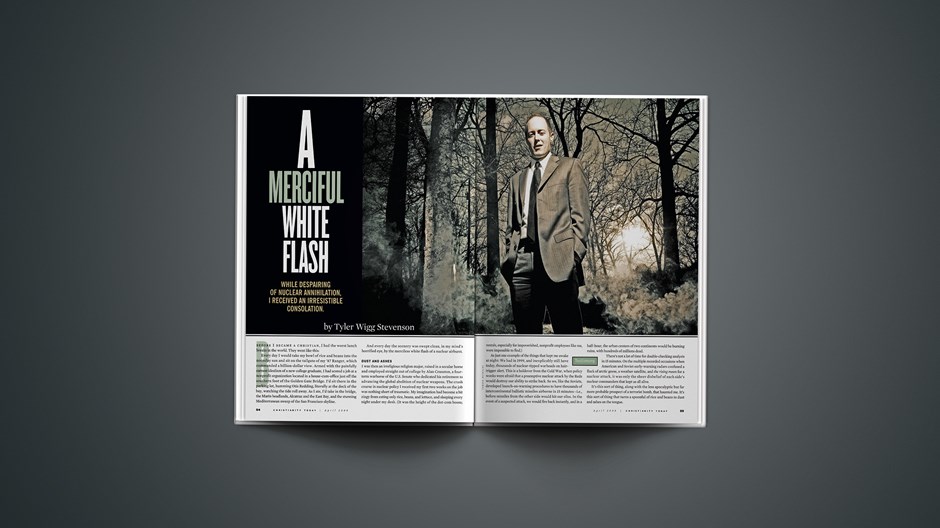
Tyler Wigg Stevenson is director of the Biblical Security Covenant. His thoughts on spiritual-disaster preparedness are at christianitytoday.com/go/postnuclear.
















 While we pray for peace, we need moral clarity about this war.
 We’ve got little information on Jesus’ appearance and personality. But that’s the way God designed it.españolFrançais
 How groups like Hillsong learned to let go of the literal in favor of creative collaboration.españolPortuguês






