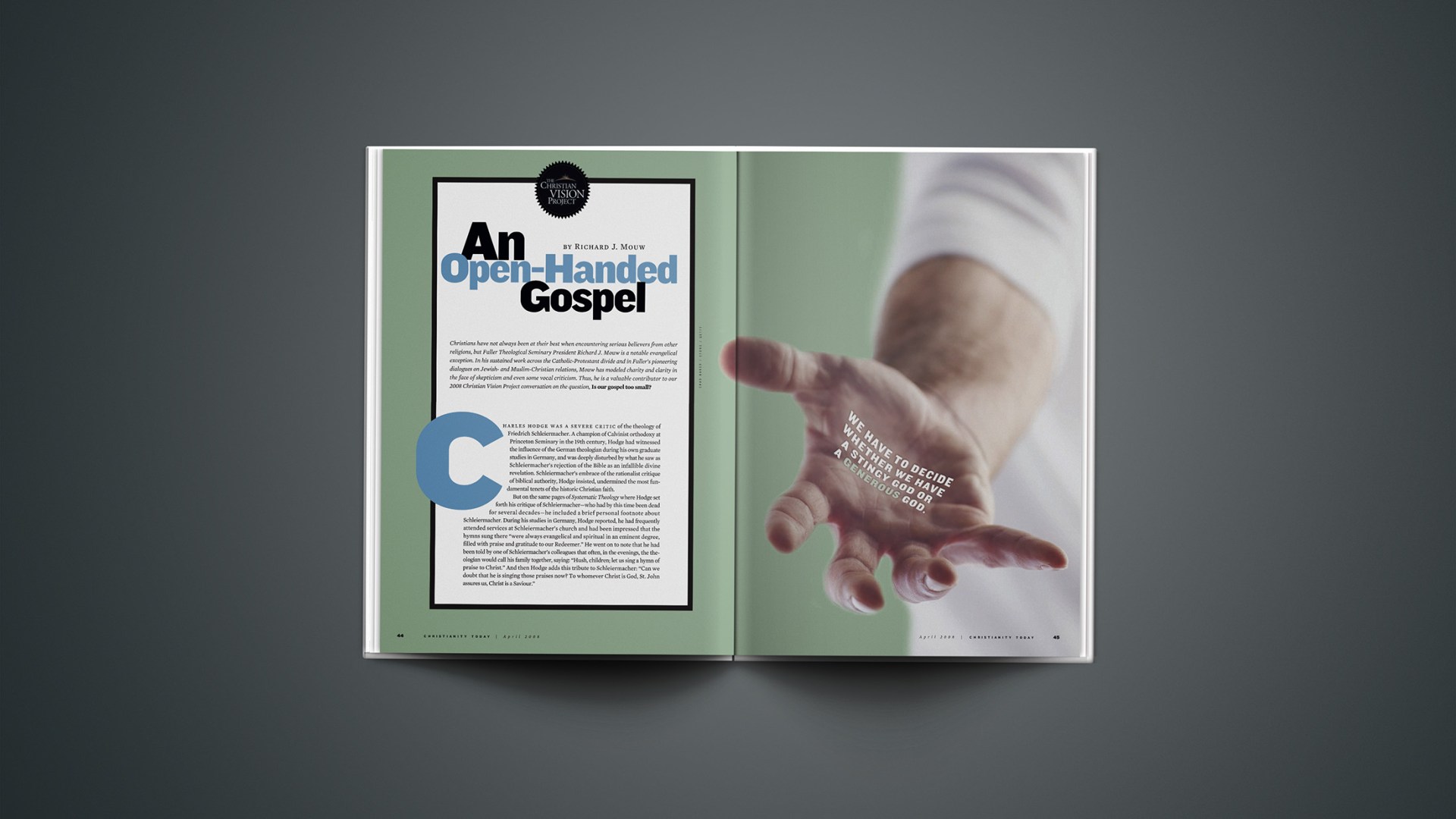

Christians have not always been at their best when encountering serious believers from other religions, but Fuller Theological Seminary President Richard J. Mouw is a notable evangelical exception. In his sustained work across the Catholic-Protestant divide and in Fuller’s pioneering dialogues on Jewish- and Muslim-Christian relations, Mouw has modeled charity and clarity in the face of skepticism and even some vocal criticism. Thus, he is a valuable contributor to our 2008 Christian Vision Project conversation on the question, Is our gospel too small?
Charles Hodge was a severe critic of the theology of Friedrich Schleiermacher. A champion of Calvinist orthodoxy at Princeton Seminary in the 19th century, Hodge had witnessed the influence of the German theologian during his own graduate studies in Germany, and was deeply disturbed by what he saw as Schleiermacher’s rejection of the Bible as an infallible divine revelation. Schleiermacher’s embrace of the rationalist critique of biblical authority, Hodge insisted, undermined the most fundamental tenets of the historic Christian faith.
But on the same pages of Systematic Theology where Hodge set forth his critique of Schleiermacher—who had by this time been dead for several decades—he included a brief personal footnote about Schleiermacher. During his studies in Germany, Hodge reported, he had frequently attended services at Schleiermacher’s church and had been impressed that the hymns sung there “were always evangelical and spiritual in an eminent degree, filled with praise and gratitude to our Redeemer.” He went on to note that he had been told by one of Schleiermacher’s colleagues that often, in the evenings, the theologian would call his family together, saying: “Hush, children; let us sing a hymn of praise to Christ.” And then Hodge adds this tribute to Schleiermacher: “Can we doubt that he is singing those praises now? To whomever Christ is God, St. John assures us, Christ is a Saviour.”
I read Charles Hodge often, and I do so for more than historical curiosity. My worries about theological trends in the early 21st century are not far removed from Hodge’s worries in his own day. Like him, I worry about trends that undermine biblical authority, thus encouraging the abandonment of historic doctrines. I even share Hodge’s particular love of Calvinist orthodoxy.
Indeed, it is precisely because I find so much to agree with in Hodge’s critique of liberal theology that I am also pleased that he added the personal footnote about Schleiermacher. I believe he was sending us a signal—one that we very much need to hear today as evangelicals.
Many evangelical commentators these days insist that salvation is closely tied to doctrinal clarity. Here, for example, is how one prominent evangelical leader criticized those of us who have endorsed the various “Evangelicals and Catholics Together” documents: “What those signers … are saying is that while they believe the doctrine of justification as articulated by the Reformers is true, they are not willing to say people must believe it to be saved. In other words, they believe people are saved who do not believe the biblical doctrine of justification.”
I can’t speak for others who look for common ground with Roman Catholics, but he certainly has me right: I am passionate in my agreement with Martin Luther on justification by faith alone. But do I believe that a person can be confused about this doctrine and still be saved? Absolutely. I wish that many of my Catholic friends would subscribe unambiguously to the views about salvation by grace alone that I hold preciously. But is their failure to do so a reason for me to doubt their salvation? Here I side clearly with Charles Hodge: “To whomever Christ is God … Christ is a Saviour.”
Convicted Civility
In a speech I heard several years ago, the Japanese-American theologian Kosuke Koyama put it nicely: We all have to decide, he said, whether we have a generous God or a stingy God. And the truth is that we evangelicals often give the impression that we have decided to be a spiritually stingy people. A recent Barna Group survey, for example, offers evidence that many young people in the larger society think of evangelicals primarily as “judgmental” types, hostile toward folks in other religions and mean-spirited in our attitudes about homosexuality. Even many young evangelicals share some of these assessments of the older generation. A leader at an evangelical college said it this way: “A lot of our students worry about typical evangelical attitudes toward people who have different belief systems and lifestyles. It’s not that they don’t take the Bible’s teachings seriously. It’s just that they have gotten to know Muslims and gays, and they are embarrassed by the harsh spirit toward such folks that they see in the older generation. If we don’t do something about this negative image soon, we could easily lose them for the evangelical cause.”
Nothing here justifies our capitulating to moral relativism or retreating from the insistence that salvation is found in Jesus Christ alone. We must resist those errors with all of our being. An understanding of divine generosity that inhibits us from calling sinners to bring the burden of their sin and guilt to Calvary is a denial of the gospel.
A number of years ago, I wrote a book on the subject of Christian civility. I was inspired to do so by a delightful line in one of Martin Marty’s books. People today who are civil, Marty observed, often don’t have very strong convictions. And people who have strong convictions often are not very civil. What we need, he said, is convicted civility.
I have spent a lot of time trying to promote convicted civility. I have to confess, however, that I sometimes get a little nervous about that project. It is so easy—as Marty made clear—to err on one side or the other; holding both up simultaneously takes constant effort. And I would hate to have assisted the cause of a freewheeling sense of divine generosity that does not maintain vigilance in protecting and defending the truth of the gospel.
But the effort to keep this marriage together needs to be made. The proper antidote to relativism and universalism is not a retreat into a stingy spirit. We must be clear in telling others about the hope that lies within us, the apostle Peter teaches; but he quickly adds that we must always do so “with gentleness and respect” (1 Pet. 3:15–16).
Humility and Our Own Mystery
The obligation of nurturing a gentle and reverent spirit toward those with whom we disagree takes on a new urgency for us today in engaging those who represent non-Christian religions and lifestyles. How do we convey our Christian convictions while displaying a spirit of generosity in our relationships with others?
The challenge here is profoundly spiritual in nature. We evangelicals have often failed to show a proper spirit in our public relations because we have not displayed a proper spirit toward our private selves.
One of my predecessors in presidency at Fuller Seminary, Edward John Carnell, got in serious trouble for some things he said on this subject. In his inaugural address in May 1955, he talked about the need for theological humility, an emphasis that so disturbed many of his colleagues that Carnell never quite recovered from the gloom that descended on the beginning of his presidential career. I would like to think that evangelicals are now ready to affirm the wisdom of what he said in that address.
Carnell’s main theme was the need to approach those with whom we disagree with a sense of mystery grounded in an acknowledgement of the mystery of our own inner lives. Quoting the oft-sung “invitation” hymn—”Just as I am, though tossed about, with many a conflict, many a doubt, fightings and fears within, without, O Lamb of God, I come”—he reflected on the mystery of those inner conflicts that take place in “the depths of our own selfhood.” “How can we treat other people as if they were empty or superficial beings, without the same kind of mystery?” he asked.
In the opening sections of his Institutes, John Calvin argues that the knowledge of God and the knowledge of self are intimately intertwined. Carnell was extending this important insight: A failure to acknowledge the complexity of our own inner workings inevitably leads to a failure to acknowledge the mystery of God’s dealings with others.
Isaac and Ishmael
Two summers ago I was asked to give the final lecture at a Chautauqua-sponsored weeklong series focusing on “the Abrahamic religions.” The audience, made up primarily of mainline Protestants, some Roman Catholics, many Jews, a few Muslims—and almost no evangelicals—had already heard from some excellent speakers representing Judaism and Islam, as well as from a Roman Catholic scholar. My assignment was to conclude the series with a presentation about the role of evangelicals in public life, focusing on our relationships with Jews and Muslims.
My speech was mainly devoted to what I see as some of the key weaknesses and strengths of evangelicalism as a public presence in American culture. But I concluded by informing my audience about two personal aspects of my own faith perspective. The first involved an encounter I had recently witnessed between a Jew and a Muslim. About thirty or so American religious leaders representing Christianity, Judaism, and Islam had the privilege of a closed-door session with King Abdullah of Jordan on one of his visits to the United States. We were impressed by the Arab leader’s professed commitment to encouraging fellow Muslims to cooperate with Jews and Christians in countering the toxic influence of extremists in each of our communities. His responses to probing questions were equally impressive—indeed, they were often quite inspiring.
As our session neared its conclusion, an elderly rabbi asked for a final word. He told the king that he was deeply moved by what he had shared. “We need you in our world of turmoil today,” he said, “but I worry about your safety and the well being of your family.” He pledged to pray for King Abdullah and his loved ones. And then the rabbi offered, as a fellow descendent of Abraham, the well-known ancient blessing: “The LORD bless you and keep you. The LORD make his face to shine upon you and be gracious unto you. The LORD lift up the light of his countenance upon you, and give you peace.”
I told my Chautauqua audience how moved I was by that encounter. As an evangelical Christian, I said, I believe with all my heart that the God I worship, the God of Abraham, looked down on that scene, where a descendent of Isaac gave a blessing to a descendent of Ishmael, and smiled and said, “That’s good! That’s the way I want things to be!” I’m not entirely clear about how to work this into my theology, I confessed, but I’m willing to live with some mystery in thinking about that encounter.
But then I quickly moved to the second aspect that I needed to share. “Those of you who watch professional football games know that there is often somebody in the crowd right behind the goalposts who holds up a ‘John 3:16‘ sign. I need to tell you this: That’s me!” I find I need to live with some mystery about what God is doing in the Abrahamic religions. At the same time, I cannot fail to proclaim the John 3:16 message that God has sent a Savior, and that those who believe on him will not perish but have everlasting life.
Both of the points I made to the Chautauqua audience were about divine generosity. We serve a God whose generous ways with others are beyond our capacity to grasp. But that same generosity has been clearly displayed in the marvelous grace that sent our Savior to Calvary—an abundant grace that is greater than all of our sin. The proclamation of that overwhelming generosity must not be muted, even as we live in the presence of mysteries we cannot comprehend.
Richard J. Mouw is president and professor of Christian philosophy at Fuller Theological Seminary.
Copyright © 2008 Christianity Today. Click for reprint information.
Related Elsewhere:
Mouw’s most recent article in Christianity Today was “Spiritual Consumerism’s Upside.”
Previous Christian Vision Project themes were culture in 2006 and mission in 2007. 2008 articles include:
The 8 Marks of a Robust Gospel | Reviving forgotten chapters in the story of redemption. (February 29, 2008)
Singing in the Chains | To be saved means more than we might think. (January 31, 2008)
The Lima Bean Gospel | The Good News is so much bigger than we make it out to be. (January 8, 2008)