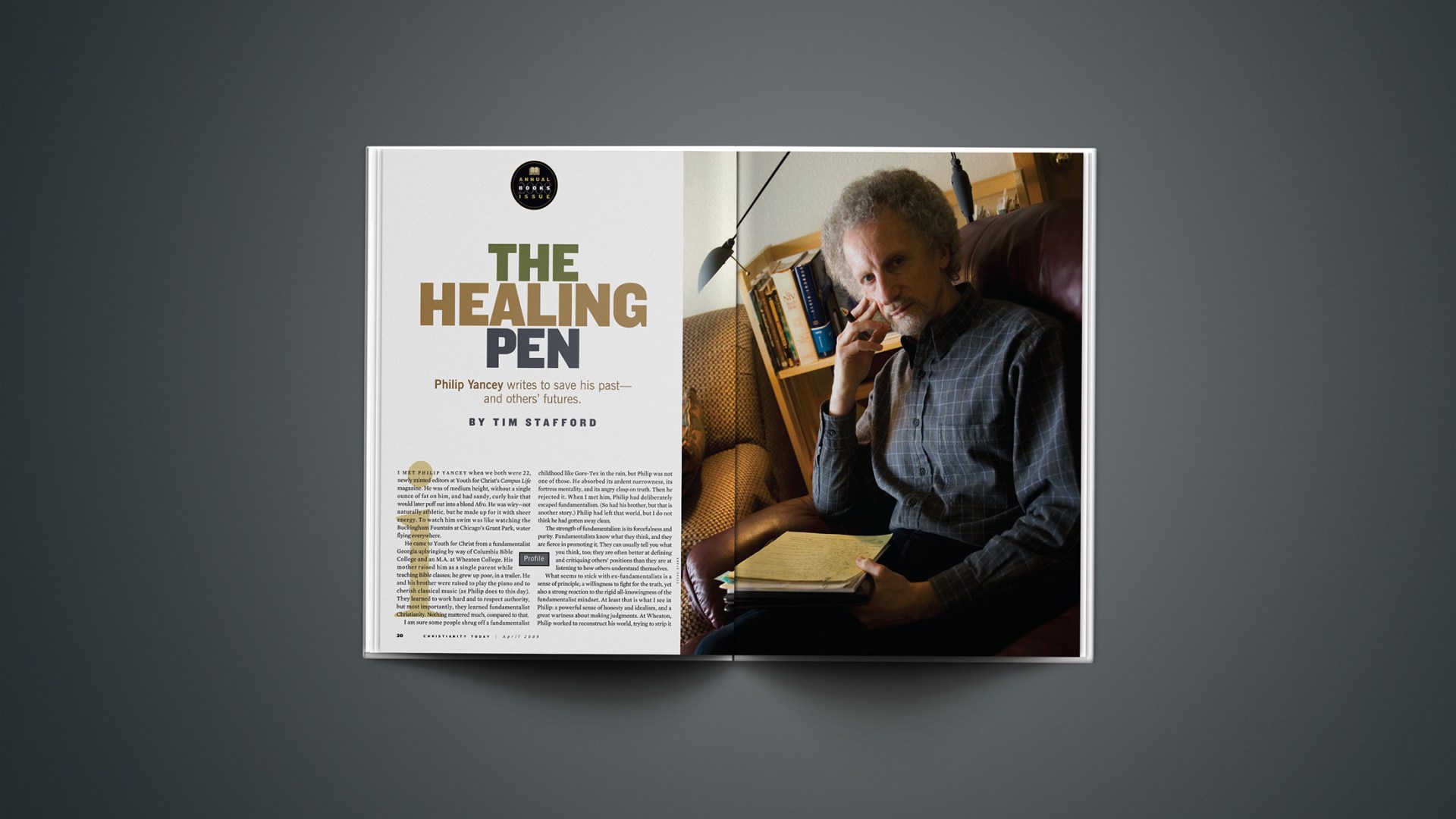

I met Philip Yancey when we both were 22, newly minted editors at Youth for Christ’s Campus Life magazine. He was of medium height, without a single ounce of fat on him, and had sandy, curly hair that would later puff out into a blond Afro. He was wiry—not naturally athletic, but he made up for it with sheer energy. To watch him swim was like watching the Buckingham Fountain at Chicago’s Grant Park, water flying everywhere.
He came to Youth for Christ from a fundamentalist Georgia upbringing by way of Columbia Bible College and an M.A. at Wheaton College. His mother raised him as a single parent while teaching Bible classes; he grew up poor, in a trailer. He and his brother were raised to play the piano and to cherish classical music (as Philip does to this day). They learned to work hard and to respect authority, but most importantly, they learned fundamentalist Christianity. Nothing mattered much, compared to that.
I am sure some people shrug off a fundamentalist childhood like Gore-Tex in the rain, but Philip was not one of those. He absorbed its ardent narrowness, its fortress mentality, and its angry clasp on truth. Then he rejected it. When I met him, Philip had deliberately escaped fundamentalism. (So had his brother, but that is another story.) Philip had left that world, but I do not think he had gotten away clean.
The strength of fundamentalism is its forcefulness and purity. Fundamentalists know what they think, and they are fierce in promoting it. They can usually tell you what you think, too; they are often better at defining and critiquing others’ positions than they are at listening to how others understand themselves.
What seems to stick with ex-fundamentalists is a sense of principle, a willingness to fight for the truth, yet also a strong reaction to the rigid all-knowingness of the fundamentalist mindset. At least that is what I see in Philip: a powerful sense of honesty and idealism, and a great wariness about making judgments. At Wheaton, Philip worked to reconstruct his world, trying to strip it clean of fundamentalist accretions while preserving (and discovering) genuine, honest faith.
Surprised by Words
Philip had come to Wheaton College to prepare for the mission field, at least partly because his father, who died of polio when Philip was just a tiny boy, had planned to be a missionary. If you know Philip, you know that what Philip plans to do, Philip does.
Campus Life, however, was an accident, no part of a plan. He had needed a job while he went to school, and the magazine offered one. Campus Life was almost entirely staff written. An editor’s job was, first and foremost, to write. It was immediately obvious to Harold Myra, our boss and mentor, that Philip was a talented and energetic writer. That was a “find” for the magazine. Just as much, it was a “find” for Philip. Bright and creative, he could have succeeded at almost anything; he would have been a great missionary. Yet writing enabled him to put his wariness and watchfulness to work for his ideals and principles.
In my years working at Campus Life, I never saw Philip forget a single detail. He was a perfectionist—a determined, driven, controlled personality who threw himself unreservedly into everything he did. But he was far kinder than most perfectionists. I must have driven him toward madness with my forgetfulness, but he rarely showed impatience. That, I suspect, was also a reaction to his fundamentalist past. He did not want to judge others and wound them as he had been wounded.
His writing has improved incredibly since those early days. I don’t recall any signs from our first years working together that he would become an artist with words, a writer capable of enchanting us. He taught me a lesson: Never underestimate a determined person. Philip read voraciously, ultimately receiving an M.A. in literature at the University of Chicago. And he turned his laser focus to writing. I don’t think anybody else gets any credit, including me, who has probably picked apart his prose as much as anybody over the years. He taught himself.
All Philip’s best writing is marked by sharp observation and caution in jumping to conclusions. His general stance is, “I didn’t understand this [prayer, pain, the seeming absence of God], it was a problem to me, so I decided to try to learn from it. And now as a fellow pilgrim, I am going to offer you what I learned, to see if it helps you too.” Make no mistake: Philip remains a missionary at heart. He wants to change lives. Writing gave him a way to do it as an escaped fundamentalist, a man wary of authoritative pronouncements.
The Great Physician
But Philip did have a prime mentor. I can clearly recall that in the mid-’70s he began talking about “Dr. Brand,” as he always called him. I could not see what drew them together so strongly. Paul Brand was a world-famous hand surgeon, an expert on leprosy who had grown up and lived much of his life in India. He was a thoughtful Christian and a brilliant doctor; he had lived a fascinating life and had some ideas for a book. But the two men were decades apart in age, and worlds apart in experience and outlook.
I once asked Philip about their connection. He said that of all the many people he had written about, Brand was perhaps the only one who worried that what Philip wrote about him would make him look better than he really was.
Brand did not pursue Philip as a potential coauthor; quite the opposite. Philip was fascinated, far beyond the editorial possibilities most would have seen. I think there were two factors. One was Brand’s fatherly status: Brand gave Philip a model of the kind of Christian he wanted to be—non-fundamentalist but thoroughly devout, humble, creative, and passionate about his work. He was the father Philip had missed.
The other factor was a shared subject: pain. Brand had participated in the discovery that most of leprosy’s terrible toll on lives began with numbness to pain. The loss of pain was at the heart of his patients’ problems. In this scientific fact, Philip saw a spiritual metaphor. And he somehow felt his way to the realization—I say felt because I doubt that it was a conscious process—that pain would be the subject of his life. Dr. Brand gave him a way to start writing about pain without being too direct or too obvious.
Philip used to say that he was an odd candidate to write about suffering, since he had never suffered. I disagree. True, he had never been starved or tortured, nor did he suffer from a terrible disease. But he was a little boy who grew up without a father, a boy sensitive to the deprivations of his childhood, and a man who, despite his rational exterior, experienced life very deeply. As long as I have known Philip, he has been drawn to suffering people—to their written accounts, to their experiences shared in letters and conversations. Somehow people recognize this sensitivity in him: he started receiving an extraordinary deluge of confessions, even before he was a well-known author. People seek him out to tell him about their pain.
Working with Brand, Philip wrote a series of meditations on the human body as a metaphor for life, majoring on the gift of physical pain: In His Image, Fearfully and Wonderfully Made, and The Gift of Pain. These were a springboard into Philip’s own reflections on spiritual pain: Where Is God When it Hurts? and Disappointment with God. (Sometime during this period he spent six years studying the Bible in order to write notes for The Student Bible.) A more rounded, positive view of faith grew out of these books about pain: What’s So Amazing About Grace?, The Jesus I Never Knew, Prayer: Does It Make Any Difference?, and others. Writing, someone has said, begins as a pain in the head. In Philip’s case, it is more a pain in the heart.
Seeking Peaks
Dr. Brand has been the most influential man in Philip’s life, but two places have also mattered. In the late ’70s, Philip and his wife, Janet, moved to inner-city Chicago. Janet’s work at the senior center of LaSalle Street Church involved the couple in a historic church in a tough north-side neighborhood. LaSalle was a church that believed in the gospel and accepted troubled people as they came. It showed concern for bodies as well as souls. Philip could be himself there; he could even teach a Sunday school class. As an escaped fundamentalist he had been wary of church, but LaSalle helped woo him back. He discovered that he could be part of the Christian body, that his gifts of wariness and observation could find a welcomed and honored place among LaSalle’s banquet of other gifts.
Chicago meant more than church, though. The Yanceys were drawn into the complexity of big-city culture—the Chicago Symphony and the Chicago Cubs, homeless people, urban crime, great restaurants. Philip is extremely curious and willing to try new experiences. Chicago was a long way from his Georgia upbringing. He ate it up.
Still, a part of Philip was radically unfulfilled in Chicago. He responds to the natural world like a violin to the bow. So for the last 15 years, Philip and Janet have lived in Colorado, in a situation just the opposite from Chicago—no symphony, no baseball stadium, no homeless people, few restaurants. But there are mountains. In 2007 he completed a goal that had become important to him (and goals are always important to Philip). He climbed the last of the 54 peaks in Colorado that exceed 14,000 feet in altitude. It would be hard to exaggerate the transcendence Philip, with Janet, has experienced atop these peaks—the glory of the high mountains, and the satisfaction of doing something so physically demanding. Colorado has become a deep part of Philip’s core. Perhaps this delight is his response to the incipient Gnosticism that afflicts fundamentalism, a way to affirm and experience the radical goodness and importance of the material world God has created—both the beauty of the mountains and the sturdiness of the human body.
The mountains, though, are recreation for Philip. Writing is his vocation, and he approaches it with a terrible, tenacious seriousness.
I confess that I just like to write. I could happily write about almost anything. My burden is to say artfully and articulately what I have to say and leave the results, if any, to God. If I have told you something you did not know, then I have done my job, and I am happy. Not Philip. He writes to heal. He has reclaimed the original kernel of his fundamentalist past—Good News to suffering and lost people—and is determined to get the message across. Talk about resolve! Read the apostle Paul and consider his unyielding determination to change lives with words, and you will get the spirit.
Only one time have I seen Philip really troubled by his audience’s response. It was after he had spoken to a group of extremely wealthy Christians in a five-star San Francisco hotel. At the time Philip was not a big-time keynoter. He gave a series of seminars over three days and was genuinely puzzled and grieved by the response.
“The first day,” he said, “I had about 50 people. The second day I had a few more, maybe 60. But the third day, attendance went way down. Only about 25 people came.”
“What did you talk about?”
“I talked about Jesus’ view of money.”
“Philip,” I said, “Jesus didn’t do so well with that material either.”
He found it hard to accept that. He thought the fault lay in him, that he had somehow failed to get his message across. Philip is extremely driven by the need to communicate. And if he has communicated clearly, how and why would anyone reject the message? Having dumped the judgmental harshness of fundamentalism and worked out in his own life what’s so amazing about grace, he communicates an intoxicating truth: There is no condemnation for those who are in Christ Jesus. Apt as any perfectionist and fundamentalist escapee to condemn himself, he carries a startling message he still finds hard to accept: God loves us!
Philip’s special gift is to communicate grace to people in pain, coming alongside them in a gentle way, not pushing too hard, not pronouncing, but offering. Of course, everybody experiences pain, so in a sense his message is universal. Yet the most visceral response comes from Christians bruised by life, those hurt by the church’s failings, those who wonder whether God can possibly care for them while permitting the suffering that has come their way. Philip understands pain. And he works hard, excruciatingly hard, to inscribe the simple message of God’s love into the heart of pain.
Tim Stafford is a CT senior writer.
Copyright © 2008 Christianity Today. Click for reprint information.
Related Elsewhere:
Yancey has been writing a column for Christianity Today since the mid-nineties.
Yancey’s website has more about him, his writing, and mountain climbing.