Westminster Theological Seminary's board voted to suspend tenured professor Peter Enns last week after a two-year theological debate over his 2005 book, Inspiration and Incarnation.
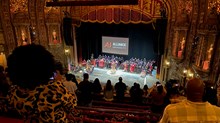
The board chairman, the president, and the secretary of the board addressed a standing-room-only group of students for about 30 minutes Tuesday morning to discuss the board's decision.
The board voted 18-9 to suspend Enns, an Old Testament professor whose book created controversy on how to interpret the Westminster Confession of Faith, a 1646 document that the faculty must affirm.
"It was made not on the basis of personality, but on the basis of the judgment on the part of a substantial number of the trustees that Inspiration and Incarnation was outside the bounds of the standards of Westminster Seminary, namely the Westminster Confession of Faith," chairman of the board John White told Christianity Today. "The essence of the question is, Does the II book fall within the parameters of the orthodox, Reformed understanding of the doctrine of inerrancy?"
The seminary's personnel committee will make a recommendation at the board of trustees' May meeting to decide whether Enns's position will be terminated. Enns declined to comment.
President Peter Lillback said he supports the board's decision. "Every institution with a theological controversy that impacts its unity is going to have to have a resolution and this is a method to accomplish that," he told CT, declining to comment on specifics of the controversy.
The board vote comes four months after the faculty voted 12-8 that Enns's book falls within the Westminster Confession, a motion that nine trustees supported in their dissent from the board's majority decision.
"We're very disappointed because we think it's a mistake, possibly a serious mistake," vice-chair of the board Peter Jansson told CT. "The nine of us strongly support Dr. Enns."
In their dissent, the nine trustees said that the board failed to give Enns an opportunity to be heard. "While theological concerns were mentioned, there was little board discussion of theological specifics," the statement says.
In his book, Enns attempts to confront issues raised by historical-critical Bible scholars that seem to compromise the Bible's divine inspiration. Enns uses an incarnational analogy, meaning that Scripture is both human and divine, similar to Jesus Christ.
The debate lies in whether Enns's incarnational analogy falls outside of the Westminster Confession, which systematic theology professor Lane G. Tipton believes Enns' book does.
"An orthodox incarnational analogy implies that the human, while real, is nonetheless secondary to the divine persons of the Son and Spirit, both in the incarnation and inspiration/inscripturation of the Word of God," Tipton said in an e-mail. "Enns' incarnational model, and the analogy he draws from it, is not consistent with a biblical and Chalcedonian approach."
Critics argue that Enns's method falls outside the Westminster Confession's statement, "The infallible rule of interpretation of Scripture is the Scripture itself."
"Instead of allowing Scripture to interpret Scripture, Dr. Enns interprets verses in isolation from and at odds with the clear testimony of other parts of Scripture, and allows an infelicitous use of extra-biblical sources to reassess what Scripture as a whole is," said church history professor Jeffrey Jue, who dissented in the faculty resolution.
"[Enns's book] has caught the attention of the world so that we have scholars that love this book, and scholars who have criticized it very deeply," Lillback told students this morning. "We have students who have read it say it has liberated them. We have other students that say it's crushing their faith and removing them from their hope. We have churches that are considering it, and two Presbyteries have said they will not send students to study under Professor Enns here."
New Testament professor Steve Taylor said there is also a larger debate over how strictly professors must hold to the Westminster Confession. He is leaving to teach at Biblical Seminary in Hatfield, Pennsylvania, because he feels that the seminary is too restrictive in its reading of the Westminster Confession. He and other professors feel that the faculty vote was completely disregarded in the board meeting.
"For the 12 [who voted for Enns], it's very frustrating, because either our competency or our orthodoxy has been called into question. This is why we're demoralized," Taylor said. He believes the debate has fractured the school. "People are using language that the feeling of the campus is so oppressive that it's almost a demonic oppression."
Westminster master of divinity student Art Boulet is trying to transfer to Princeton Theological Seminary after three years at the seminary because Enns was suspended.
"It's like watching divorced parents. You know they are nitpicking at each other, you know there are problems, but you don't exactly know why," Boulet said. "There is this tension and there is a dividing line almost like, 'What team are you on? Show me your card.'"
The seminary, located near Philadelphia, lists about 600 students in its phone directory and 21 professors on its website. Westminster began in 1929 as an alternative to Princeton Theological Seminary because its founder, J. Gresham Machen, felt Princeton was departing from its Reformed theological roots.
"I think it's really important for seminaries that serve particular church bodies to realize that they are not simply academic institutions, but that they are accountable to the church to whom they are preparing ministers and missionaries," said Michael Horton, theology and apologetics professor at Westminster Seminary in California.
University of Notre Dame historian and Westminster alumnus George Marsden said challenges arise for institutions with confessional statements because it can be difficult to interpret the documents for specific cases.
"Westminster has always wanted to be strictly consistent with the Presbyterian, Westminster standards and also be a place that defends traditional Christianity with the highest sort of scholarship," Marsden said. "It's impossible to anticipate where those conflict with each other."
Historically, the difference between evangelical and non-evangelical Christian movements has been an emphasis on boundaries, such as confessional statements, says Mark Noll, University of Notre Dame Francis A. McAnaney Professor of History.
"It's a delicate problem for theologians and Bible people who are saying whether what is true and what is right," Noll said. "They just have a more difficult life to lead when it comes to these questions."
Copyright © 2008 Christianity Today. Click for reprint information.
Related Elsewhere:
Westminster Seminary explains its mission statement.
Westminster alumnus Brandon Withrow has compiled several links to reviews and websites about the controversy.
The Center for Reformed Theology and Apologetics provides the full text of the Westminster Confession of Faith.
Gregory Beale reviewed Enns's book for the Journal of the Evangelical Theological Society.
Susan Wise Bauer reviewed Enns's book for Books & Culture.






Support Our Work
Subscribe to CT for less than $4.25/month