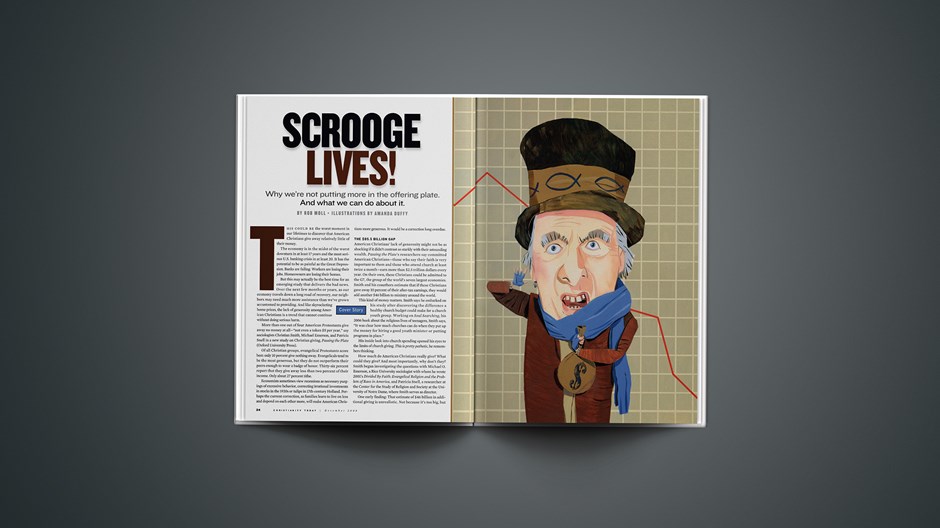
This could be the worst moment in our lifetimes to discover that American Christians give away relatively little of their money.
The economy is in the midst of the worst downturn in at least 17 years and the most serious U.S. banking crisis in at least 20. It has the potential to be as painful as the Great Depression. Banks are failing. Workers are losing their jobs. Homeowners are losing their homes.
But this may actually be the best time for an emerging study that delivers the bad news. Over the next few months or years, as our economy travels down a long road of recovery, our neighbors may need much more assistance than we've grown accustomed to providing. And like skyrocketing home prices, the lack of generosity among American Christians is a trend that cannot continue without doing serious harm.
More than one out of four American Protestants give away no money at all—"not even a token $5 per year," say sociologists Christian Smith, Michael Emerson, and Patricia Snell in a new study on Christian giving, Passing the Plate (Oxford University Press).
Of all Christian groups, evangelical Protestants score best: only 10 percent give nothing away. Evangelicals tend to be the most generous, but they do not outperform their peers enough to wear a badge of honor. Thirty-six percent report that they give away less than two percent of their income. Only about 27 percent tithe.
Economists sometimes view recessions as necessary purgings of excessive behavior, correcting irrational investments in stocks in the 1920s or tulips in 17th-century Holland. Perhaps the current correction, as families learn to live on less and depend on each other more, will make American Christians more generous. It would be a correction long overdue.
The $85.5 Billion Gap
American Christians' lack of generosity might not be as shocking if it didn't contrast so starkly with their astounding wealth. Passing the Plate's researchers say committed American Christians—those who say their faith is very important to them and those who attend church at least twice a month—earn more than $2.5 trillion dollars every year. On their own, these Christians could be admitted to the G7, the group of the world's seven largest economies. Smith and his coauthors estimate that if these Christians gave away 10 percent of their after-tax earnings, they would add another $46 billion to ministry around the world.
This kind of money matters. Smith says he embarked on his study after discovering the difference a healthy church budget could make for a church youth group. Working on Soul Searching, his 2006 book about the religious lives of teenagers, Smith says, "It was clear how much churches can do when they put up the money for hiring a good youth minister or putting programs in place."
His inside look into church spending opened his eyes to the limits of church giving. This is pretty pathetic, he remembers thinking.
How much do American Christians really give? What could they give? And most importantly, why don't they? Smith began investigating the questions with Michael O. Emerson, a Rice University sociologist with whom he wrote 2001's Divided By Faith: Evangelical Religion and the Problem of Race in America, and Patricia Snell, a researcher at the Center for the Study of Religion and Society at the University of Notre Dame, where Smith serves as director.
One early finding: That estimate of $46 billion in additional giving is unrealistic. Not because it's too big, but because it's too small. Estimating 10 percent giving for every committed Christian in the U.S. neglects two groups: those who truly can't afford to give 10 percent (due to illness or unemployment or similar reasons), and those who are already giving more than 10 percent (more on this group in a moment). If you calculate that 10 percent of Christians can't give because of their financial limitations, most of the rest give 10 percent, and a handful of generous givers continue their current generous giving pattern, committed American Christians could realistically increase their giving by $85.5 billion each year.
Admittedly, $85.5 billion doesn't look as big as it used to. The U.S. government spent as much to save the ailing insurer American International Group from bankruptcy. But such an increase in religious giving could be world changing. Smith and his coauthors try to provide some idea of what that money could accomplish:
$10 billion would sponsor 20 million children for a year, and just $330 million would sponsor 150,000 indigenous missionaries in countries closed to religious workers. $2.2 billion would triple the current funding of Bible translation, printing, and distribution. $600 million would be enough to start eight Christian colleges in Eastern Europe and Southeast Asia.
These figures only begin to spend that extra cash. What Christians could do—if they managed their money in a way that gave priority to giving a portion away—is astounding.
The Biggest Givers
Actually, it's not quite true to say that American Christians give only a small portion of their money toward religious endeavors. Looking closer, the picture is more disturbing.
Article continues below
As already noted, a quarter gives away no money at all. The average, regularly attending churchgoer gives 6 percent of after-tax income, but that's a mean skewed by a handful of very generous givers. The median annual giving for an American Christian is actually $200, just over half a percent of after-tax income. About 5 percent of American Christians provide 60 percent of the money churches and religious groups use to operate. (It's these people who skew the average.) "A small group of truly generous Christian givers," say Passing the Plate's authors, "are essentially 'covering' for the vast majority of Christians who give nothing or quite little."
In addition, America's biggest givers—as a percentage of their income—are its lowest income earners. The widow who gave out of her poverty rather than her wealth (Mark 12:42; Luke 21:1-4) has a lot of company, it seems. Yet so does the rich young ruler (Luke 18:18-30).
"Americans who earn less than $10,000 gave 2.3 percent of their income to religious organizations," Smith, Emerson, and Snell write, "whereas those who earn $70,000 or more gave only 1.2 percent." While the actual percentages are slightly higher for Christians who regularly attend church, the pattern is similar. Households of committed Christians making less than $12,500 per year give away roughly 7 percent of their income, a figure no other income bracket beats until incomes rise above $90,000 (they give away 8.8 percent).
In fact, in absolute terms, the poorest Christians give away more dollars than all but the wealthiest Christians. We see the pattern in recent history as well: When Americans earned less money following the Great Depression, they gave more. When income went up, they began to give less of it away.
That giving is so low may be no surprise to those familiar with the adage of the camel and the eye of the needle. But Passing the Plate's authors were not interested in chronicling stinginess. They were instead propelled by a nagging question: Why?
Example Deficit
Combing through previous data sets, conducting their own survey, and interviewing dozens of church leaders and members, the researchers came to some plausible answers.
First, a major reason Christians don't give more is because many can't. Fixed costs in households have increased from 54 percent to 75 percent of family budgets since the early 1970s.
Article continues below
"A mere two buying decisions—the purchases of homes and cars—are enough to lock household budgets into tight budgetary situations for decades," they say.
It doesn't get better with larger incomes, says Bill Walter, a financial planner for 35 years at Church Growth Services, a South Bend, Indiana-based consulting firm that helps churches raise money in capital campaigns. In fact, a high income often means more debt.
"Oftentimes there's a misperception that if we have this really wealthy church in this well-heeled neighborhood, achieving the campaign goal ought to be a slam dunk." Instead, Walter says, "Many of the folks in the well-heeled neighborhoods driving Lexuses and going to their summer cottages are doing this all on credit."
Another part of the answer, the researchers found, is that some would-be donors don't trust how churches and religious organizations would use their donations. Only 9 percent of church-attending Christians say this is an important reason for their lack of giving—but majorities in several church families (Lutherans, Presbyterians, Baptists, and Catholics) say they don't have high levels of trust in their denomination's management and allocation of funds.
A larger problem isn't that the parishioners distrust their churches; it's that they are acting just like them. American families are repeating their churches' examples.
"Relatively little donated money actually moves much of a distance away from the contributors," Smith, Emerson, and Snell write. The money given by the people in the pews, it turns out, is largely spent on the people in the pews. Only about 3 percent of money donated to churches and ministries went to aiding or ministering to non-Christians.
Meanwhile, the study found that a major reason Christians do not give is because they are not asked to. The researchers found "a strong correlation between perceived expectations and readiness to give money." Americans know that nearly all denominations teach that Christians should give away 10 percent of their incomes. But this teaching is rarely reinforced. Pastors are reluctant to bring it up because the issue is so closely tied to their own salaries. And the study found that pastors themselves are often not great models of financial giving, which can exacerbate their reluctance to preach on it.
The Cheerful Giver Dilemma
Resource constraints, low leadership expectations, and ignorance are each significant hurdles to clear if American Christians are to become more generous. But the real question may not be why Christians don't give away more money. A better question, the researchers suggest, is, How do they give when they do?
Article continues below
Offering money, many Christians believe, should be like Hollywood's version of romance: spontaneous, exuberant, and impulsive. Financial gifts should be joyful, we think, so we give only when the urge strikes. "Structured systems" such as annual pledges, write Smith, Emerson, and Snell, "seem to strike many American Christians as rigid, impersonal, legalistic, and even unspiritual."
This attitude translates to giving from our wallets instead of our paychecks. When the offering plate comes by, we dig into our purses or pockets and freely, joyfully give of what we find. Meanwhile, nearly all of our income is spoken for.
One congregant put it this way: "God requires it, but … he also tells us that he doesn't want us to give if we don't want to." The proof text for this attitude is 2 Corinthians 9:7: "Each man should give what he has decided in his heart to give, not reluctantly or under compulsion, for God loves a cheerful giver."
The application, however, suggests that God prefers consumerism to generosity. If buying the bigger home or the larger car makes it more difficult to give cheerfully, we will cut back on the giving until it's cheerful.
So we give our money like we spend it: haphazardly and without intention. "Most people are looking out no more than a week or a month on their spending," says Rusty Leonard, an investment manager and founder of MinistryWatch. Christians act no differently with their money than other Americans who don't save for retirement, buy houses they cannot afford, or invest only when stocks are rising. But, Leonard says, Christians are starting to pay more attention to financial issues, and their attention to issues such as debt is helping them be better givers as well.
Chip Bernhard has seen such effects as the senior pastor of Spring Creek Church in Pewaukee, a Milwaukee suburb. The church is one of more than 4,000 congregations using Dave Ramsey's Financial Peace University curriculum this fall. By the end of the three-month course, which Spring Creek offers twice a year, the class of 50 to 100 people will have as a whole paid off about $100,000 in debt.
Helping people take a long-term view of household finances increases parishioners' ability to give not just because they have more money, but also because they start thinking about priorities.
Article continues below
Teaching people the theology of giving is the easy part, Bernhard says. More difficult is showing that the church means it. So, for example, no one can be in a leadership position who doesn't give (though there is no minimum specified).
"Where your treasure is, there is your heart," says Spring Creek's executive pastor, Tom Price. "Why put people in leadership positions if their hearts aren't in it?"
In addition, Spring Creek elders call to thank anyone who gives any dollar amount above their usual offering. Once a quarter, members receive a newsletter with a testimony, a handwritten thank-you note, and an update on their financial giving for the year.
The church is undergoing its second capital campaign to expand its facilities—something that often lifts general giving along with directed gifts, notes Walter of Church Growth Services. But Bernhard says he never talks about giving in terms of brick and mortar.
"Our expansion is people driven," he says. So the church makes sure members hear the testimonies of people who have experienced a changed life because of the church's ministry. Then Bernhard tells the congregants, "That is why you give to Spring Creek."
Boring is Better
Helping Christians take a long view of their finances helps, Passing the Plate's researchers note. Even more important is helping them form habits. Asking church members to make annual pledges will do more to encourage generosity than asking for spontaneous gifts or pleading for cash to fix a broken boiler.
And if there is one thing better than pledges, it's automatic withdrawals. Giving would never again be dependent on having cash in your purse or remembering your checkbook on the way out the door. This approach would make obedience independent of our various charitable impulses. It makes sense. Financial planners encourage families over and over to have their savings and retirement investments taken right out of their paychecks.
But is obedience that requires no effort, no thought, really obedience? Spiritual formation occurs when we, week after week, grab the checkbook, write a check, and drop it in the offering plate. We remember God's goodness, his continual care, as we build up a habit of giving.
Giving should be a matter of intentional obedience, a joyful expression of returning thanks to God. And there seems to be something sacred about physically collecting the offerings and blessing them during worship. Isn't something lost if it's left to church administrators sorting the daily mail?
Article continues below
On the other hand, the Bible warns often enough about money that perhaps we should be mistrustful of our ability to be impulsively generous week after week. A man's pocketbook, Martin Luther said, is the last piece of him to be converted. Money has a strange power, as the current economic crisis illustrates, that suggests humility and prudence are the appropriate attitudes toward it, not exuberance and impulsiveness.
Rather than being impersonal and legalistic, a steady, habitual, even automatic approach to giving can do more to form us spiritually than the give-only-out-of-joy approach. The decision to give a percentage of our income automatically and "off the top" can affect everything from the house we live in to the groceries we buy to a pizza delivery. When we pass on a purchase because we know the check to church or a sponsored child is going out that week, it forces us to prioritize. It places supremacy with someone or something other than us. Most importantly, and formatively, it reorients our life.
Francis Chan, pastor of Cornerstone Church in California's Simi Valley, says churches are often theologically accurate when they teach about giving. But they haven't reoriented themselves.
Chan asks, "Do our actions show that we really believe that our money belongs to God?" Cornerstone gives away 55 percent of what it brings in. And staff members have tried to model financial generosity in a number of ways. Some raided their retirement accounts and gave the money to organizations serving the poor and needy. Some started businesses and donated the profits (and then their free time) back to the church.
The example spread to church members. A college student moved into his car, showered and shaved at friends' homes, and gave what had been his rent money to a Christian aid organization. A single professional moved in with his parents so he could give away a large percentage of his paycheck.
Cornerstone faced a difficult choice when its leadership looked into purchasing a new building. After five years of stagnant attendance, the church realized that its building limited growth. So Chan and the rest of the pastoral staff brought in consultants and architects who laid out a sweeping new campus for the church: an extended complex of buildings, brick streets, fountains, and gardens.
"I really felt it was repulsive," Chan says. "It showed us spending money for our own comfort."
Chan showed the designs to the congregation. When the gasps subsided, he told them it was off the table. Instead of a huge sanctuary, he explained, they were building an open-air amphitheater and saving millions of dollars. A few small buildings would suffice for offices. "There is greater joy in sacrifice," Chan says, "than when we give just out of our excess."
Article continues below
That greater joy comes from habitual, routine, and generous giving—even automated giving—and forms our lives. It's what teaches the giver to be cheerful.















 While we pray for peace, we need moral clarity about this war.
 We’ve got little information on Jesus’ appearance and personality. But that’s the way God designed it.españolFrançais
 The rage of the mob is a poor substitute for real community.






