Hungry for Justice
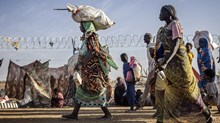
Christianity Today's November cover story ["Hunger Isn't History"] thankfully included the most overlooked and unpopular aspect of world hunger: It could be avoided. We like to think we have done something by sending boatloads of food, but this approach will never solve the institutional problem; people need to be allowed to sustain agriculture in their own lands.
The crux of the problem is that the governments of the nations with the most starving people are not properly using the assets provided by more secure nations. Haiti, North Korea, and Zimbabwe are all examples of having poor or nonexistent agricultural investment for their own populations. What would happen if the world were to hold the leadership of hungry nations accountable for investing in food production infrastructure and post-harvest storage? Were we to give investment aid to those in need—but only in financial-package increments for meeting sustainable benchmarks—we might see some examples of management of food assets like in the days of Joseph in Egypt.
Mike Mueller
Executive Director, Hope Seeds
Bradenton, Florida
Women of the Book
I agree with CT's November editorial "Misunderstanding Sarah" that gender is "neither qualification nor impediment to any other endeavor." While some believe women can lead a country but not a church, the Bible consistently celebrates women like Deborah, whose leadership as judge and prophet influenced all of Israel. Huldah was also a prophet whose leadership brought sweeping reform. When the Book of the Law was discovered (2 Chron. 34:14-33; 2 Kings 22), King Josiah and his committee sought Huldah's advice rather than Zephaniah's or Jeremiah's, both of whom were prophets during this time.
The legacy of women's leadership continues in the early Christian community. Here we find female house-church leaders like Nympha and Lydia (Acts 16:13-15, 40), Chloe (1 Cor. 1:11), Apphia (Phm. 1:2), the Elect Lady (2 John 1), and Priscilla (Acts 18:2, 18-19, 26; Rom. 16:3). We also note the female apostle Junia (Rom. 16:7) and deacon Phoebe (Rom. 16:1). Scripture celebrates women leading Israel's army, advising Israel's prophets, priests, and kings, and serving as apostles, deacons, and house-church leaders.
God delights in using whomever he wishes despite the expectations of ancient or modern people. Scripture provides no refuge to those who grant women opportunities for leadership in the secular sphere but exclude them from leadership in the spiritual sphere. Just as the gifts of leadership are not restricted by gender, neither are the arenas in which these gifts are used. Thousands stand with Kenneth Kantzer in affirming the biblical basis for service in any realm, regardless of gender.
Mimi Haddad
President, Christians for Biblical Equality
Minneapolis, Minnesota
|
* * * |
Let's not be so quick to blame the ignorance of mainstream media in their expecting evangelicals to be upset about Bristol Palin's pregnancy. I don't recall any grace extended to President Clinton by mainstream evangelicals. And can you imagine the harrumphing that would have gone on had Chelsea Clinton become pregnant at 17? Let's confess that we have often deserved the reputation of being judgmental.
Mary VanderVennen
Toronto, Ontario
Islam According to the Qur'an
With chagrin I read the article "Islam According to Gallup" [November]. To say that it soft-pedals Islam is an understatement. The interviewer should have asked more probing questions or offered some refutation to what Islamic scholar Dalia Mogahed gave an ignorant public.
Mogahed glides over the question about the punishment for apostasy in Islam by saying, "Islamic law is a vibrant, ever-changing set of interpretations." Islamic law, however, is clear that the penalty for apostasy is death. The more secularized Muslim governments may impose lesser penalties, but that is because they are not following Islamic law strictly. On October 20, Afghanistan's government commuted the death sentence of a young journalist for blasphemy. The sentence was reduced from death to "only" 20 years in prison. A couple days later, a Somali man was murdered because he had converted from Islam to Christianity. Yet the article did not address occurrences like these. Why not?
Further, Mogahed says that some violent verses from the Qur'an have a "historical context and must be understood … in a specific way," implying that those verses are no longer valid. Yet the fundamental principle of Islam is that the Qur'an is the literal word of Allah, perfect, complete, immutable, and valid for all eternity. Is Mogahed prepared to openly and publicly declare that those violent verses are no longer valid?
Gallup can survey the opinions of Muslims, but it cannot determine what Islam is. There is only Islam according to the Qur'an and the sayings of Muhammad.
Carl Goldberg
Phoenix, Arizona
Voting In Shalom
Let me express my deep gratitude for John Stackhouse's "A Variety of Evangelical Politics" [November]. Its balance and wisdom were refreshing in a sensational and emotionally charged political environment. Evangelicals are in desperate need of more material like this, which will help the church grow in credibility and effectiveness in its political and social engagement. Keep up the good work.
Jonathan Watts
Dallas, Texas
|
* * * |
John Stackhouse, in an otherwise balanced look at faith in politics, suggests that a Christian officeholder might depart from the biblical model and support same-sex "marriage" in the pursuit of shalom. Such a compromise could be prudentially justified to help us to not appear homophobic and imperialistic by being "accommodating and tolerant."
But shalom can be a very slippery word.
In my view, it is the ultimate description of God's justice, the perfect state of harmony and concord that can be achieved among people to best promote human flourishing—but not at the expense of ignoring biblical teaching. The way Stackhouse uses the term, however, is to embrace Christian utilitarianism, doing the greatest good for the greatest number.
The Christian legislator's job is to defend biblical truth prudentially mediated in the public process. We cannot establish one standard for our personal beliefs and another for our public positions. Mario Cuomo famously tried to justify that and gave sophistry a bad name. If the Christian legislator cannot for whatever reason vote his Christian conscience, he should simply step down from office.
Chuck Colson
Naples, Florida
|
* * * |
John Stackhouse may not be informed that many U.S. citizens participate, in a variety of ways, in direct democracy within the general framework of representative democracy. The New England town hall meetings demonstrate this. At the state and local levels, citizens use the initiative, referendum, and recall to directly influence the functions of governance. When the people are dissatisfied with the decisions (or lack thereof) of elected representatives, voters may initiate legislation and terminate an official's term without waiting to replace him or her at the next election.
In the 2008 election cycle, hundreds of issues, including same-sex marriage, abortion, and assisted suicide, were decided without the vote of elected politicians. Those who participate in direct democratic processes have shown we have the information and skill to make direct political decisions that best serve our communities.
Bruce McCartney
Puyallup, Washington
Is Voting a Duty?
I sense a little defensiveness in John Wilson's review of Electing Not to Vote [CT Review, November]. Wilson thinks the book is tilting at windmills, but plenty of folk seem to get this faith-and-politics thing all mixed up, including those who so easily urge our Christian "duty" to vote.
Consider the hijacking of Christian hymnody by President Bush's speechwriters: "There's power, wonder-working power, in the goodness and idealism and faith of the American people." Or this, from President-elect Barack Obama: "I still believe that America is the last, best hope of earth." (Note that Obama changed Lincoln's line describing freedom to a description of the U.S.)
The temptation of politicians throughout history is to claim eschatological significance for their penultimate governance. Christians know better. Last. Best. Wonder-working power. Only Israel's Messiah, the world's true Lord, can claim these things.
Glenn Paauw
Colorado Springs, Colorado
Copyright © 2008 Christianity Today. Click for reprint information.







Support Our Work
Subscribe to CT for less than $4.25/month