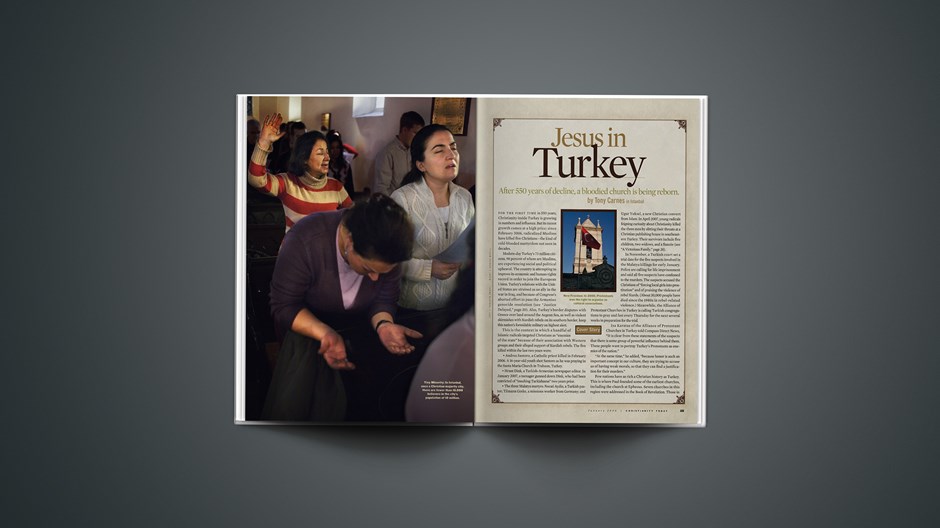
For the first time in 550 years, Christianity inside Turkey is growing in numbers and influence. But its recent growth comes at a high price: since February 2006, radicalized Muslims have killed five Christians—the kind of cold-blooded martyrdom not seen in decades.
Modern-day Turkey's 73 million citizens, 98 percent of whom are Muslims, are experiencing social and political upheaval. The country is attempting to improve its economic and human-rights record in order to join the European Union. Turkey's relations with the United States are strained as an ally in the war in Iraq, and because of Congress's aborted effort to pass the Armenian genocide resolution. Also, Turkey's border disputes with Greece over land around the Aegean Sea, as well as violent skirmishes with Kurdish rebels on its southern border, keep this nation's formidable military on highest alert.
This is the context in which a handful of Islamic radicals targeted Christians as "enemies of the state" because of their association with Western groups and their alleged support of Kurdish rebels. The five killed within the last two years were:
• Andrea Santoro, a Catholic priest killed in February 2006. A 16-year-old youth shot Santoro as he was praying in the Santa Maria Church in Trabzon, Turkey.
• Hrant Dink, a Turkish-Armenian newspaper editor. In January 2007, a teenager gunned down Dink, who had been convicted of "insulting Turkishness" two years prior.
• The three Malatya martyrs: Necati Aydin, a Turkish pastor; Tilmann Geske, a missions worker from Germany; and Ugur Yuksel, a new Christian convert from Islam. In April 2007, young radicals feigning curiosity about Christianity killed the three men by slitting their throats at a Christian publishing house in southeastern Turkey. Their survivors include five children, two widows, and a fiancée.
In November, a Turkish court set a trial date for the five suspects involved in the Malatya killings for early January. Police are calling for life imprisonment and said all five suspects have confessed to the murders. The suspects accused the Christians of "forcing local girls into prostitution" and of praising the violence of rebel Kurds. (About 30,000 people have died since the 1980s in rebel-related violence.) Meanwhile, the Alliance of Protestant Churches in Turkey is calling Turkish congregations to pray and fast every Thursday for the next several weeks in preparation for the trial.
Isa Karatas of the Alliance of Protestant Churches in Turkey told Compass Direct News, "It is clear from these statements of the suspects that there is some group of powerful influence behind them. These people want to portray Turkey's Protestants as enemies of the nation."
"At the same time," he added, "because honor is such an important concept in our culture, they are trying to accuse us of having weak morals, so that they can find a justification for their murders."
Few nations have as rich a Christian history as Turkey. This is where Paul founded some of the earliest churches, including the church at Ephesus. Seven churches in this region were addressed in the Book of Revelation. Those in the early monastic movement found the caves of Cappadocia a near-perfect place to live out lives of prayer. Constantinople, now the city of Istanbul, became the capital of the Roman Empire just as it was being Christianized, and the Ecumenical Patriarch of Constantinople has been the leader of worldwide Orthodoxy for centuries.
But Christianity came under Islamic rule in Turkey in 1453 and steadily declined for centuries; the last 100 years have been the worst. In 1900, the Christian population was 22 percent. Now most experts estimate that there are fewer than 200,000 Christians nationwide, comprising less than 0.3 percent of the population.
Protestant missions work began around 1820. There are now more than 30 Protestant organizations operating nationwide. In 1999, the Izmit earthquake, which killed 17,000 and left 800,000 homeless, led Christian agencies to start new relief work, and they eventually began working alongside independent Christian fellowships. These fellowships, along with new growth in traditional Orthodox congregations, have created a 3 percent annual growth in the country's Christian population, about three times Turkey's overall population growth rate. Following the Malatya murders, Christianity Today traveled to Turkey, meeting church leaders from throughout the region.
Tasting Forbidden Fruit
In so many ways, the story of Turgay Ucal, a pastor of an independent church in Istanbul, embodies the promise and peril of Turkish Christianity. On a weekday afternoon, Ucal sat down with CT to describe his journey to faith in Jesus Christ.
Ucal (pronounced u-CHAAL) grew up in Old Town, Istanbul. He told CT that as a high school student he took a leap of faith, almost literally, out of his comfort zone. In Turkish life, generations of families live together with unlocked doors and few secrets. One day, he strolled down a cobblestone street, past some decaying buildings. He walked back and forth to make sure no one he knew was around—and slipped into a Catholic church.
Article continues below
At the time, Ucal was deeply curious about what had happened to Jesus when, as the Koran says, he left this earth still alive. "The Koran said Jesus didn't die," Ucal recalls, "and I asked, 'Why? What is in the Bible?'—I wondered."
Turkey's religious landscape is not simple: sharply partisan politics, strident nationalism, and disputed history make it a complex scene. Secular nationalists who are Muslim in private practice fiercely oppose public religiosity. They see Christian converts as tools of Western powers that want to undermine Turkey's sovereignty.
In the 1960s, the era in which Ucal grew up, Turks in Istanbul were exploring many forbidden fruits. Coca-Cola and Pepsi factories opened up. Turkish kids tasted hot dogs for the first time, despite the warning that hot dogs might contain donkey meat.
Others, like Ucal, drew close to Christ.
Thirty years later, the church started by new believers has achieved new maturity and public acceptance. The independent Turkish church now comprises almost 100 congregations and more than 100 house fellowships.
Turkish Christians of Muslim backgrounds have anchored the leadership of the church around their own new identity—and by portraying Jesus Christ as a Turk. This helps resolve a crucial conflict in Turkish minds, that only Muslims can be truly "Turkish."
Leaders have discovered that by the time a Turk of Muslim background enters a church, he or she is often ready to convert and is looking for reassurance. Ucal told CT that when he went to university to study Islamic literature, he even belonged to an Islamic youth group. But his ultimate purpose was to learn more about Jesus. "At the university, I saw the biblical background to what I was studying," he said. "The Bible became my fate."
He said Christianity offered a new balance of freedom in a disciplined context, transcending the stringent legalism of his upbringing. As a young man, Ucal had tried to be a good Muslim. "My family was Muslim. I prostrated myself to Mecca five times a day. I participated in 'The Light' [Nurcu], a Muslim youth group. I had a very structured Muslim mind."
Changed Identity
New Christian believers find it very difficult to become openly active in Turkey's traditional churches—Armenian Orthodox, Catholic, Eastern Rite Catholic, and Greek Orthodox. The handful of Protestant-affiliated congregations operate in the open, but they mainly meet the needs of ethnic minority groups or Westerners living in Turkey.
Article continues below
So new Christians coming from Muslim families are often isolated and ostracized. Ucal realized there was more to Christian living than an individualized faith. He wanted to create a Turkish church for Islamic-background Turks like himself.
Shortly after becoming a believer, Ucal had not told anyone what had happened to him spiritually. But he quietly opened a court case to change his religious identity registration.
His father, a military officer responsible for defending Istanbul's harbor, saw his son's name on the list of people changing their religious affiliation. Even today there is a common belief that the Greeks use Turkish converts to Christianity as spies. Ucal says, "Buddhism is okay, but not Christianity. There was a history."
When Ucal's father saw his son's name included on the list, he went ballistic. He stormed home, screaming to his wife, "They are turning our son into a spy!"
At first, Ucal's father became more Muslim in reaction to his son's faith. Later, he took a closer look. His son hadn't changed friends and seemed more at ease. What most people saw was that the young Christian hadn't changed his identity as a Turk. One individual told CT, "He still seemed to be a real Turk."
Ucal kept living within the Turkish Muslim community. There was also a growing sense among his generation that they were reshaping Turkey into a nation that respected freedom and religious diversity. "We have created a new world for us—for me—in my own country," Ucal says.
Engaging Islamic Society
In 1986, Ucal finally started a church. His tiny congregation was allowed to worship for 60 minutes every 15 days inside the Swedish Consulate in Istanbul.
But Turkish newspapers immediately made a big deal out of a Muslim-background pastor starting a Christian church for Muslim-background Turks. His parents hadn't become used to Ucal being a Christian and had no idea he was going to start a church. They were startled when they opened their morning newspaper. "Those years were terrible," Ucal recalls. His parents were frightened for their son. Campus Crusade staff members who were helping Ucal warned, "Turgay, you will die." Yet they stayed with him. Within a year, Ucal had 20 Muslim-background Turks in his church, and stability was emerging.
Ucal's congregation moved toward a charismatic, Vineyard-style form of Christianity. Meanwhile, Ucal served in the army for eight months and received training in ministry in the Philippines and South Korea. After that, Ucal decided to plant a different kind of church based on systematic theological teaching. While in South Korea, he had noticed the parallels between systematic theology and the disciplined Islamic lifestyle and mindset. He wondered if other Muslim-background Turks might respond to a more structured approach than the informal evangelicalism of which he was a part. Ucal found that his Muslim neighbors are attracted to systematic approaches to religious instruction, and are also easily touched emotionally. So Ucal began approaching them with an "emotional Calvinism."
Article continues below
Ucal started arguing that Christianity was "authentically Turkish" and "socially natural." This became a huge breakthrough for believers. Today, Ucal's Istanbul Presbyterian Church is one of the largest churches nationally. And something else happened beyond Ucal's wildest imagination: His parents began visiting his church.
Other like-minded leaders have begun new churches, but for different reasons. The Ankara Church, in Turkey's capital, has grown with an emphasis on the gifts of the Holy Spirit. Four other churches (Izmit Protestant, Eskisehir Protestant; and in Istanbul, Altintepe Church and Besiktas Protestant) have grown through effective mentoring from a culturally savvy Spaniard, Carlos Madrigal.
Anadolu Turk Protestant Church, located in the same neighborhood as Ucal's church, has greatly benefited from inquirers from a Bible Correspondence course that Operation Mobilization began 30 years ago.
In the strife-torn eastern part of Turkey, pastor Ahmet Guvener has created a much-admired evangelistic strategy that has resulted in a multiethnic church of Turks and Kurds. Guvener has launched youth teams that stay within their Islamic social networks and form long-term relations with neighborhood families. The strategy reflects a theme of many of the successful evangelistic efforts: direct engagement with the cultural milieu of Muslim-majority society.
Another common practice among these Christians is teaching morality in the public square. Pastor Kaan Koryurek of Besiktas Protestant makes a point of showing how the Bible inveighs against public corruption, a problem Turks are deeply motivated to fight. Koryurek says, "Today I preached on the fig tree that had no fruit. Jesus used it as a warning and then went to throw out the traders and moneychangers in the temple." After the service, several people shared how they were standing up against corruption in their workplaces.
Article continues below
Not Honor, But Jesus
According to the Istanbul-based church growth center Silas, the four most common channels of Turks coming to faith are: a personal relationship with a believer; taking the aforementioned Bible Correspondence course; a church visit; and the Internet. No matter the channel, new Turkish Christians are quick to make use of traditional beliefs, culture, and relational networks to extend the influence of their ministry and teaching.
Ucal and his wife, Sibel, have adapted Sufi music, which is based on mystical Islamic traditions and popular among Muslims, to the lyrics of Christian hymns. Many people request cds of their music over the Internet, and some of them came to the church for the first time to hear the music.
As many have noted, Muslims place much weight on dreams and visions. In 1989, after Sibel became a Christian, she wondered if there were any other young Turkish believers around. "I prayed for a Turkish believer husband and to serve God. People teased me: 'Where can you find a Turkish man who believes in God?'"
Eventually, she found her way to Ucal's church. After a month of watching Sibel and a long lunch together one day, Ucal was smitten and ready to get married. Sibel says, "I was surprised, but I was ready to hear that. I saw it in my dream that God gave me." After eight months, they were married.
Murat Akgul, an elder at Ucal's church, has been shaped by a vision his wife had. Akgul and his wife come from Turkish subcultures that celebrate warfare and fighting. He had trained for a military career until he became disillusioned by the army's harsh conditions.
Then his wife became a Christian, which almost led to a divorce and triggered threats of an honor killing. Akgul recalls that in 1999, when his wife first believed, "It was very dangerous for us." He feared his wife's family would kill her. Her father had cut off the head of his brother in an honor murder and had spent 20 years in jail for it.
Akgul couldn't bring himself to abandon his wife to an honor killing. Big and tough, he stayed to protect her. They also believe God visited their house to protect them.
"One night my wife was at the stove in the kitchen and she wanted to die," says Akgul. The pressure, the fear, and the arguments with her husband built an overwhelming mountain before her. She leaned across the stove to pray, "If you are God, give me a sign."
Article continues below
Akgul said, "At midnight, a star came from far away to our house. A great light exploded in front of the windows. She thought that this was a sign from God, and it gave her strength."
For the next five years, Akgul stayed by his wife to protect her from murder, but the tensions were palpable. In the morning, Akgul said he could feel his skin tighten up as he prepared for the day. But he noticed a steady transformation in his wife's perspective. Instead of wanting to kill her enemies, she started to become more peaceful and gentle. "She was very deeply changed," Akgul says.
Three years ago, Akgul was lying on his bed listening to a radio appeal for funds for a hospital. Then he heard a voice in the bedroom say, "Matthew 6. Matthew 6. Matthew 6." Startled, he got up and looked around. He went out to his wife in the kitchen and asked, "What is Matthew 6?" She opened her Bible and read aloud how alms should be given to God, not man. Strangely enough, that verse broke open Akgul's heart. "I realized that life is not about honor, but Jesus."
During the same year, Ucal appeared on national television, debating a Muslim leader. The pastor didn't attack Islam but kindly, reasonably, and boldly answered the leader's charges. The Muslim leader was brusque and bullying. The media's coverage was sensational and favored Ucal. Other Muslims called for the leader to get off the air. Akgul watched these programs and realized that a "real Turk" from a Muslim background could openly believe in Jesus. In time, he and his wife joined Ucal's church, where Akgul now serves in leadership.
Love Without Fear
Despite the progress, real danger persists for outspoken Christians. It is not from the conservative Muslims who control the government. Indeed, most Turkish pastors with whom CT talked favored the reelection of the conservative Muslim Prime Minister, Recep Tayyip Erdogan.
Rather, the danger is primarily from strident ultranationalists and their youth movement, known as the Grey Wolves. Some experts say the Grey Wolves are terrorists responsible for hundreds of killings.
Christian leaders told CT that the Malatya murders have left a deep impression about the cost of discipleship. These leaders vividly remember the moment they heard the news of the killings.
Pastor Koryurek remembers that he was on the ferry from Asian Istanbul to European Istanbul. "Brother Ibrahim and I were talking when the cell phone rang. I saw tears start to form." The ferry's motor chugged in the background, and the wet wind seemed to stand still as Koryurek began to guess what happened. Ibrahim closed his cell phone and said, "Our brothers were killed." They couldn't move.
Article continues below
Pastor Guvener in Diyarbakir lives not too far away from Malatya, the site of the killing. He and his church's leaders were meeting to discuss the day's business. They had just finished discussing fixing a clogged toilet when their cell phones went off. Hearing the news, several leaders flashed back to an incident three years ago when a deranged man, brandishing a knife, ran into their church.
The pastors remembered how one of the Malatya martyrs, Necati Aydin, had recently portrayed Jesus in a passion play. Later, at the memorial service at Ucal's church in Istanbul, everyone wore a small picture of Aydin. The late pastor's son sang, "Jesus Loves the Little Children."
Necati's smile keeps coming to mind. Guvener said, "You should remember that God has wiped away the tears." Ucal says Jesus is walking with the Turks. "We love without fear. Something protects this country. Turkey will keep its balance."
Tony Carnes, a CT senior writer, is based in New York City.
From CT Liveblog: On Trial in Turkey | Malatya murder trial defense finds footing by playing to anti-missionary sentiments. Also: the roots of anti-Christian violence in Turkey. (November 30, 2007)















 While we pray for peace, we need moral clarity about this war.
 As my doubts about his teachings grew, so did a secret fascination with Jesus.
 Beyoncé’s right. Whether listening to Cowboy Carter or reading theology, diversity is a good thing.






