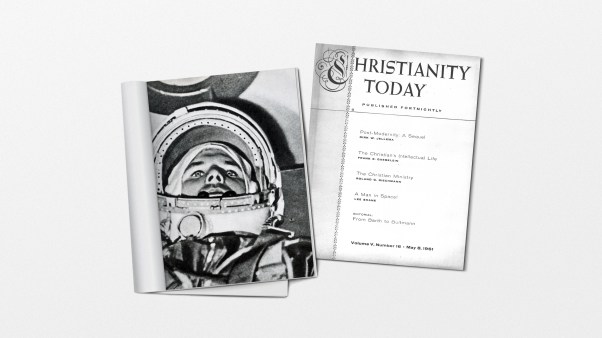
This article was originally published in the June 23, 1978 issue of Christianity Today.
This is the year my first child will leave home: Over the past 18 years I have often had cause to lament the fact that Jesus never had any children. The area where I have needed the most guidance and the clearest pattern of behavior has been a great grey mist through which move the bewildering and sometimes contradictory figures of Abraham and Isaac, Jacob and Joseph, David and Absalom. My own mother’s favorites were Hannah and Samuel, but then he left home at the relatively uncomplicated age of 3, not 18. From the very first, however, something had gone awry in human families. Cain was a prodigal who went off to a far country but never returned.
If the Old Testament is full of the all-too-human failings of families, the New Testament supplies the opposite problem. We see few families and scarcely any children. We know Peter had a mother-in-law, so he must have been married. Several of the disciples were close kin and at least two had a pushy mother. Philip had three daughters whose spinsterhood was presumably alleviated by their gifts of prophecy. Timothy’s mother and grandmother were obviously virtuous women, but where was his father?
It is only Mary who provides any kind of fully developed pattern of parenthood in the New Testament. We see her energy, her youthful exuberance, and defiant idealism evident in the Magnificat and the subsequent cross-country hike to her cousin Elizabeth’s. We watch her being transformed and tempered as she participates in the mystery of the Incarnation, is rebuked by her 12-year-old son in the temple, shows him off at the Cana wedding, and attempts unsuccessfully to deprogram him at the beginning of his itinerant ministry. Yet she is still there, grieving at the cross (when the disciples have fled) and rejoicing at Pentecost.
But what kind of model is Mary? True, the same conflicts that were hers have also been mine. First, there is the sense of floundering in depths over one’s head, of participating in a drama one cannot possibly comprehend nor foresee the outcome of. And second, there is the vertigo produced by the constant vacillation between asserting parental authority and allowing the child autonomy. The blessed mother herself must have sometimes regretted that her son did not see fit to marry and bring forth a brood of offspring like the other boys. Yet the very fact that I can so easily identify with Mary’s pain and failure merely proves the need for a more satisfactory manual of child rearing.
The lack of a proper example for parenthood is sorely felt by our entire culture. It seems we know how to do almost everything else in this country today except how to make lasting marriages and raise children. The advances in social justice and economic equity of the past two centuries have been in almost directly inverse proportion to the steadiness and reliability of familial relationships. Governments take human rights with a seriousness never before seen in history. But the family, the basic human experience, lives in an atmosphere of disaster.
Provided with the world’s most luxurious accommodations, our families live an interior life of poorer quality than refugees among rubble. Their existence has that impermanent, hand-to-mouth nature usually associated with poverty — only now it grows out of wealth. Convenience food, easy access to entertainment, disposable dishes and diapers, the quick call, the fast getaway. Yet half of all marriages end in divorce. We are at war with one another on the home front. And the heart is ripped open as surely as by shrapnel and left to heal as best it can. The only balm seems to be a friendly pat on the back from the secular media: “There, there. It happens to everyone these days. Buck up. It’s only a trend.”
Even so, the bombed-out marital landscape is not as personally unsettling to me as the paradox of parenthood. First of all, one at least enters marriage consciously and with consent. The terms, whether one intends to keep them or not, are clear.
But children are different. Birth control notwithstanding, one is not apt to be in a rational state at their conception. No one asks you, the prospective parent, or the unborn child, if either agrees to enter into this relationship. Children happen. In fact, their appearance — or failure to appear — often foils the best calculations of man and machine. One may speak of a contractual relationship between marriage partners, but that possibility simply does not exist with a parent and child. “I didn’t ask to be born!” The phrase reverberates with all the unanswerable ambiguities of the universe.
In our small rural community, a situation thought to be the last bastion of old-fashioned family values, we have about 250 souls. Among those there are at least nine families that during the past year have been seriously damaged either by violence or desertion. Several of these have been church families. The whole gamut of child-rearing exponents, from Parent Effectiveness Training to Bill Gothard’s Basic Youth Conflicts, seems a weak joke when prescribed as an antidote to this kind of problem. Given the choice, I’d rather muddle through with Mary.
Before the birth of my first child, I dreamed of her as my own production, my signature upon the world. But from the moment she was first laid in my unready arms, I have instead been startled and spellbound by the separateness of this creature. With her folded fists and squinting eyes, she was a stranger to me. Her infant cries, as I searched frantically for the source of her discomfort, were a horrifying sign of our frustrated communication. And now, as she prepares to leave for college, packing up the chaos of her personal belongings and at least half a dozen career choices, she is still a stranger to me. Even though I am convinced I know her better than any other human being does, nevertheless she is a singular, unpredictable entity.
A friend once told me she thought the curse on Eve in Genesis was not simply to bear children in pain. That is soon over. But that is only the beginning. The real sting is being allowed to participate in creation, but always having to see one’s handiwork turn out differently than one had intended. Perhaps I’ve been an unnatural mother, but I’ve never had even the faintest hope of predicting how, where, or with whom my daughter would turn out. She’s as much an enigma as the magnetic field of the Milky Way.
To further compound my feeling of unnatural motherhood, I have to admit that I am glad to see her go. I know the hole left by her extraction will be painfully felt by the rest of us. But quite plainly, I find myself an awkward parent, abashed at the ineptitude with which I play my part. I am uncomfortable and confused by telling other obviously unwilling people what to do. As a teacher I honestly relished my authority, which I felt was properly justified by my superior knowledge of my subject. I lopped off grade points with never a quiver of conscience. College students, after all, have a choice of whether or not to subject themselves to a teacher’s authority.
But children have no choice, are indeed incapable of making one, and thus parents have their authority thrust upon them. In their heart of hearts they know their frightful incapacity to govern even themselves, much less others. The only resources they have are a few years’ head start and a Pandora’s box of mistakes. But to abdicate that authority, ramshackle and gerrymandered though it be, is to invite appalling and certain chaos. To try to slither out of the responsibility is cowardice, no matter how we try to disguise our laxness or indulgence. It is a task we must stick to, even in the face of inevitable failure.
And failure is inevitable. Despite the manuals, the self-help guides, the democratizing or tyrannizing of the family, despite even our most sincere efforts at searching the Scriptures and the mind of God in prayer, we fail. Every day, children from Christian families with the best sort of spiritual and moral instruction and example run away from home, become alcoholics, get or are gotten pregnant, become addicted to drugs, wreck cars, cheat in school, break windows, commit suicide. Like cancer, it strikes indiscriminately. Being a Christian offers no immunity from family tragedy.
It is not simple cause and effect that is at work here nor only a sociological pathology. Although our society creates a climate for domestic disaster, we all know of instances where the most creditable parents inexplicably turn out deplorable children.
In fact, isn’t that at least one of the points of the parable of the Prodigal Son, the story Jesus offered his followers in lieu of his own example? The eternal parental question of “Where did I go wrong?” seems totally irrelevant to Jesus’ purpose. It is simply a fact of fallen life that something will go wrong, inevitably. And the story takes up at that point. For whatever reasons, the younger son, spoiled and ungrateful, thoughtless and inconsiderate, takes off for the first century equivalent of Las Vegas.
And the father lets him go. That’s all. No recriminations, no breast-beating, no guilty introspection.
Then the father waits. Again, we are dissatisfied with the sketchiness of the details. As parents, we don’t need to be told what Sonny is doing off there in the far country. But what about the father at home? Did he weep, did he worry, did he write urgent letters? Apparently not. Work seems to have gone on as usual.
And when the prodigal “comes to himself,” (months, years later?), he lets the penitent return and rejoices.
I think parents can take some sort of heart from the sociological evidence that many, though by no means all, children who have a consistently Christian upbringing return, by one road or another, to the faith of their fathers and mothers. Particularly when they begin to have children of their own.
Up to this point, the parable satisfies, even consoles us. Then comes the unexpected fly in the ointment, the older brother. It’s hard enough to raise a black sheep, God, if anyone, knows. But a wolf in sheep’s clothing is infinitely worse. We are all rather secretly fond of the prodigal. Yes, he is inconsiderate and excessive. But having sowed his wild oats and gotten hungry, he’s ready to come home again. Perhaps the father was wisely counting on that all along. But the older brother’s spite and stinginess are not in the slightest attractive. Something within us seems to know that squandering one’s inheritance on harlots is less damaging to one’s soul than the mean-spirited hoarding of the older brother.
As long as our children are out carousing, we can at least feel like self-righteous victims of their thoughtlessness. But the “good child” at home with his nose to the grindstone — see how quick he is to outdo even his father in rectitude, how impermeable to joy he is behind his pointing finger. The one whose problem is prodigality at least repents. The good child with his heart frozen in resentment seems unreachable. We never witness his reconciliation with the father or with the younger brother.
Psychologically and sociologically, the parable of the Prodigal is no doubt quite accurate. But as a how-to book for being a parent, it offers few foolproof techniques. What hope it holds out to parents is tempered with the promise of suffering.
I go to the hospital to visit a friend. He mentions that a neighbor is there also with her daughter who is a 30-year-old victim of multiple sclerosis. I stop by to see them and am shaken. The child is a skinny, twisted mass of uncoordinated muscle. Her mother is feeding her, using painfully developed techniques to stimulate her involuntary nervous system to swallow. The daughter’s communication consists of a high whine of desolation and an awkward pawing at her mother’s hand for comfort.
The mother, who lives 50 miles away, arrives at the hospital every morning at eight and doesn’t leave till nine at night. I ask, inanely, if she doesn’t get tired. You don’t let yourself, she answers.
Her eyes are like craters — deep and dark though not dead. Her mouth is no longer set in suffering but quick to catch the fleetest glint of thought or feeling reflecting off another’s face. We pray together, each holding one of the daughter’s hands.
I leave the hospital reeling. I have been in my scrupulous, self-assured way, praying for holiness. Now I have seen it and I have to be honest. I hesitate at holiness, terrified at the cost.
We often speak of the cost of our salvation to the Son. What of the cost to the Father, watching?
When Jesus enjoined his followers to “call no man your father upon earth; for one is your Father, which is in heaven,” he freed earthly parents from a burden they are not capable of bearing. It is only God to whom true parenthood belongs. The rest of us are imposters, shocked and dazed by the whole experience. The first children of God were turned into parents when they usurped the enormous task of managing their own lives (and the Father, just as in the parable, let them do it). Ever since, we have found ourselves standing in God’s place in relation to our children, charged with ordering their unruly universe for their own good, a good they stubbornly resist. Understandably we find the position alarming. Much rather would I think of my child as my sister in Christ than as my daughter.
On the other hand, it is only because of the pain we experience at the hands of our children that we can acquire the smallest understanding of the suffering of God. Because we have stood in a parent’s place with our children, we can appreciate the plight of our true Father. As we, the parents, become once more the children, and as such, are able to enter the kingdom, the awesomeness of that Father himself becoming the Child overwhelms us. Both the Incarnation and the Trinity open out before us in a terrifying vista. It is true, Chesterton’s claim that “we can never reach the end even of our own ideas about the child who was a father and the mother who was a child.”
For in Christ, even the image of the elder brother of the parable is undone. He becomes the elder brother who intercedes, who takes the punishment for the prodigal, who sets the example of loving obedience to the dread father, who shares his inheritance with us. In him, the world’s one child who did ask to be born, the parable becomes complete.
I look at my daughter, who is several inches taller than I am now. My years of sheltering her are over. I sometimes quake with gratitude that she has, beyond dreaming, turned out to be strong, intelligent, and beautiful, knowing that her being so is a matter of grace and not my doing. I am also grateful that her heart has grown large enough to shelter others, perhaps even her provoking parents, when that time comes. But most of all I look forward to that time beyond time when the both of us “will be set free from bondage to decay and obtain the glorious liberty of the children of God,” together, as sisters.
Copyright © 2008 Christianity Today. Click for reprint information.
Related Elsewhere:
Virginia Stem Owens blogs at The God Spy.
Other articles on parenting are in our family section.