


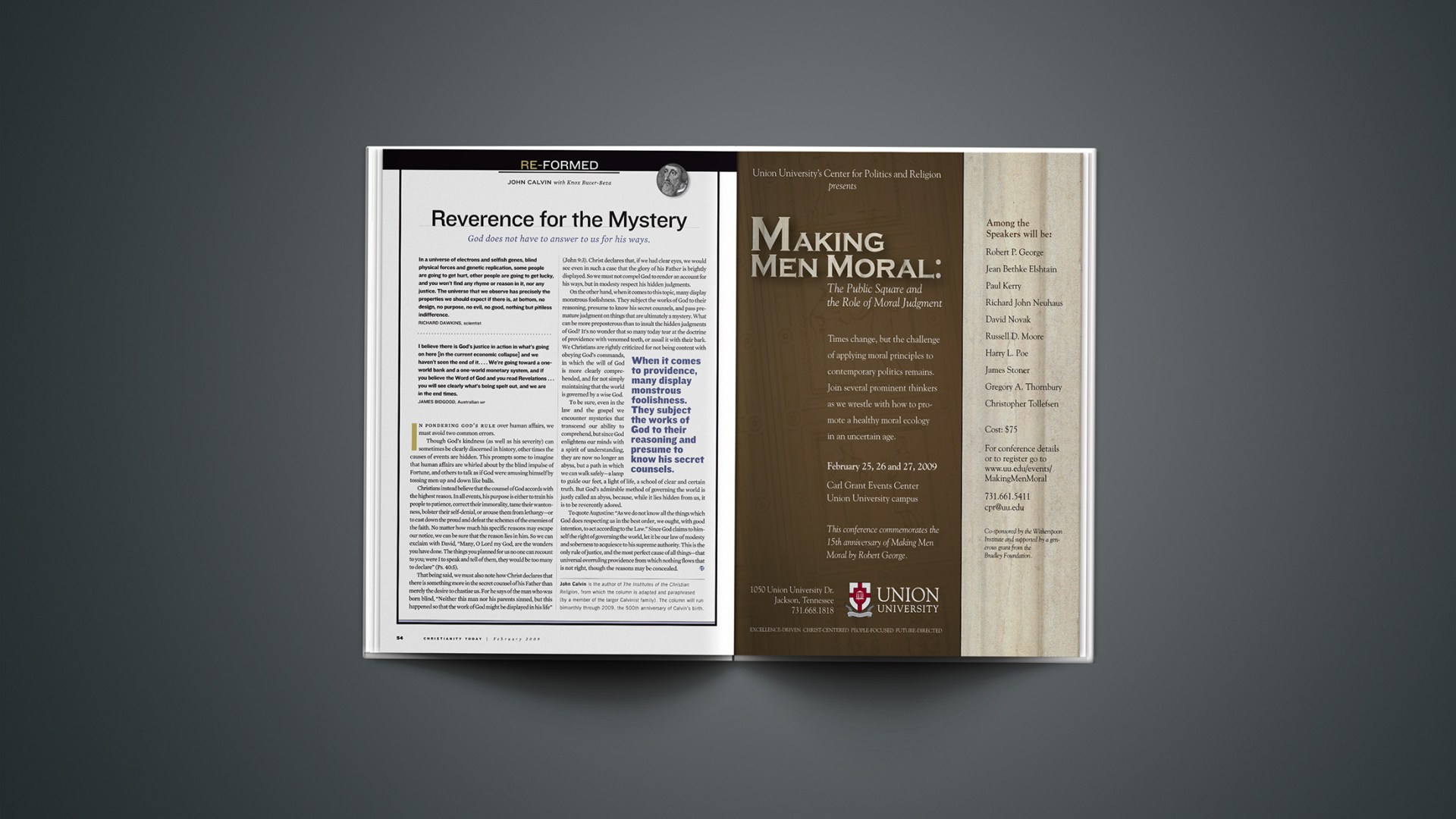

In a universe of electrons and selfish genes, blind physical forces and genetic replication, some people are going to get hurt, other people are going to get lucky, and you won’t find any rhyme or reason in it, nor any justice. The universe that we observe has precisely the properties we should expect if there is, at bottom, no design, no purpose, no evil, no good, nothing but pitiless indifference.
Richard Dawkins, scientist
I believe there is God’s justice in action in what’s going on here [in the current economic collapse] and we haven’t seen the end of it. … We’re going toward a one-world bank and a one-world monetary system, and if you believe the Word of God and you read Revelations … you will see clearly what’s being spelt out, and we are in the end times.
James Bidgood, Australian MP
In pondering God’s rule over human affairs, we must avoid two common errors.
Though God’s kindness (as well as his severity) can sometimes be clearly discerned in history, other times the causes of events are hidden. This prompts some to imagine that human affairs are whirled about by the blind impulse of Fortune, and others to talk as if God were amusing himself by tossing men up and down like balls.
Christians instead believe that the counsel of God accords with the highest reason. In all events, his purpose is either to train his people to patience, correct their immorality, tame their wantonness, bolster their self-denial, or arouse them from lethargy—or to cast down the proud and defeat the schemes of the enemies of the faith. No matter how much his specific reasons may escape our notice, we can be sure that the reason lies in him. So we can exclaim with David, “Many, O Lord my God, are the wonders you have done. The things you planned for us no one can recount to you; were I to speak and tell of them, they would be too many to declare” (Ps. 40:5).
That being said, we must also note how Christ declares that there is something more in the secret counsel of his Father than merely the desire to chastise us. For he says of the man who was born blind, “Neither this man nor his parents sinned, but this happened so that the work of God might be displayed in his life” (John 9:3). Christ declares that, if we had clear eyes, we would see even in such a case that the glory of his Father is brightly displayed. So we must not compel God to render an account for his ways, but in modesty respect his hidden judgments.
On the other hand, when it comes to this topic, many display monstrous foolishness. They subject the works of God to their reasoning, presume to know his secret counsels, and pass premature judgment on things that are ultimately a mystery. What can be more preposterous than to insult the hidden judgments of God? It’s no wonder that so many today tear at the doctrine of providence with venomed teeth, or assail it with their bark. We Christians are rightly criticized for not being content with obeying God’s commands, in which the will of God is more clearly comprehended, and for not simply maintaining that the world is governed by a wise God.
To be sure, even in the law and the gospel we encounter mysteries that transcend our ability to comprehend, but since God enlightens our minds with a spirit of understanding, they are now no longer an abyss, but a path in which we can walk safely—a lamp to guide our feet, a light of life, a school of clear and certain truth. But God’s admirable method of governing the world is justly called an abyss, because, while it lies hidden from us, it is to be reverently adored.
To quote Augustine: “As we do not know all the things which God does respecting us in the best order, we ought, with good intention, to act according to the Law.” Since God claims to himself the right of governing the world, let it be our law of modesty and soberness to acquiesce to his supreme authority. This is the only rule of justice, and the most perfect cause of all things—that universal overruling providence from which nothing flows that is not right, though the reasons may be concealed.
John Calvin is the author of The Institutes of the Christian Religion, from which the column is adapted and paraphrased (by a member of the larger Calvinist family). The column will run bimonthly through 2009, the 500th anniversary of Calvin’s birth.
Copyright © 2009 Christianity Today. Click for reprint information.
Related Elsewhere:
The Institutes of the Christian Religion is available at ChristianBook.com and other book retailers.
Previous articles on John Calvin include:
Books: Why Calvin Was a Calvinist | Rediscovering the Geneva Reformer in his long-lost catechism. (June 15, 1998)
Christian History: John Calvin | Father of the Reformed faith (August 8, 2008)
Books & Culture: Calvinism and Liberty | Reformed influences on America’s founding principles. (February 6, 2009)