There are three kinds of people: those who believe in God, those who don't, and those who believe in belief. Robert Wright is a member of the third group. He calls himself an unbeliever who holds that "gods arose as illusions" invented by mankind. At the same time, he thinks it is an excellent thing for others to believe in God. Since he advocates belief largely for secular and social purposes, Wright insists that religions evolve in the direction that he considers most conducive to social harmony and global peace.
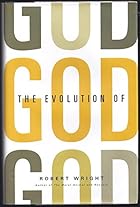
It may seem odd that someone would take the trouble to write a 576-page book making this argument. Even so, I approached Robert Wright's new one, The Evolution of God (Little, Brown and Company), with anticipation. Years ago I enjoyed Wright's The Moral Animal (1994), which competently summarized then-recent research of evolutionary biologists on the origins of altruism. Wright presented his findings in a supple, breezy style that made the book a pleasure to read.
The Evolution of God is also engaging, and when you consider the topic you might wonder if the book is yet enough to do it justice. According to the publisher's summary, Wright seeks to provide nothing less than a "sweeping narrative that takes us from the Stone Age to the Information Age," a span of about 7,000 years. Besides, Wright's book covers the entire world, drawing on multiple fields including anthropology, history, biology, philosophy, and theology. Even great polymaths from Voltaire to Thomas Jefferson never attempted anything so ambitious, and Wright deserves credit for trying.
His thesis is simply stated upfront: While the gods arose as illusions, "the story of this evolution itself points to the existence of something you can meaningfully call divinity," Wright argues. Moreover, religion has "matured" so that it is now closer to modern ideas of tolerance and scientific truth. In Wright's words, "the illusion has gotten less and less illusory."
This may seem a strange way to justify religion, and it is. Oddly enough, Wright considers himself a friend of religion. His massive narrative is intended to show that religion has slowly gotten its act together and its story right, and he is hopeful that religion will continue to evolve away from its harsh, primitive roots, toward less exclusivity and more tolerance, so it can be reconciled with modern secular liberalism. Wright sees himself as making a kind of defense of God, although "not exactly the kind of God that most religious believers currently have in mind."
Wright begins by claiming that polytheism persisted much longer than the Old Testament lets on, and that even Jews persisted in worshiping many gods despite their monotheistic God's jealous demands for exclusive allegiance. So far, he isn't saying anything controversial.
Wright proceeds to make claims about Jesus and Muhammad that are equally banal. He insists that Jesus didn't say some of the things that are attributed to him, something Christians have been hearing for a century and a half, and something that rests on questionable assumptions. The logic behind such an approach is that scribes in subsequent centuries may have made up the good stuff attributed to Christ, but they surely wouldn't have made up things in the Bible that make Christ look bad. But no one applies these principles to Socrates or any other historical figure. Imagine if you deleted all of Socrates' good arguments, imagining these to have been exaggerations concocted by his enthusiastic disciples Plato or Xenophon, and only credited Socrates with his bad arguments. We would have an entirely different picture of Socrates today. While there is indeed controversy about how accurately the disciples of Socrates pictured him, no philosophy student would stand for such a tendentious, one-sided mode of historical interpretation. By the same token, there is no reason for Christians to gullibly ingest whatever is served them on the plate of modern biblical scholarship.
Wright proceeds with several chapters on Muhammad and Islam, and here, too, is his narrative distinguished by its lack of distinction. There are so many interesting things to say about Islam, but Wright seems content to argue that Muhammad's political pragmatism shows that he was not a religious zealot. Wright's conclusion may be correct, but his argument confuses means and ends. Showing Muhammad's pragmatism in operational practice, as Wright does, tells you nothing about how strongly or fanatically Muhammad held his beliefs. In other words, it is quite possible for a religious or political leader to be a zealot in ideology while being ruthlessly pragmatic in promoting that ideology.
Admittedly, Wright's section on Islam is well intentioned. He seeks to demonstrate that there is no straight line that connects Muhammad to bin Laden, and that Islamic radicals have seized upon a few verses in the Qur'an in order to justify their bloodthirsty rampages. I agree with Wright on this. But Wright promptly moves to more dubious ground. Regretting the "problem" passages that seem to justify violence in the Qur'an and also in the Bible, Wright speculates that "if we could magically replace the Qur'an with a book of our choosing, or could magically replace the Bible with a book of our choosing, we could probably make Muslims, Jews, and Christians better people." But would people actually be improved if they stopped reading these holy books and took up, say, Darwin's On the Origin of Species or Wright's own works? I would love to hear Wright answer this question.
Article continues below
Wright insists that the major religions of the world have evolved—but not enough.
If Wright's book has a single redeeming virtue, it is that he shows throughout that the findings of modern science support and corroborate the main claims of religion. For example, Wright recognizes that the grim Darwinian picture of man's evolution fits pretty well with the Christian idea of fallen humanity, even if problems remain in reconciling evolutionary biology with the Genesis account of human origins. Wright also notes that evolutionary accounts of morality affirm traditional religious precepts such as "do unto others as you would have them do unto you." But you could have found these things out by reading The Moral Animal.
The Evolution of God ends abruptly with a suggestion for religious reform. Wright insists that the major religions of the world have evolved—but not enough. They have failed to "align individual salvation with social salvation." No less than the "salvation of the planet," according to Wright, depends on this. And further, "Any religion whose prerequisites for individual salvation don't conduce to the salvation of the world is a religion whose time has passed."
To show this, Wright needs to make the case that the conflicts jeopardizing the planet today are caused primarily by religious differences. This he just assumes. Moreover, Wright must demonstrate some plausible route by which religions can modify their precepts from what believers hold to be true into what Wright holds to be useful. No such route is offered. Finally, Wright's argument requires some proof that religions that refuse to evolve in his recommended direction are doomed to decay. He offers no evidence whatsoever for this. It is Wright's failure to provide good answers to important questions that makes The Evolution of God, in the end, a disappointing book.



















 While we pray for peace, we need moral clarity about this war.
 We’ve got little information on Jesus’ appearance and personality. But that’s the way God designed it.españolFrançais
 The plan would organize UMC churches in four global regions, with each given more leeway around same-sex marriage and other theological issues.






