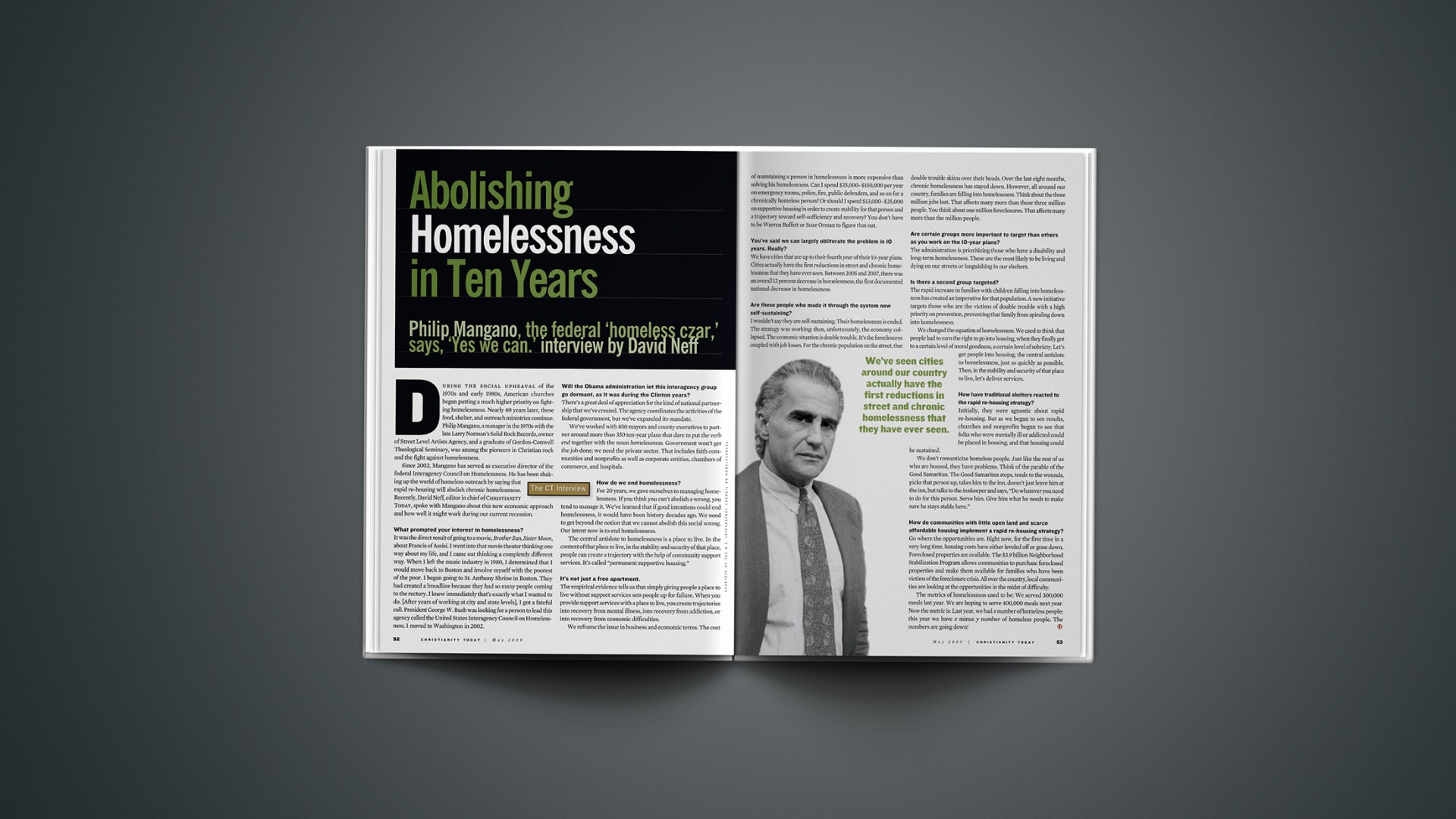

During the social upheaval of the 1970s and early 1980s, American churches began putting a much higher priority on fighting homelessness. Nearly 40 years later, these food, shelter, and outreach ministries continue. Philip Mangano, a manager in the 1970s with the late Larry Norman’s Solid Rock Records, owner of Street Level Artists Agency, and a graduate of Gordon-Conwell Theological Seminary, was among the pioneers in Christian rock and the fight against homelessness.
Since 2002, Mangano has served as executive director of the federal Interagency Council on Homelessness. He has been shaking up the world of homeless outreach by saying that rapid re-housing will abolish chronic homelessness. Recently, David Neff, editor in chief of Christianity Today, spoke with Mangano about this new economic approach and how well it might work during our current recession.
What prompted your interest in homelessness?
It was the direct result of going to a movie, Brother Sun, Sister Moon, about Francis of Assisi. I went into that movie theater thinking one way about my life, and I came out thinking a completely different way. When I left the music industry in 1980, I determined that I would move back to Boston and involve myself with the poorest of the poor. I began going to St. Anthony Shrine in Boston. They had created a breadline because they had so many people coming to the rectory. I knew immediately that’s exactly what I wanted to do. [After years of working at city and state levels], I got a fateful call. President George W. Bush was looking for a person to lead this agency called the United States Interagency Council on Homelessness. I moved to Washington in 2002.
Will the Obama administration let this interagency group go dormant, as it was during the Clinton years?
There’s a great deal of appreciation for the kind of national partnership that we’ve created. The agency coordinates the activities of the federal government, but we’ve expanded its mandate.
We’ve worked with 850 mayors and county executives to partner around more than 350 ten-year plans that dare to put the verb end together with the noun homelessness. Government won’t get the job done; we need the private sector. That includes faith communities and nonprofits as well as corporate entities, chambers of commerce, and hospitals.
How do we end homelessness?
For 20 years, we gave ourselves to managing homelessness. If you think you can’t abolish a wrong, you tend to manage it. We’ve learned that if good intentions could end homelessness, it would have been history decades ago. We need to get beyond the notion that we cannot abolish this social wrong. Our intent now is to end homelessness.
The central antidote to homelessness is a place to live. In the context of that place to live, in the stability and security of that place, people can create a trajectory with the help of community support services. It’s called “permanent supportive housing.”
It’s not just a free apartment.
The empirical evidence tells us that simply giving people a place to live without support services sets people up for failure. When you provide support services with a place to live, you create trajectories into recovery from mental illness, into recovery from addiction, or into recovery from economic difficulties.
We reframe the issue in business and economic terms. The cost of maintaining a person in homelessness is more expensive than solving his homelessness. Can I spend $35,000–$150,000 per year on emergency rooms, police, fire, public defenders, and so on for a chronically homeless person? Or should I spend $13,000–$25,000 on supportive housing in order to create stability for that person and a trajectory toward self-sufficiency and recovery? You don’t have to be Warren Buffett or Suze Orman to figure that out.
You’ve said we can largely obliterate the problem in 10 years. Really?
We have cities that are up to their fourth year of their 10-year plans. Cities actually have the first reductions in street and chronic homelessness that they have ever seen. Between 2005 and 2007, there was an overall 12 percent decrease in homelessness, the first documented national decrease in homelessness.
Are these people who made it through the system now self-sustaining?
I wouldn’t say they are self-sustaining. Their homelessness is ended. The strategy was working; then, unfortunately, the economy collapsed. The economic situation is double trouble. It’s the foreclosures coupled with job losses. For the chronic population on the street, that double trouble skims over their heads. Over the last eight months, chronic homelessness has stayed down. However, all around our country, families are falling into homelessness. Think about the three million jobs lost. That affects many more than those three million people. You think about one million foreclosures. That affects many more than the million people.
Are certain groups more important to target than others as you work on the 10-year plans?
The administration is prioritizing those who have a disability and long-term homelessness. These are the most likely to be living and dying on our streets or languishing in our shelters.
Is there a second group targeted?
The rapid increase in families with children falling into homelessness has created an imperative for that population. A new initiative targets those who are the victims of double trouble with a high priority on prevention, preventing that family from spiraling down into homelessness.
We changed the equation of homelessness. We used to think that people had to earn the right to go into housing, when they finally got to a certain level of moral goodness, a certain level of sobriety. Let’s get people into housing, the central antidote to homelessness, just as quickly as possible. Then, in the stability and security of that place to live, let’s deliver services.
How have traditional shelters reacted to the rapid re-housing strategy?
Initially, they were agnostic about rapid re-housing. But as we began to see results, churches and nonprofits began to see that folks who were mentally ill or addicted could be placed in housing, and that housing could be sustained.
We don’t romanticize homeless people. Just like the rest of us who are housed, they have problems. Think of the parable of the Good Samaritan. The Good Samaritan stops, tends to the wounds, picks that person up, takes him to the inn, doesn’t just leave him at the inn, but talks to the innkeeper and says, “Do whatever you need to do for this person. Serve him. Give him what he needs to make sure he stays stable here.”
How do communities with little open land and scarce affordable housing implement a rapid re-housing strategy?
Go where the opportunities are. Right now, for the first time in a very long time, housing costs have either leveled off or gone down. Foreclosed properties are available. The $3.9 billion Neighborhood Stabilization Program allows communities to purchase foreclosed properties and make them available for families who have been victims of the foreclosure crisis. All over the country, local communities are looking at the opportunities in the midst of difficulty.
The metrics of homelessness used to be: We served 300,000 meals last year. We are hoping to serve 400,000 meals next year. Now the metric is: Last year, we had x number of homeless people; this year we have x minus y number of homeless people. The numbers are going down!
Copyright © 2009 Christianity Today. Click for reprint information.
Related Elsewhere:
The Interagency Council on Homelessness has more background on Mangano on its website.
Malcolm Gladwell profiled Mangano for The New Yorker.
Previous Christianity Today stories on homelessness include:
Bridge to a Place Called Home | How one ministry partners with churches to put the homeless back on their feet. (February 1, 2006)
The Word on the Street | What the homeless taught me about prayer. By Philip Yancey (January 1, 2006)
A Bridge Over Troubled People | Sinners of all stripes find a church home under the I-35. (April 1, 2004)