



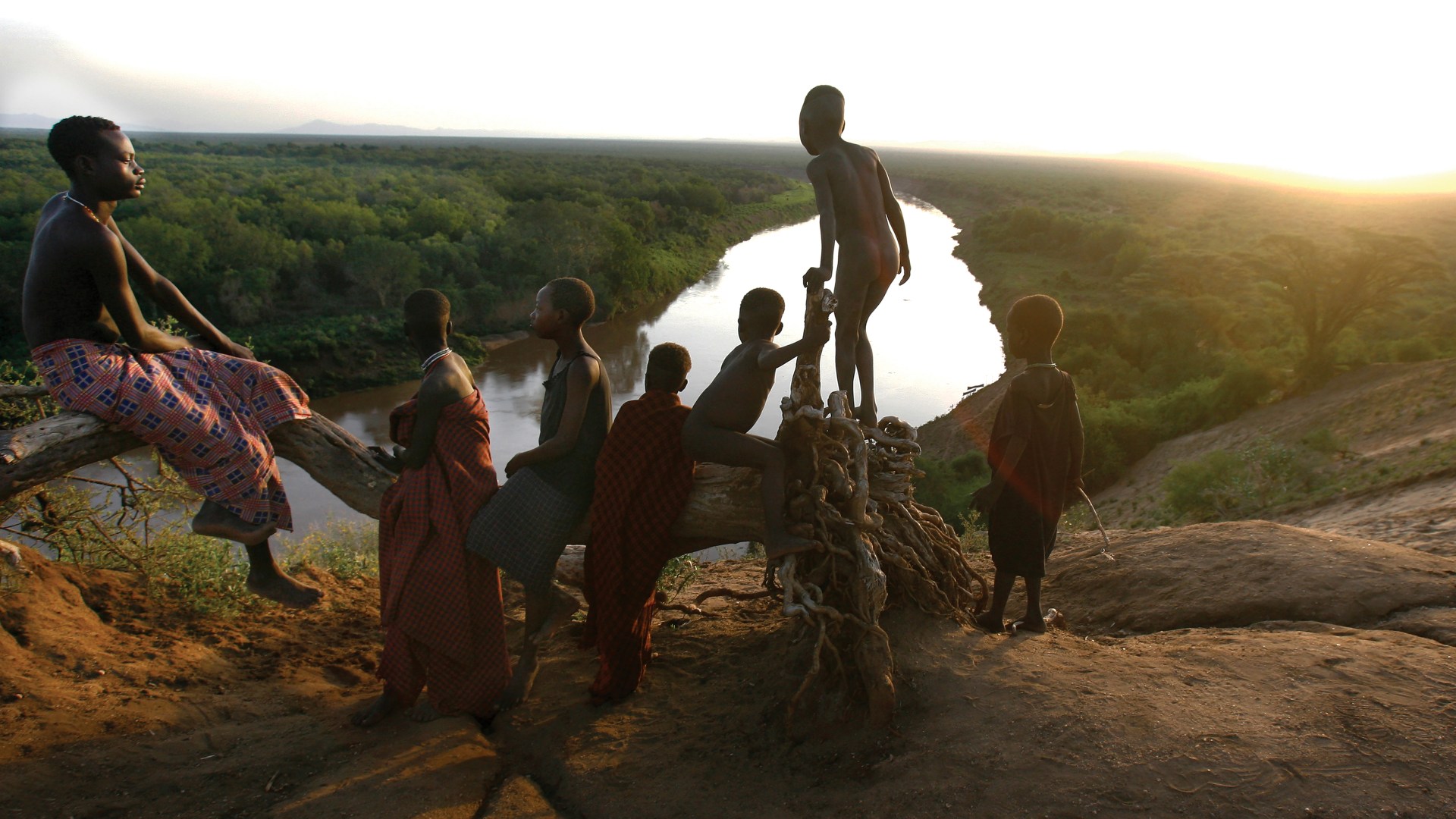

The healthy infant boy's top teeth came in before his bottom teeth. For this, elders of the Kara tribe in Ethiopia's primitive Omo River region determined that the child must die.
The child was mingi—"cursed" according to superstition. With every breath, the elders believed, the boy was beckoning an evil spirit into their village. It was the sacrifice of one child for the good of the entire tribe, a rite that elders had witnessed for untold generations.
Less clear was what to do about the boy's dead twin. After some debate and an examination of goat intestines, the elders decided the dead twin must have been mingi too. They dug up the corpse, bound it to the living boy, paddled a canoe into the center of the swiftly moving Omo River, and threw them both into the cold, brown waters.
That was five years ago. Several years ago, regional officials had begun taking action—threatening prison for those complicit in mingi killings. But at best, officials are equipped to step in only after a child has been murdered. So, in the villages of southern Ethiopia, a region the size of Texas with few roads or infrastructure, a few concerned tribespeople started an orphanage for cursed children. Yet the orphanage is mired in controversy, and meanwhile, few have challenged the underlying fear of mingi.
But one small band of Christians in one tribe, along with other supportive Christians, has pledged to protect these cursed children until mingi is no more. They are determined to show tribal elders that there is something "stronger than mingi"—the power of Jesus Christ. Earlier this year, I traveled to the hard-to-reach Ethiopian river valley to hear their story.
Modern-Day Child Sacrifice
Bona Shapo, a tribal elder, took me to where mingi children are being sacrificed. He steered his dugout canoe through the crocodile-infested waters of the Omo River, guiding the craft beneath a crumbling precipice near the stick-and-thatch village of Korcho. Across the river, Colobus monkeys whooped and howled, stirring Marabou storks from their perches on a stand of acacia.
"This is where they do it," says Bona, who had stood on these muddy banks the day the boys were thrown into the river.
There has been little modern research on mingi. Elders single out for death children who are born out of wedlock, have damaged genitals, or whose top baby teeth emerge before the bottom ones. Kara elders believe keeping this traditional practice is crucial to tribal survival. Allowing a mingi child to live among their people, they fear, will cause the rains to cease and the sun to grow hotter.
"If they have mingi, there will be no water, no food, no cattle," Bona says. "But when they throw the baby away, everything is good again. So yes, it is sad, but we are thinking about the village, the family, all the people."
Tribal parents tolerate the killing. After Erma Ayeli gave birth, elders took her newborn. She was not permitted to nurse him, hold him, or see him. "I think he must have been a beautiful boy," she says. "I wanted to keep him."
Her chin sinks into the colorful beads draped around her neck. Erma still grieves over her son's death—but she does not question it. "There was no other option," she says.
Sex outside of marriage is acceptable among the Kara. But if a woman becomes pregnant before participating in a marriage ceremony, as Erma did, her child is considered kumbaso—a mingi curse that occurs when parents fail to perform the appropriate rites before conceiving.
As Erma speaks, her hands fall to her swollen stomach; she is pregnant again.
"It was an accident," she cries. "I don't want to lose this baby, too."
This time, at least, she has reason to hope that her child might be spared. Far from her village is an orphanage for mingi children. Erma has pleaded with village leaders to let her child go there. Either way, she will not be allowed to see the baby. "This time, I think, I might have a girl," Erma says.
Failed Deterrent
The criminal case of another young mother, Mashi Limo, shows how difficult it is to stop mingi practices. The beads, animal skins, and jewelry that Mashi once wore have been replaced by a tattered shirt and loose-fitting skirt. She is indistinguishable from the other inmates at the prison in Jinka, the regional capital.
Yet everyone in the ragtag penitentiary knows who she is. "The mingi mother," says one guard. "Yes, we all know what happened to her. It is very sad."
Back in her Kara village, it is well known that Mashi did not kill her cursed infant; she was far too weak after the birth to do so. Other women took the baby away.
But when the police arrived, Mashi took the blame. Within days, she had been sentenced to three years in prison. She had no attorney; there was no trial.
Mashi is conversant only in her native language. She has never been to school. When she is finally released, there will be one place to go—back to the village. And so, under the watchful eyes of several other Kara prisoners, Mashi stands by her story.
"What they say is false," she says of those in her tribe who have proclaimed her innocence. "I did it all myself."
Asked if she deserves to be in prison, the teenager sinks her face into her hands. "I hate it here," she says. "I wanted to keep my baby. That was not allowed. This is our culture."
The government succeeded in putting someone behind bars for a mingi murder, but there has been little deterrent effect. Solomon Ayko, a lanky young Kara man who has witnessed several mingi killings, told me, referring to tribal elders, "Before they did it in the open. Now it just happens in secret."
It is extremely uncommon for police officers to make the arduous trip from Jinka to any of the far-flung Kara villages. Officers who make the trip discover that villagers strongly support mingi killings.
Korcho village elder Ari Lale described to me how some mingi killings, in addition to drowning, are carried out. Some 15 years ago, a cursed baby had been born. The elders asked Ari to take part in the child's execution. "The baby was crying," Ari says, "so we put sand in its mouth, and he was still trying to cry but couldn't anymore." Soon the child was dead.
Ari counts his participation in the boy's death as one of his proudest memories. "All the families would thank me for throwing away that baby," he says. He and others have found different ways to carry out the killings to avoid detection. He says, "After the baby is born, we keep it alone in the house, and we do not give it water or milk."
Without nourishment, the infants die quickly. There is little that can be done to prove that a baby wasn't simply stillborn. Ari appears to be pleased with this solution. Yet he balances his pride with lament. "They are human," he says. For all the praise he got for carrying out the first killing, Ari says, he would have preferred to let the child live—if only there had been another way.
Controversial Solution
For a younger Kara man, Shoma Dore, mingi killings were simply part of his generational heritage. "I didn't realize there was anything wrong with it."
Not, that is, until Shoma left the tribe to attend school. When he returned from Jinka two years later, he realized how wrong it was. Shoma found others among the Kara's educated youth who had come to the same conclusion.
"There are many important and good parts of our culture," says Aryo Dora, one of about 30 young Kara who joined Shoma to ask elders to stop the mingi killings a few years ago. "There is also a sickness in our culture, and we have to change ourselves."
Their plan, developed with the help of a team of Westerners, was simple: If mingi children could be sent far away from the village, they would pose no risk to the tribe. That is how the orphanage began. Today, more than 30 mingi children live together in a small, single-story home in a quiet Jinka neighborhood.
Still, the process of placing a mingi newborn with the orphanage is gut-wrenching for the mother.
On a bright May morning in Korcho village, dozens of women are on their knees, grinding sorghum into flour, but Zelle Tarbe is working inside. It has been six days since she gave birth to her baby boy. The shock of having him taken away is still evident in her face. Nonetheless, she says, she feels fortunate, "because my son is alive."
Zelle was able to spend a few short moments with her baby before orphanage officials spirited him away. "He was so sweet and beautiful," she says. "But I did not give him a name, because he was mingi and could not stay with me."
No one, least of all Zelle, would argue that the rescue mission isn't preferable to death for mingi children. But the orphanage has nonetheless been a controversial solution.
'The rains stopped for a short time. The people rose up and said, "You must get rid of her. Throw her into the bush." But I said, "Do not throw your child into the bush."'— Kaiso Dobiar
A group of American Christians had supported the orphanage for two years, but this spring they decided to withdraw their backing, believing the orphanage's director was using orphanage funds for personal benefit.
Then, orphanage leaders accused the Americans—who had helped arrange the adoption of four mingi babies—of stealing the children from their families. The adoptions were, in fact, legal under Ethiopian law, which treats mingi children as abandoned. But orphanage leaders have argued that the birthparents surrendered their babies under cultural duress and have the right to reclaim the children.
Regardless, adoptions and orphanages don't address the fears that instigate mingi killings. Even with support from Westerners, the rescue and shelter system is able to save only a fraction of at-risk children.
Tribal leaders in Korcho say about 20 mingi children have been born into their small village since the orphanage opened. Orphanage workers say they arrived in time to save only about half of those children.
Last year, mission leaders learned that a woman had given birth to a mingi boy, whom tribal elders had promptly attempted to kill by ripping out his umbilical cord. The wounds quickly went septic. Evacuation by air was the only solution. Chartering the aircraft cost $3,500.
"That was the sum of all the money we had," said Levi Benkert, an American and one of the mission's former leaders. "We couldn't be certain that, even if we did it, he was going to live."
They did it anyway—and saved the boy. An online fundraising effort quickly recouped the costs, but rescue mission officials knew they couldn't sustain those sorts of expenses.
"We did our best," Benkert says. "We saved as many children as we could. And we continue to pray for them every day."
Change from Within
In light of orphanage scandal and government inaction, several tribal Christian families have turned to foster care.
Foster care keeps mingi children closer to their birth families, which can show elders that mingi poses no threat to a village's prosperity. German missionary Andreas Kosubek, who has ministered to the Kara for six years, believes Kara parents genuinely love their children. "These people are really good people," says Kosubek. "They are not doing this because they are evil, wild, dumb monsters. They fear for the lives of others in the tribe."
From Kosubek's point of view, the only thing that will overcome the fear is helping the Kara believe in something "stronger than mingi." Ultimately, the 29-year-old evangelist would like to see the Kara come to Christ—though few villagers have taken up his offer to accept Christ, and many openly mock his pitch.
Kosubek is undeterred. He figures the next best thing to leading the Kara to Jesus is serving them like Jesus. Since 2005, he has organized medical mission trips into the tribe's villages. "Our main goal was to help these people really get to know Jesus, but we cannot do that unless we approach them with humility and a dedication to service," he says.
Kosubek recognizes the need to end mingi killings but doesn't feel called to condemn tribal elders. "Before we judge, we have to ask ourselves what we have done to help these children." If the mingi killings are to end, he believes, the change will have to come from within the tribes.
That's what happened with the Banna, another Omo River tribe.
'These babies are like influenza. If it is not stopped, it can kill many people. That is what they believe. When things go badly, the people believe this more than ever.'— Andualem Turga
In a mud hut in the village of Alduba, Kaiso Dobiar dips a ladle into a tar-black pot of coffee and stirs the simmering brew. She is proud to be Banna, and she follows many of her tribe's customs and beliefs. But Kaiso is also a Christian, a member of the Kale Heywet evangelical denomination, which has 7,700 churches nationally. Wary of idolatry, she and her husband refused to perform the rites mandated by tribal leaders before they conceived.
"My children are mingi, in that way of thinking," says Kaiso, who is fostering two additional mingi children in her home.
A petite toddler crawls onto Kaiso's lap, reaching over to help stir the pot. "This is Tarika," Kaiso says. "She is 2, and she is mingi."
Tarika was born without the appropriate Banna ceremonies, but her birthmother refused to give up her daughter for six months. "Then the rains stopped for a short time," Kaiso says. "The people rose up and said, 'You must get rid of her. Throw her into the bush.' But I said, 'Do not throw your child into the bush. Give her to me.' "
Sharing this hut with Kaiso's family is Tegist, another mingi child. Kaiso says her foster daughters cannot play with other Banna children and must remain in her family's compound.
"They will have to stay here until they are older," Kaiso says. "After that? God, he knows."
Missionaries first came to the Banna decades ago. Today, Christians compose just 1 to 2 percent of the tribe's population, but their collective devotion has been enough to eliminate almost all mingi killings within the tribe. With little money or other means of support, the Banna Christians have accepted responsibility for scores of mingi children.
Many, like Kaiso, are already caring for one or more mingi boys and girls. One family has taken in 17 foster children.
They do so at great risk to their own families. "What are you doing protecting those children?" an angry neighbor screams from beyond a stick fence as Kaiso steps out of her home. "Tell us why!"
Long Journey Ahead
The Banna have not faced drought or a significant bout of disease for years. That, local Christians say, has prevented their neighbors from lashing out. But if the tribe's fortunes were to change, its leaders would be swift to identify a culprit, says Banna tribesman Andualem Turga.
"To these people, these babies are like influenza," Andualem says. "If it is not stopped, it can kill many people. That is what they believe. When things go badly, the people believe this more than ever."
Uri Betu tries not to think about such things. She is unwavering in her obligation to the two mingi children who live in her home—and any others who need her care.
"We do not worry," Uri says as she watches her pair of 2-year-old foster daughters, Tariqua and Waiso, play in the yard. "This is what God has called us to do."
Over time, Uri prays, the Banna will see that the presence of mingi children in their midst is unrelated to weather patterns. Perhaps, she says, that recognition will help bring them to Christ. And, God willing, other tribes that practice mingi child sacrifice will follow.
Still, Uri knows, "There is a long way to go to change the beliefs we have had for so long."
Matthew D. LaPlante is an assistant professor of journalism at Utah State University. Rick Egan is a staff photographer at The Salt Lake Tribune.
Copyright © 2011 Christianity Today. Click for reprint information.
Related Elsewhere:
Christianity Today has additional coverage of Ethiopia and Africa on our website.
Other CT articles on human sacrifice and ritual killing include:
Human Sacrifice Redux | How the church battles deadly prophets in its midst. (December 1, 2004)
Debate continues on Incorporating Animal Sacrifices in Worship | Some Christians warn that African rituals to honor ancestors could subvert the Gospel message. (October 1, 2000)
Let Africans Honor Ancestors with Blood Libations in Mass, Says Bishop | 'Is there a way to integrate this custom with their Christian belief as a step toward meaningful inculturation?' (April 1, 2000)
Ending Human Sacrifice | How Patrick may have convinced the Celts to turn from ritual killings to the one who died for all. (October 1, 1998)