There may be hope for France yet. At the 2010 Cannes Film Festival, held in the southern region of a country whose official religion is none at all, a film about Christian hope was given the Grand Prix, the festival’s second highest honor. (It went on to snag several more prestigious French film awards.) That audiences knew beforehand that the film ends in the murder of eight Catholic monks makes its warm reception all the more striking. Add the fact that the film fixates on praying to Christ and chanting the Psalms, and you’ve got yourself a mystery in the homeland of Marquis de Sade.
Of Gods and Men (in French, with English subtitles), now in limited release in the U.S., explores the spiritual anatomy of a community of Christians whose love is tested by imminent violence. Taking its name from Psalm 82 (“I said, ‘You are “gods”; you are all sons of the Most High,’ but you will die like mere mortals”), the film recounts the 1996 Tibhirine massacre, in which seven French Cistercian monks, living in a monastery in Algeria, find themselves caught in conflict between Algeria’s government and the Armed Islamic Group. The monks were later kidnapped and beheaded; their bodies were never found. Fifteen years later, amid ongoing investigations, the precise circumstances of their deaths are unknown. While director Xavier Beauvois clearly pays homage to the monks, he isn’t interested in solving that mystery as much as asking why the men didn’t try to save their lives in the first place.
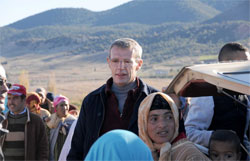
The answer, the film suggests, lies in the men’s devotion to God, expressed in daily worship, prayer, and caring for the Muslim villagers with whom they share a quiet countryside. The film’s structure follows that of monastic life, moving from extended scenes of the eight men chanting and taking Communion, to meeting with village leaders and selling honey in the market. Music of praise and sorrow permeates the film (as it should—Cistercian monks sing for four hours each day), and unifies the monks when they are at odds with each other. Singing apparently had the same effect on the actors: Lambert Wilson, who plays monastery leader Brother Christian, said recently that through learning to chant Psalms, the actors “became brothers.” “To chant Psalms is to breathe together, to share the Breath of Life,” said Olivier Rabourdin, who plays Brother Christophe.
The men’s psalms grow dire when a group of foreign workers in the village is murdered by terrorists, inciting fear in the region and division in the monastery. But Brother Christian refuses the protection of the army, deciding the brothers will stay to show solidarity: “We were called to live here, in this country, with this people, who are also afraid.” “I didn’t come here to commit collective suicide,” counters Brother Christophe. “I became a monk to live, not to sit back and have my throat slit,” scoffs another. Discord grows when gunmen storm the monastery on Christmas Eve, demanding medical supplies. Brother Christian handles them deftly, quoting from the Qur’an to show goodwill, even slipping in an evangelistic message: “Tonight is different from other nights …. We celebrate the birth of the Prince of peace: Sidna Aissa.” Yet all the monks fear another, bloodier, encounter, and each wrestles with whether following Christ means waiting passively to die.
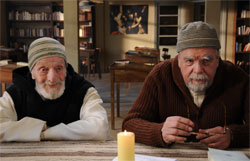 ????????????????????????????????????
Though we mostly avoid labeling films “Christian,” Of Gods and Men comes close to being one. Besides all the worshiping and direct quotes from Scripture, the film casts the monks’ faith and their decision in a dignified, even heroic light. In one scene, two of the monks confess to the village leaders, “We are like birds on a branch. We don’t know if we’ll leave.” One Muslim woman answers, “You are the branch. If you go, we lose our footing.” Luc, the monastery’s doctor (played winsomely by Michael Lonsdale), decides early on to stay no matter what, even binding up the wounds of one of the terrorist gunmen. “I’m not scared of death, I’m a free man,” Luc announces later. “Let the free man through!” The language of freedom here is distinctly biblical, though some audience members won’t pick up on it.
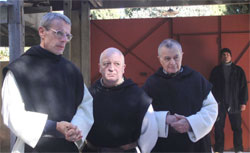
At the same time, the monks remain human and thus relatable throughout. Luc confesses to a village girl that he has been in love with several women (though he eventually followed “another Love, even greater”). The brothers become irked with each other, and their meetings include lots of scoffs and eye-rolls. For Brother Christophe, the looming decision precipitates a crisis of faith, as he cries out in the night, begging God not to abandon him. “As a kid I dreamed of becoming a missionary,” he confesses to Christian. “Dying for my faith shouldn’t keep me up at nights. Dying here … does it serve a purpose? I don’t know. I feel like I’m going mad.” He voices the agony most people would know in his circumstances. It is good that the film makes room for this.
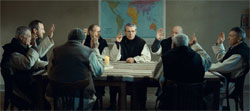
Brother Christian’s answer refuses to bow to pragmatism, conforming instead to the higher logic of love. “We are martyrs out of love, out of fidelity. Love endures everything,” he says, embracing Christophe. “It is through poverty and death that we advance towards him.” The next time the brothers meet about the decision, each has decided on his own accord (or perhaps by the prompting of the Spirit) to stay. In one of the film’s most moving scenes, the men enjoy a final meal together while listening to Tchaikovsky’s Swan Lake, their Last Supper, filled with laughter and tears. Then one gray day, they are taken away by armed captors into a mist of snow, never to be seen again.
No doubt many audiences will leave the film convinced that the monks’ decision was foolish, a display of cowardice and weakness that accomplished nothing. Then again, without the eyes of faith, the Cross appears to be the same. For those with eyes to see, Of Gods and Men is a quiet, profound meditation on the glory of dying for Christ and the hope of resurrection.
Talk About It
Discussion starters- The brothers meet several times to discuss whether or not to leave the monastery. What do their meetings reveal about living in Christian community?
- Was Brother Christian right in refusing the protection of the Algerian military, which he believed was corrupt? What does his decision say about the relationship between church and state?
- Brother Christophe says he didn’t become a monk to “commit collective suicide.” Yet through prayer and speaking with Brother Christian, he embraces the possibility of death. How is Christian martyrdom different from “collective suicide”?
The Family Corner
For parents to considerOf Gods and Men is rated PG-13 for a momentary scene of startling wartime violence, some disturbing images, and brief language. The violence is committed by terrorists, and there are a couple of bloody images. There is also one f-word in the movie.
Photos © Sony Pictures Classics.
Copyright © 2011 Christianity Today. Click for reprint information.