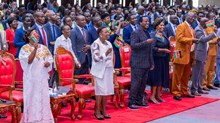
The Alliance Defense Fund (ADF) held its "Pulpit Freedom Sunday" this week. The annual event encourages pastors to "preach from their pulpits … about the moral qualifications of candidates seeking political office." The event encourages pastors to stand up against tax regulations that, according to the ADF, unconstitutionally regulate pastor speech.
However, in practice, pastors are free to speak out on candidates.
The ADF event is part of its Pulpit Initiative, a larger legal strategy to change tax law—not the way the IRS implements it. This strategy, ironically, needs the Internal Revenue Service (IRS) to start punishing pastors so that the ADF can sue to have the IRS stop punishing pastors.
As non-profits, churches cannot participate in political campaigns for or against a candidate for office. The so-called Johnson Amendment limits nonprofits' involvement in electoral politics. The ADF considers the Johnson Amendment to be unconstitutional.
But in the U.S., it is not enough to believe that something is unconstitutional; one needs a victim. The ADF is conducting a classic test case strategy. The ADF cannot sue to change tax regulations unless it represents a client who has been harmed by the law.
This is the reason for Pulpit Freedom Sunday: to find a victim whose case can be used to change the law.
According to the ADF, "The goal of the Pulpit Initiative is simple: have the Johnson Amendment declared unconstitutional—and once and for all remove the ability of the IRS to censor what a pastor says from the pulpit. ADF is actively seeking to represent churches or pastors who are under investigation by the IRS for violating the Johnson Amendment by preaching biblical Truth in a way that expresses support for—or opposition to—political candidates."
In other words, the ADF is goading the IRS into the church speech regulation business. If the IRS takes the bait and begins punishing pastors, then the ADF can use a resulting case to try to overturn the Johnson Amendment.
The ADF is not looking for just any case. Pulpit Freedom Sunday does not promote actual campaign activity—it is a time for pastors to speak about the morality of candidates. According to the ADF, the event is "only related to what a pastor says from his pulpit." It is "not about voter guides, candidate appearances, or other 'political' activities." If the IRS starts punishing pastors for mere words, then there would be a very strong case on both freedom of religion and freedom of speech.
ADF senior legal counsel Erik Stanley said that only churches should decide if it is inappropriate for pastors to speak from the pulpit about candidates.
"ADF is not trying to get politics into the pulpit. Churches can decide for themselves that they either do or don't want their pastors to speak about electoral candidates. The point of the Pulpit Initiative is very simple: the IRS should not be the one making the decision by threatening to revoke a church's tax-exempt status. We need to get the government out of the pulpit," said Stanley.
But to get them out of the pulpit, the IRS first needs to get into the pulpit. The IRS does state in its guide for churches that the following hypothetical circumstance would be illegal:
Example 4: Minister D is the minister of Church M, a section 501(c)(3) organization. During regular services of Church M shortly before the election, Minister D preached on a number of issues, including the importance of voting in the upcoming election, and concluded by stating, "It is important that you all do your duty in the election and vote for Candidate W." Because Minister D's remarks indicating support for Candidate W were made during an official church service, they constitute political campaign intervention by Church M.
According to the IRS, churches most clearly cross the line with references to specific candidates or voting in a particular election. If a pastor makes it clear that he is speaking on his own, that his views are personal and do not reflect the official position of the church, then it is not illegal. Discerning the difference between an official endorsement and a pastor's own views would be difficult to prove in court. In practice, the IRS has not gone after pastors for their statements in services. According to the ADF's own documents, the IRS has never punished a pastor or a church for what was spoken from a pulpit in the five decades since the Johnson Amendment.
When pastors signed up for the event, they needed to affirm that they would speak out from the pulpit in a way that would violate the law. It was not enough to speak from the pulpit on candidates; the pastors had to have the authority to represent the church (i.e. speak for the 501(c)(3) organization). The pastors agreed "to preach a sermon that evaluates the candidates running for political office in light of biblical Truth and church doctrine and I am willing to make specific recommendations about those candidates in light of the biblical evaluation."
In the two previous Pulpit Freedom Sundays, the ADF turned in its own pastors to the IRS. Information on each of the pastors and their churches was taken to the government. The IRS, however, did nothing. According to the ADF, none of the churches or their pastors were penalized for their alleged illegalities.
Copyright © 2011 Christianity Today. Click for reprint information.
Related Elsewhere:
Lifeway Research recently released survey data on what Protestant pastors think about endorsing candidates from the pulpit (84% are against it) and the IRS regulation (86% are against it).
Managing Your Church, a Christianity Today sister publication, also covered Pulpit Freedom Sunday this week.
Previous coverage of Pulpit Freedom Sunday includes:
'Pulpit Freedom Sunday' Tally: 31+ Sermons, 6 Complaints With IRS (Politics blog, Sept. 30, 2008)
Who Is in Charge of Our Pulpits? | Pulpit Freedom Sunday was about bringing kingdom principles to bear on contemporary social problems, not seizing political power. (Ron Johnson Jr., Oct 16, 2008)
Tempted by Politics | Why many pastors want to, but shouldn't, endorse candidates. (Mark Galli, Oct. 2, 2008)
Endorsing from the Pulpit | Pastors launch challenge of IRS rules on endorsements. (Sept. 25, 2008)







Support Our Work
Subscribe to CT for less than $4.25/month