You have founded the new religion Christianity in the holy city of Moscow."
So reads a notification on the side of my screen while I'm playing Civilization V: Gods and Kings. It represents a moment in my kingdom when my hodge-podge of chosen values and beliefs have coalesced into one coherent system, when a Great Prophet has been produced within my kingdom, and the right amount of faith has been generated. These things must line up perfectly to produce a particular religion. Someone needs to be pulling the strings.
That someone is me. I'm not exactly a king, but I'm not a sovereign god either. I have much more power than any historical king has ever had, though I'm still surrounded by challenges. I'm able to make decisions in an abstract vacuum, virtually divorced from political impulses and without having my decisions influenced by concrete things like dying citizenry or a demanding populace.
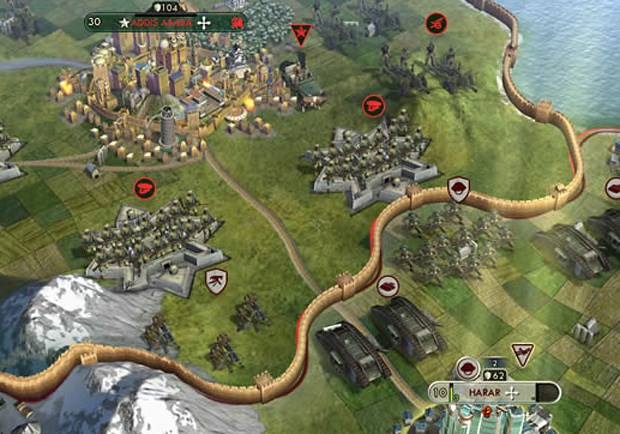
From my vantage point, the actions I take seem rote and mundane, but they are acts of extreme power. I expand my kingdom at every opportunity, eventually overcoming the landscape of an entire island. For the most part, I am on the defensive, building a sufficient army to hold off barbarians and attacking nations.
The Civilization series is primarily about acquiring power, though that power can come in the form of anything from military might to cultural weight, political influence, or technological advancement. The series is remarkably nuanced in the way it reflects the possible ways a kingdom might achieve success. These aspects of power all influence one another in unforeseen ways, and as other nations are introduced into the world narrative, the pursuit becomes even messier and more desperate.
It's telling that an encounter with other nations typically results not in joyous collaboration but in mutual distrust. The inevitable power struggle between nations is the key component of Civilization and the driving force for the player. There is little motivation to simply exist, little motivation to pursue beauty or a culture of love for the sake of it. These motivations are all tied to the end goal of becoming the world's greatest superpower.
Just as we have seen throughout actual world history (that reality where Christianity was founded, um, somewhere other than Moscow), when religion is introduced in the context of a power struggle, its teachings are diluted. Eventually, the small city-state situated on my otherwise completely occupied island seemed to warm to the brand of Christianity its neighbors subscribed to. I was offered a "quest" notifying me that their citizenry had requested we send missionaries to share our faith with them.
That's the opportunity that evangelistic Christians live for: a literal invitation to share their faith with an entire populous. Naturally, I took them up on the offer as quickly as possible, producing a great prophet whom I could send down to proselytize. After a while, the population of the city-state grew to appreciate Christianity, and our partnership was solidified. We had allies.
But religious allies are also military allies, and any threats to their city-state became a threat to my nation. I became preoccupied with fighting wars on their behalf, and while none of the wars were primarily about religion, it's hard to deny its role in our current military arrangement. I had wanted to establish a true, unstained version of Christianity. What I found instead was that in the world of Civilization, it was impossible to keep religion from being influenced by power and intrigue.
Games rarely address the subject of religion, but when they do, it's almost always connected to a power struggle, even when entire nations aren't at play. In fact, in most other games, religion is represented in a game's villains. The Assassin's Creed series introduces an entire web of conspiracy against the common people that goes all the way up to the Pope. Dead Space offers up the shadowy Unitologists, whose beliefs and traditions are mysterious and seemingly insidious. Even the more personal independent offering, The Binding of Isaac offered up the Christian religion as the ideology that pushes poor Isaac's mother over the edge, causing her to unleash all sorts of abuse on her son in the name of God.
None of these portrayals are exactly unfair—religion, when misused for the sake of attaining power can be downright villainous. Civilizationat least gives religion a positive spin, allowing faith to be a commodity that improves a nation rather than a liability. Still, there is a significant dearth of religious portrayals in videogames that represent the heart of true religion: meekness.
There's a reason for that. Meekness operates on of the assumption that the first will be last. It eschews self-interest for self-sacrifice. It simply isn't compatible with any game where winning matters most—which is, of course, most games. Whether religion plays an antagonistic or heroic role, striving for first place is simply not the primary function of Christianity. Trying to live out Christian meekness in almost any traditional game will result in an incredibly short play session and a rapidly-displayed game over screen.
Article continues below
But that's changing. As videogames mature and grow past the typical mechanics and begin to explore other possibilities, winning becomes a secondary aspect of digital play. Even now a number of games have risen to the top that have exploration and experimentation rather than earning points or defeating enemies as their focal point. In Minecraft, players explore an infinitely expansive land, gathering resources and building creative structures. Last year's Skyrim was extremely popular, not because of the challenge it provided its players, but because of the stories the players were able to live out through their on-screen characters. This year, the accessible and critically acclaimed Journey exhilarated players by allowing them to bump into actual human strangers in the midst of an epic pilgrimage.
Journey in particular may provide the best model for meekness exhibited through digital play. A traveler often sees another anonymous traveler out in the distance, and at that point the game leaves the response up to each player. It's possible to leave the other player behind, but the game offers no incentive to do so. Instead, what makes the game interesting are those moments that come when players help one another. If one player is stuck, the other patiently demonstrates how to proceed. If players seem to have different ideas of which way to go, they have the opportunity to compromise. Journey doesn't force you to love your neighbor, but it goes out of the way to encourage it, not with points or a sense of achievement, but with a fuller experience and a sense of deep satisfaction.
Civilization provides a bird's eye view of the role of religion in world history, and provides enough nuance that it doesn't paint an unfair picture of what it's attempting to portray. But demonstrating true religion in games requires zooming in closer to the individuals who believe. Christianity isn't as well represented when it's founded in Moscow as it is when we see its citizens living it out.






![Sid Meier's Civilization V: Gods and Kings [Download]](https://m.media-amazon.com/images/I/51dBv3wdBsL._SL500_._SX140.jpg "Sid Meier's Civilization V: Gods and Kings [Download]")
![Buy Sid Meier's Civilization V: Gods and Kings [Download] from Amazon](/ct/channel/img/btn_buy_amazon.gif "Buy Sid Meier's Civilization V: Gods and Kings [Download] from Amazon")







 While we pray for peace, we need moral clarity about this war.
 As my doubts about his teachings grew, so did a secret fascination with Jesus.
 The plan would organize UMC churches in four global regions, with each given more leeway around same-sex marriage and other theological issues.





