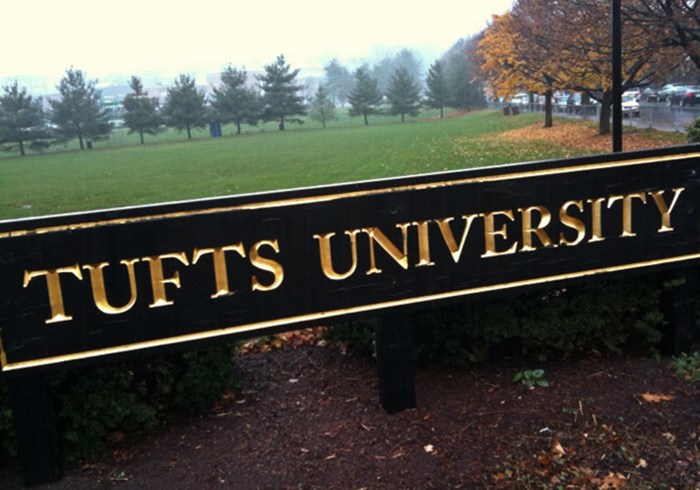
Tufts University will likely restore official status to Tufts Christian Fellowship (TCF) after student leaders appealed a decision by the student judiciary to de-recognize the group.
"Tufts' decision demonstrates that universities willing to engage in a conversation will recognize that any religious group must have freedom to choose leaders who affirm those standards," said InterVarsity Christian Fellowship national field director Greg Jao. "It's a very good sign that universities are open to conversation and change in many cases."
In October, the Boston-area research university had barred the group from using Tufts in its name, receiving student activity funds, or reserving campus meeting spaces because TCF required its leaders to adhere to its statement of faith.
According to the The Tufts Daily, the Committee on Student Life yesterday unanimously upheld the October decision by the Tufts Community Union Judiciary.
However, the student life committee created a policy change that will exempt student religious groups (SRG) from the school's nondiscrimination policy when selecting group leaders—as long as they adhere to the policy with respect to group membership.
"It is reasonable to expect that leaders within individual SRGs be exemplars of that particular religion," the ruling stated. "Therefore, an 'all comers' policy for group leadership may not be appropriate for all SRGs. Justified departures from the Tufts nondiscrimination policy in SRG criteria for leadership will no longer present grounds for de-recognition."
Jao says this is "a common-sense approach" because it acknowledges that religious groups are minorities on campus and that those groups are defined by their beliefs.
Yesterday's decision does not immediately restore official recognition to TCF; the group must now reapply under the new rules.
The policy change is the culmination of a long campus-access conflict over the group. In 2000, the Tufts Community Union Judiciary similarly barred TCF from campus after a lesbian student said she had been barred from leadership. After several months, Tufts reinstated TCF.
That 2000 conflict was not the first IVCF chapter conflict with school antidiscrimination policies, but it received significant media attention. And since then, chapters have faced challenges to its on-campus presence at many other universities.
In a highly publicized battle earlier this year, Vanderbilt University de-recognized its InterVarsity chapter over similar nondiscrimination issues. The school ultimately instituted an "all-comers" policy in May, requiring all student groups to allow any student in any leadership position. (All-comers policies were rare two years ago, but they became much more common after the Supreme Court said a University of California law school's policy could trump a Christian Legal Society chapter's desire to limit its leadership positions to Christians.)
Vanderbilt's policy shift prompted 15 Christian student groups to step forward and willingly de-recognize themselves rather than omit faith statements from their governing documents, says Carol Swain, professor of political science and law and adviser for the Christian Legal Society chapter at the Nashville school.
Even without official recognition, Swain says, all of the unregistered Christian groups at Vanderbilt still are meeting—and even reporting growth in membership.
"The ability to minister and grow has not been dampened by the fact that the university has made it harder for them to be in the open," she said.
And if defending those beliefs comes at the expense of official recognition, that is a price Christian student organizations must pay, says Carl Esbeck, professor of law at the University of Missouri.
"There's really nothing that a religious organization of integrity can do," Esbeck said. "You're not going to be recognized."
But Jao says official recognition over non-discrimination is not the issue. Rather, the issue at stake is whether or not Christian organizations can regulate who applies for leadership roles—and whether or not they need to, he said.
"The Bible requires us to have clear leadership criteria," Jao said. "To eliminate these (criteria) and not make them explicit would be unfaithful to what tradition requires."
TCF welcomes all students to participate in meetings and become members. And with more than 120 students, it's one of the campus's larger groups. However, TCF requires its student leaders "to support and advocate for the letter and spirit of TCF's Basis of Faith," which includes belief in the Trinity, biblical authority, and salvation by grace through faith.
Similarly, Douglas Laycock, professor of law at the University of Virginia, says the principal function of statements of faith is not to exclude nonbelievers, but to preserve the integrity of the organizations themselves.
"Plenty of Christian organizations drift or split apart over doctrine," he said.
Thus, for student groups that experience total leadership turnover at least once every four years, sustainability is not created by long-term leadership, but by leaders' "allegiance to a clear basis of faith," Jao said.
"It's not a choice between acceding to the university's request or standing our ground," Jao said. "We're going to choose to stand our ground because when student groups have failed to do that over time, they lose doctrinal fidelity and they're removed from campus over time by God."
Tufts' decision confirms for IVCF that choosing to hold its fellowships and leaders to a core set of Christian beliefs is the correct path, Jao says. He hopes the policy change will embolden other universities to follow suit.
Meanwhile, IVCF is currently tracking campus-access issues at more than 30 other college campuses nationwide, including the 26 schools in the California State University system.
"Universities that are truly committed to a pluralistic environment understand why we're making that choice," he said. "Their rationale affirms that principled pluralism is possible."







Support Our Work
Subscribe to CT for less than $4.25/month