You won't find a more apt example of an excerpt that is contradictory to an author's broader writings than this bit from C.S. Lewis' Mere Christianity:
Before leaving the question of divorce, I should like to distinguish two things which are very often confused. The Christian conception of marriage is one: the other is quite the different question—how far Christians, if they are voters or Members of Parliament, ought to try to force their views of marriage on the rest of the community by embodying them in the divorce laws. A great many people seem to think that if you are a Christian yourself you should try to make divorce difficult for every one. I do not think that. At least I know I should be very angry if the Mohammedans tried to prevent the rest of us from drinking wine. My own view is that the Churches should frankly recognize that the majority of the British people are not Christian and, therefore, cannot be expected to live Christian lives. There ought to be two distinct kinds of marriage: one governed by the State with rules enforced on all citizens, the other governed by the church with rules enforced by her on her own members. The distinction ought to be quite sharp, so that a man knows which couples are married in a Christian sense and which are not.
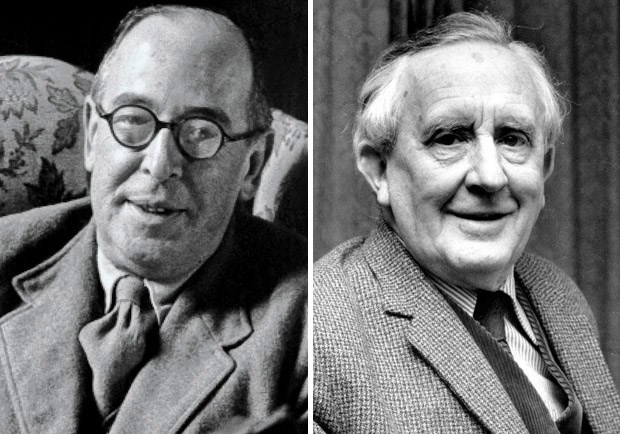
This argument provoked a strong response from Lewis' friend and fellow Inkling, J.R.R. Tolkien. Tolkien drafted a response to Lewis sometime in 1943 but never sent it. After Tolkien died, the letter was found folded up inside his copy of Lewis' "Christian Behavior,"which would be republished as part of Mere Christianity. (I've added the emphasis.)
My dear L.,
I have been reading your booklet 'Christian Behavior." I have never felt happy about your view of Christian "policy" with regard to divorce. …
[Y]ou observe that you are really committed (with the Christian Church as a whole) to the view that Christian marriage—monogamous, permanent, rigidly "faithful"—is in fact the truth about sexual behavior for all humanity: this is the only road of total health (including sex in its proper place) for all men and women. That it is dissonant with men's present sex-psychology does not disprove this, as you see: "I think it is the instinct that has gone wrong," you say. Indeed if this were not so, it would be an intolerable injustice to impose permanent monogamy even on Christians. If Christian marriage were in the last analysis "unnatural" (of the same type as say the prohibition of flesh-meat in certain monastic rules) it could only be imposed on a special "chastity-order" of the Church, not on the universal Church. No item of compulsory Christian morals is valid only for Christians. … I do not think you can possibly support your "policy," by this argument, for by it you are giving away the very foundation of Christian marriage. The foundation is that this is the correct way of "running the human machine." Your argument reduces it merely to a way of (perhaps?) getting an extra mileage out of a few selected machines.
The horror of the Christians with whom you disagree (the great majority of all practicing Christians) at legal divorce is in the ultimate analysis precisely that: horror at seeing good machines ruined by misuse. I could that, if you ever get a chance of alterations, you would make the point clear. Toleration of divorce—if a Christian does tolerate it—is toleration of a human abuse, which it requires special local and temporary circumstances to justify (as does the toleration of usury)—if indeed either divorce or genuine usury should be tolerated at all, as a matter of expedient policy.
Under your limitations of space you have not, of course, had opportunity to elaborate your "policy"—toleration of abuse. … A Christian of your view is, as we have seen, committed to the belief that all people who practice "divorce"—certainly divorce as it is now legalized—are misusing the human machine (whatever philosophical defense they may put up), as certainly as men who get drunk (doubtless with a philosophic defense also). They are injuring themselves, other people, and society, by their behavior. And wrong behavior (if it is really wrong on universal principles) is progressive, always: it never stops at being "not very good," "second best"—it either reforms, or goes on to third-rate, bad, abominable.
The last Christian marriage I attended was held under your system: the bridal pair were "married" twice. They married one another before the Church's witness (a priest), using one set of formulas, and making a vow of lifelong fidelity (and the woman of obedience); they then married again before the State's witness… using another set of formulas and making no vow of fidelity or obedience. I felt it was an abominable proceeding—and also ridiculous, since the first set of formulas and vows included the latter as the lesser. In fact it was only not ridiculous on the assumption that the State was in fact saying by implication: I do not recognize the existence of your church; you may have taken certain vows in your meeting place but they are just foolishness, private taboos, a burden you take on yourself: a limited and impermanent contract is all that is really necessary for citizens. In other words this "sharp division" is a piece of propaganda, a counter-homily delivered to young Christians fresh from the solemn words of the Christian minister.
Article continues below
Tolkien understood the stakes. The debate strikes at the heart of what it means to confess that the Christian faith is "true." As Tolkien wrote, no article of Christian morality is intended exclusively for Christians. Rather, the faith teaches us that submitting to the laws of our creator is the surest way to live reconciled lives with his creation. This is what we ought to mean when we say Christianity is true. We don't simply mean that it provides factually accurate information about the world or that it offers an authentic path to spiritual fulfillment for those who choose to follow it. We mean that Christianity gives an accurate accounting of the world in its fullness and that it instructs us in how we ought to relate to the world.
In writing to Lewis on these matters Tolkien would have been preaching to the choir. Which is precisely what makes this oft-quoted section of Mere Christianity so baffling. If it came from any other pen, the natural thing would be to point out that the presuppositions behind the author's analogy are faulty. The argument simply assumes that religious dogma is strictly personal and, therefore, ultimately relative. You have your practices and I have mine. In this view, religious teachings are not a true description of how to live well and justly in the world, they are just a set of suggested behaviors that followers of a religion should consider practicing. There is no necessary connection between a religious command and human flourishing. This is simply the modern view of religion: Religion consists of private devotional beliefs and (empty) public ritual.
Of course, there was no greater debunker of that entire system of thought than C.S. Lewis. To read him is to come face-to-face with a man who, according to one friend, was "the most thoroughly converted man I ever knew." Few people wrestled with the absolute, pervasive nature of Christ's lordship more capably and intelligently than Lewis.
Article continues below
Consider the social critique in That Hideous Strength as one example of this "thoroughly converted" mind. In that book, Lewis is not merely defending an article of faith or a specific political platform. He's defending an entire orientation toward the world. To borrow a phrase used by Doug Wilson to describe his debates with Christopher Hitchens, the conflict between St. Anne's and the NICE in Lewis' novel is not an academic exchange of mutually exclusive beliefs. It is a collision of lives and worlds. The world of St. Anne's is for Christianity. The NICE is for applied science, modernity, and industrialization.
St. Anne's Christianity is worth describing in more detail: The home is defined by an integrated way of life directed toward creational flourishing. Some of the less appreciated aspects of this life will be recognizable to many younger evangelicals with broader social interests. St. Anne's is an agrarian home where they grow most of their own food, where animals come and go as they please, and where the boundaries between "mine" and "yours" are quite a bit fuzzier than they are in our own experience. It's a place where the land is valued as such and is not buried under the growing burden of human abuse. If it calls to mind scenes from Wendell Berry's Port William, you are on the right track. In all these ways, That Hideous Strength is extremely friendly to those of us concerned by the abuses of creation perpetrated by industrialization.
But we mustn't stop there in our analysis of Lewis' social imagination. If we reduce Lewis' critique to ecology, we have missed his point. Lewis' ecological views flow out of something more basic and essential. What Lewis is describing is an orientation toward the world. As such, it encompasses an ethic toward the land, but it is not limited to that.
To discover the bedrock of the book's social vision, one need look no further than the book's first word: "Matrimony." At its roots, That Hideous Strength is a book about marriage. The book begins with Jane Studdock contemplating the love poems of John Donne. The story ends with a chapter titled "Venus at St. Anne's." In that chapter, nearly every major character is paired off, including Ransom, who returns to the planet Venus. More on that shortly. Significantly, Mark and Jane are finally reunited, this time sans contraception with the expectation that their child will be the Pendragon, the one who saves England.
Article continues below
And if you scratch a little deeper, you find that this book actually dovetails marvelously with the planetary themes of Lewis' work discussed so marvelously in Michael Ward's Planet Narnia. St. Anne's, by the book's end, has come to represent the alliance of Venus and Jupiter. In fact, it isn't even that subtle. Jupiter's viceregent, Ransom, is whisked off to Venus. And that is not coincidental. Lewis didn't choose Venus based on whim. Venus, in Lewis' work, denotes beauty and fertility. Jove, meanwhile, signifies a secure and satisfied kingly joy. Their union signifies creation at its apex, as the beauty and fertility of creation (Venus) is brought under the wise, joyful lordship of its creator king (Jupiter). If you remove marriage, you are removing the beauty and the joviality that animate all of St. Anne's. If you lose the larger worldview implied by marriage's design, you lose the entire social vision of That Hideous Strength.
This brings us back to the oddness of Lewis' concession in Mere Christianity. Certain aspects of the Christianity articulated at St. Anne's are very much en vogue right now. Evangelical Christians are talking about how to build deeper ties to our local communities by shopping local. We're attempting to respect and sustain creation by being less wasteful with our resources. Some of us have a renewed interest in agrarian communities.
We've had many conversations at my church, a broadly reformed evangelical college-aged congregation, about these sorts of issues. My pastor and I recently attended the Prairie Festival at The Land Institute. At Grace, we're trying to articulate a broadly Christian social imagination that encompasses all of life. And we aren't alone in that pursuit. The growing number of evangelical publishers releasing books dealing with Christianity and ecology suggest a broader trend. So far as they go, these are all desires and ambitions that Lewis and Tolkien would warmly commend.
But Lewis—in the majority of his work—and Tolkien would say we must look more closely at the underpinnings of our social ethic. The dominant metaphor for all those commendable activities described above is that of marriage. The ecological, communal, and creational (a far superior word to "environmental") goals are all understood through the metaphor of marriage, by which we mean a permanent, communally recognized, community-sanctioned relationship characterized by affection and fertility. That's the best description you'll find for Lewis' ethic toward the land, but it flows out of his ethic of sexuality. In much of his writing, and especially in That Hideous Strength, that is quite clear. So understood, we can now see that Tolkien's letter is simply Tolkien's attempt to help his friend see that his concession in Mere Christianity actually undermines his larger social vision. That's why Tolkien pushes so hard in the letter above. In staking out his odd position on divorce, Lewis was giving away much more than a single law on the books of a single nation. Rather, he was giving away the metaphor that shapes all elements of the Christian worldview.
Article continues below
On a note more relevant to contemporary evangelicals, this is why we need to be crystal clear on what the defining themes of our social vision actually are. Matt is fond of saying that the problem with the culture war for evangelicals wasn't necessarily the "war" part, but the "culture" part. We were defending certain values in the absence of a culture that can sustain those values. Now younger evangelicals are reacting against that and are attempting to develop a robustly Christian social ethic that holds all of creation accountable to the claims of Christ. It's an undeniably positive and most welcome development.
However, it is important to understand that evangelical commitments to both the pro-life cause and the preservation of traditional marriage are not contrary to those broader counter-cultural concerns. Rather, they fit into that social agenda quite neatly. More than that, if Lewis and Tolkien are correct, the heart of that social vision is not an ethic of the land or economics or sustainability. It's marriage, understood as both the private union of a man and woman and the larger social vision implied by the imagery of marriage; of a community united together in formally-recognized union and relating to one another in an affectionate, fertile way. Such an ethic is good for all areas of life, but it is premised on a certain understanding of marriage. And if we move away from that, we're moving away from far more than sexual norms.












 While we pray for peace, we need moral clarity about this war.
 We’ve got little information on Jesus’ appearance and personality. But that’s the way God designed it.españolFrançais
 Beyoncé’s right. Whether listening to Cowboy Carter or reading theology, diversity is a good thing.





