At this time in history, the gulf separating the worlds of Islam and the Christian West can sometimes seem unbridgeable, the conflicts between them unsolvable. The time is ripe, then, for Lamin Sanneh, someone intimately familiar with both worlds, to tell his improbable life story.
Sanneh, though of royal lineage, grew up in a poor Muslim family in the colonial Gambian village of Georgetown, on an island in the Gambia River. "There was no church," he writes, "in the town where I was growing up; I had never seen a Bible in my life; I had never heard anyone teach or preach about Christianity; there was no mention of Christianity in the books we read at school."
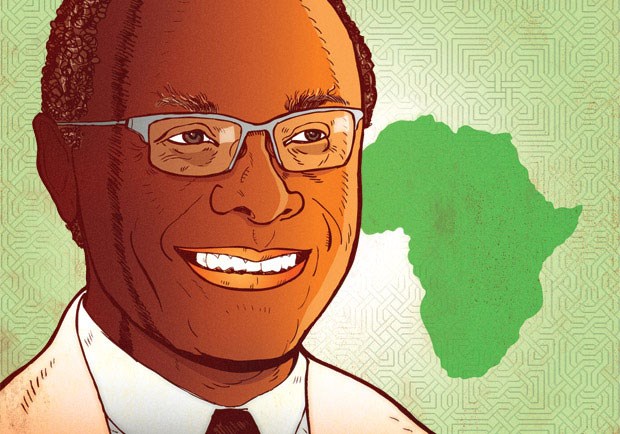
Today, however, Sanneh is an accomplished Christian scholar whose influence traverses multiple continents. Teaching and researching posts with Yale Divinity School, the University of London, and two Pontifical Commissions are among this distinguished man's many titles and honors.
From Islam to Christianity, from provincial poverty to global intellectual preeminence—Sanneh has indeed been on quite a journey. In Summoned from the Margin: Homecoming of an African (Eerdmans), he reflects on the many steps and decisions that shaped this unlikeliest of biographies.
At first, the title is likely to suggest to a Western reader, as it did to me, that the margin from which Sanneh was summoned was his birthplace, and that his homecoming was to the Christian world—ultimately to Catholicism, where he has found his spiritual home. But the image also suggests the opposite: the Christian world as the margin to which he was summoned—a strange, distant world, remote from the world of his childhood. The homecoming, in this vein, is his return to Georgetown with his children, which first fueled his autobiographical reflections.
Three Levels of Reflection
Sanneh, who seldom allows anything of his own or others' lives to pass without careful analysis, reflection, and contemplation, writes on at least three levels.
One is autobiography, the story of a fascinating life—growing up in a traditional African culture being transformed at once by Islam (or the Arab world) and by Christianity (or the Western world). We learn of the dynamics of polygamous families—not in the abstract, but based on direct experience. This family structure drove a wedge between his paternal and maternal siblings, with the former emerging as rivals and the latter as allies. Sanneh's Muslim father, experienced more as a distant patriarch than a loving caretaker, forbade him to attend a "Western," "infidel" school. His equally Muslim mother, in the manner of mothers, evaded that order, though that meant that young Lamin would have no money for school fees, books, supplies, clothes, and sometimes food.
Not only is Sanneh highly regarded as a scholar of both Islam and Christianity, he has also lived reflectively within cultures profoundly shaped by both faiths.
Summoned from the Margin, then, is not the dramatic biography of a soldier or statesman. Instead, it's the story of a scholar and thinker who, through very long, patient, and disciplined work, rises to the highest reaches of his profession. Driven by a hunger for education and learning, Sanneh clawed his way into an outer world that repeatedly rejected him on account of his conversion, his new faith, and his race. Most of the story concerns his inner life—spouses and children enter only intermittently, though lovingly.
Another level is a kind of personal anthropology, wherein his life's experiences and choices are weighed and connected. Sanneh analyzes his thoughts and carefully compares the multiple languages that he needed to make sense of his life's journey. There are many references to scholars, but his purpose is not to enter scholarly debates. Sanneh is after something deeper: an examination of his own heart. To wit, he chooses more quotations from poets, novelists, and other literary figures (Virgil, William Wordsworth, William Shakespeare, John Keats, Fyodor Dostoyevsky, Gustave Flaubert, Thomas Gray, Elizabeth Browning, John Masefield, Oscar Wilde, Helen Keller, and C. S. Lewis) than from scholars. The largest source of quotations is the Psalms.
A third level is confession, in the sense of Augustine's confessions: how a boy raised in a Muslim family, in a Muslim village, almost in a Muslim world, came, with little human intervention, to become a Christian. This story deserves careful consideration, since it comes from a man with a doubly unique vantage point. Not only is Sanneh highly regarded as a scholar of both Islam and Christianity, he has also lived reflectively within cultures profoundly shaped by both faiths. His conversion narrative shows a sharp awareness of what he has come from, and to—and why. Clearly, Sanneh has loved his Muslim family and friends. He is deeply aware of what draws them to Islam, and keeps them within it.
Sanneh writes critically, however, of the church's relation to Islam, portraying with keen sensitivity the formidable pressures that confront converts to Christianity. At the risk of making his perspective on Christian-Muslim relations seem unduly harsh, it's worth exploring some of his trenchant observations.
Article continues below
"Islam," he writes, "encourages conversion—just not from it …. Muslims honor and celebrate their converts as trophies of faith, while Christians take their converts as charitable rations with a pinch of shame. It forces Christian converts underground to keep their faith quiet, or else makes them propitiatory tokens of a grateful church for Muslim forbearance. This arrangement gives Muslims the confidence that they hold the high ground vis-À-vis Christians; after all, only the inferior religion would agree to such terms."
As a convert to Christianity, Sanneh felt the crushing weight of these dynamics. Churches, beset by the "Western guilt complex," welcomed former Muslims only reluctantly, as they threatened to "upset the status quo." Between Islamic self-confidence and Christian self-doubt, "the border crossing with Islam was a one-way street," and Sanneh was "moving against the flow of traffic, and in the process setting off alarm bells all around the ramparts."
The West's relationship with Islam is likely to remain a major issue in coming decades, and perhaps well beyond that. This struggle will have many dimensions, and Lamin Sanneh's story, analysis, and confession can be an indispensable aid in our attempts to understand it.
Rejection and Honor
One of Sanneh's many themes is rejection—rejection from the academy because of his beliefs, and rejection from churches because of his race and his conversion. Many in the universities, especially in the Ivy League, were apparently uncomfortable with his clear devotion to the truth of Christianity. And because of his race and culture, he did not fit their New England ethos; he was not one of them. In American churches, he often faced raw racist paternalism. Both African and American Christians frequently regarded him as a potential source of embarrassment. As a convert from Islam, they worried he could pose an obstacle to their programs for interreligious dialogue.
Sanneh closes with words from John Bunyan's Pilgrim's Progress: "[A]nd though with great difficulty I am got hither, yet now I do not repent me of all the trouble I have been at to arrive where I am …. My marks and scars I carry with me, to be a witness for me that I have fought his battles who will now be my Rewarder."
Of course, Sanneh wears not only scars of rejection, but laurels of honor. It is a testimony to the depth of his oft-embattled faith that, having experienced both rejection and honor in great measure, he perseveres in his homecoming journey.
Paul Marshall is senior fellow at the Hudson Institute's Center for Religious Freedom.
Have something to add about this? See something we missed? Share your feedback here.


















 While we pray for peace, we need moral clarity about this war.
 How Jesus rescued a New Age psychic from spiritual darkness.
 After this week’s UMC votes on LGBTQ issues, African Methodists should join American conservatives in the new Global Methodist denomination.