




In college, I took an exegesis class in the Pauline Epistles. The class required students to translate the apostle's letters on sight from their Greek New Testaments. Our professor's eyes were failing, and the temptation to crib from an English Bible was just too much for some of my friends.
One day, as a student faked a translation on the fly, the professor looked up and said, "Mr. H—, is that an RSV on your desk?"
Sure enough, H— had been reading aloud from a black, leather-bound Revised Standard Version. Nervously, he said, "Y-y-yes, sir."
"Why," quipped our professor with a big grin, "it almost looks like a Bible."
Back then, the default meaning of Bible for Christians in my group was the King James Version. The default physical form was a black leather binding.
The physical form of the Bible matters because it influences the way Christians use their sacred book. In the countercultural 1960s, for example, publishers shucked the black leather uniform in favor of more contemporary dress. The aim was to reach those who might not otherwise pick up the Scriptures. The American Bible Society's Good News for Modern Man resembled a mass market paperback, and Tyndale House's Reach Out: The Living New Testament looked just plain "groovy."
Three centuries before Luther's New Testament first came off the press in 1522, workshops in Paris produced one-volume Bibles called pandects. Unlike the large multivolume Bibles that sat in churches, monasteries, and rich men's libraries, these could be conveniently carried by Sor-bonne students and mendicant preachers. Thus began the revolutionary shift from communal reading of Scripture to its private, individual consumption.
In 1735, the Bible emerged in another physical form—the family Bible. An English publisher named William Rayner produced The Compleat History of the Old and New Testament or a Family Bible. This was the first time that phrase was used, according to Liana Lupas, curator of the American Bible Society's collection of rare Bibles.
The purpose of these Bibles, says Lupas, who curated a current exhibition of family Bibles for the Bible Society's MOBIA gallery, was to provide study helps to answer questions that readers might have, and also to stimulate families to center their common devotions on the Bible.
People soon found other uses for these Bibles, pressing flowers, preserving locks of hair, and protecting other keepsakes. Families had already used the blank pages at the beginning or end of large Bibles to preserve genealogical information, recording births, marriages, and deaths. Dedicated family history pages were a natural development. And so in 1791, Isaiah Thomas published the first American Bible to contain pages dedicated to this purpose.
Placing the family Bible at the physical center of the ideal American home helped entrench the idea of the family as the main training ground in Christian living.
Both Catholic families and Eastern Seaboard Protestants traditionally enshrined their family histories in parish registers and churchyard burial plots. But the American family became mobile, and American faith became more baptistic and individualized. Families who moved west left their family networks behind, and the family Bible became a portable shrine, recording the family as a sacred institution.
Nineteenth-century family Bibles were sold door-to-door by salesmen called colporteurs. Their sales pitch helped to create a hunger for these lavishly bound volumes. In some cases, Lupas told me, the colporteurs took advantage of illiterate families, claiming that the family records pages had legal value and that without one of these Bibles, you couldn't prove your marriage was valid.
Family Bibles also acquired value as a status marker for the middle class. Displayed on a stand in the family parlor, they were the sacred equivalent of the parlor piano or the installment-plan encyclopedia set. But placing the family Bible at the physical center of the idealized American home also helped entrench the Puritan ideal of the family as the main training ground in Christian living.
My parents inherited a large family Bible from my grandparents. It was leather bound and weighed a ton. In addition to pages for our family history, it had illustrations and special sections on Bible animals and plants and a paraphrase of Bible history.
Our family Bible was not just holy; it was also holey. As a boy, one of my uncles needed pictures for a school project and took a scissors to the family Bible. In slicing up the family Bible, my uncle had attacked the family rectitude, respectability, and religion. My mother, who was supposed to supervise her younger brothers, got what for from her mother.
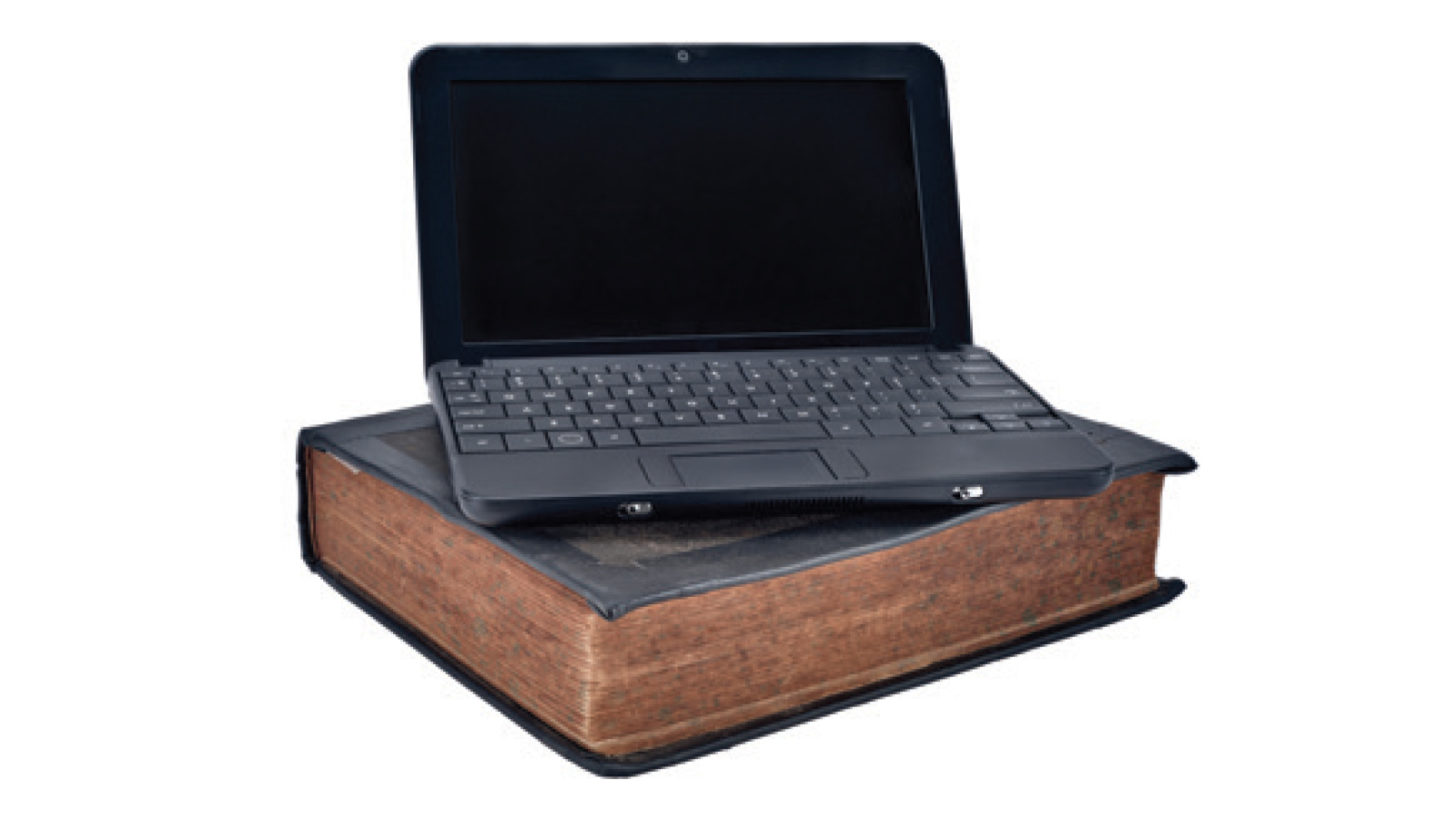
Today, many of us use Bibles with no physical properties of their own. They borrow their frame from computers, iPads, and smartphones—also markers of middle class existence—but created for individual use. Will this digital revolution cement the decline of family spirituality that was once fostered by the family Bible? God knows.
Copyright © 2012 Christianity Today. Click for reprint information.
Related Elsewhere:
Previous "Past Imperfect" columns by David Neff include:
Our Secret African Heritage | How we can remember our big family history. (November 23, 2011)
Criminalizing Circumcision| We have secularized the ancient Jewish rite—but it is still inescapably religious. (August 29, 2011)
A Second-Coming Christian | The 'blessed hope' was the linchpin of my father's faith. (July 18, 2011)
Remember the Red Sea | Why not capitalize on the richness and mystery of our ancient symbols? (May 19, 2011)
Dwelling in Heaven's Suburbs | Creating a culture of resurrection is key to full-orbed ministry. (September 28, 2010)