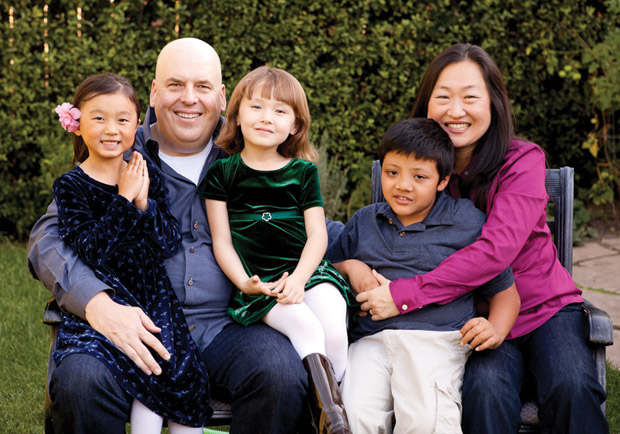

When Hope Van Riesen turns 7 years old on November 1, she will celebrate with her adoptive parents and siblings in Palo Alto, California. That week, Hope will also see her birth mother, Miranda Wang.
With help from Bethany Christian Services, Wang arranged an agreement with Alex and Susan Van Riesen during her pregnancy that enables her to maintain a presence in Hope's life. Seeing Wang three or four times annually assures Hope that her birth mother loves her, say the Van Riesens.
A recent report by the Evan B. Donaldson Adoption Institute, which studied 4,400 recent adoptions from 100 agencies, estimates that more than half (55 percent) of U.S. infant adoptions are now open or "fully disclosed," involving ongoing, direct contact between birth parent and adoptive family. Only 5 percent remain "closed" or confidential.
"Openness in adoption is fast becoming the norm within the United States," noted the report.
Most adoptions became closed after the 1930s. Carol Demuth, a supervisor with Dallas-based Buckner International, attributes this to a desire to protect out-of-wedlock children from societal scrutiny.
But this admirable goal had unintended consequences.
"People were still returning to agencies and had questions about their birth family and why the adoption took place," she said, speaking from firsthand experience. Although grateful her single, 17-year-old mother placed her for adoption, Demuth said the forced separation left her with many questions.
Buckner migrated to open adoptions in 1995 after a decade-long transition.
"We see it as a good thing," said Bethany president Bill Blacquiere. About two-thirds of the agency's adoptions are now open, and the rest have mediated contact via photos, text messages, or Facebook posts.
However, open adoptions have their challenges. Sometimes one party violates the terms of pre-birth agreements, or both parties struggle to negotiate frequency and type of contact. Differing socio-economic standards, lifestyles, and values can cause conflict. Sometimes a birth mother seeks financial help, further straining relations.
"That's why it helps to have an agency involved," Demuth said.
Christian families tend to embrace open adoption more, said Demuth, who has worked for both faith-based and secular agencies. They are more open to viewing parenting as stewardship, showing hospitality to strangers, and trusting God to work out the challenges involved, she said. "[They] see that both [sets of] parents are part of God's plan for a child's life."
Together for Adoption executive Jason Cornwell sees the trend as good for children since it helps remove the stigma often associated with adoption. Benefits include children's awareness of their background, medical history, and reasons for their adoption—which helps prevent feelings of rejection.
"The child is only going to feel as good about their birth parents as their [adoptive] parents do," he said.
Phillip Wurster, director of Spirit of Faith Adoptions, also sees this as positive for birth mothers.
"In the past, the last thing [a mother] would see was that infant leaving her arms," he said. "She'd have no clue as to what happened to that child. That wasn't very healthful."
However, seminary professor Russell Moore—who, in the process of adopting two sons, became a leading evangelical advocate for adoption—said most people have little choice in "open or closed" questions. "In some cases, particularly international adoptions, the situation is by necessity closed because the birth parents cannot be found."