





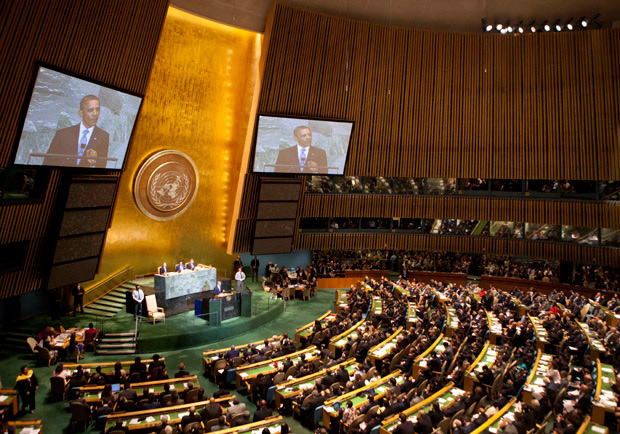
President Obama on Tuesday (Sept. 25) gave a forceful speech at the United Nations, in which he challenged much of the world's assumptions about free speech and religion.
Here are five points from his address, which together, add up to as close to an Obama Doctrine on Religion as we've seen:
1. Blasphemy must be tolerated, however intolerable
The idea that the U.S. protects even vile speech, so ingrained in American culture, seems counterintuitive to much of the world. It's an especially tough concept when speech targets a religion, but Obama argued that restrictions on speech too often become weapons to suppress religion—especially the rights of religious minorities.
"Americans have fought and died around the globe to protect the right of all people to express their views, even views that we profoundly disagree with. We do not do so because we support hateful speech, but because our founders understood that without such protections, the capacity of each individual to express their own views and practice their own faith may be threatened," Obama said. "Given the power of faith in our lives, and the passions that religious differences can inflame, the strongest weapon against hateful speech is not repression, it is more speech."
Moreover, he continued, no one can control speech even if he or she wanted to.
"When anyone with a cell phone can spread offensive views around the world with the click of a button, the notion that we can control the flow of information is obsolete," Obama said.
2. Religious respect is a two-way street
Obama went on the offensive: If you're going to denounce intolerance against your own religion, he said, you must also call out those who demean the religion of others.
"The future must not belong to those who slander the prophet of Islam," the president said. "Yet to be credible, those who condemn that slander must also condemn the hate we see when the image of Jesus Christ is desecrated, churches are destroyed, or the Holocaust is denied."
3. Turn the other cheek
In the wake of riots across the Muslim world sparked by the anti-Muslim film The Innocence of Muslims, Obama called violence an illegitimate reaction to offensive speech, religious or otherwise.
"There are no words that excuse the killing of innocents. There is no video that justifies an attack on an embassy. There is no slander that provides an excuse for people to burn a restaurant in Lebanon, or destroy a school in Tunis, or cause death and destruction in Pakistan."
4. One nation under God
Obama drew on the religious diversity of the U.S. to make his case for tolerance abroad.
"We are a country that has welcomed people of every race and religion. We are home to Muslims who worship across our country," he said. "We understand why people take offense to this video because millions of our citizens are among them."
5. The danger of extremism
The democratic movements sweeping the Arab world could be derailed by intolerance rooted in religious difference, Obama warned. He made the preservation of the Arab Spring a global responsibility.
"It is time to marginalize those who—even when not resorting to violence—use hatred of America, or the West, or Israel as a central principle of politics," he said. "For that only gives cover, and sometimes makes excuses, for those who resort to violence."
Obama's full remarks are available at the White House site and YouTube.
Additional reporting by CT staff.







