The word Jesus stuck in my throat like an elephant tusk; no matter how hard I choked, I couldn't hack it out. Those who professed the name commanded my pity and wrath. As a university professor, I tired of students who seemed to believe that "knowing Jesus" meant knowing little else. Christians in particular were bad readers, always seizing opportunities to insert a Bible verse into a conversation with the same point as a punctuation mark: to end it rather than deepen it.
Stupid. Pointless. Menacing. That's what I thought of Christians and their god Jesus, who in paintings looked as powerful as a Breck Shampoo commercial model.
As a professor of English and women's studies, on the track to becoming a tenured radical, I cared about morality, justice, and compassion. Fervent for the worldviews of Freud, Hegel, Marx, and Darwin, I strove to stand with the disempowered. I valued morality. And I probably could have stomached Jesus and his band of warriors if it weren't for how other cultural forces buttressed the Christian Right. Pat Robertson's quip from the 1992 Republican National Convention pushed me over the edge: "Feminism," he sneered, "encourages women to leave their husbands, kill their children, practice witchcraft, destroy capitalism, and become lesbians." Indeed. The surround sound of Christian dogma comingling with Republican politics demanded my attention.
After my tenure book was published, I used my post to advance the understandable allegiances of a leftist lesbian professor. My life was happy, meaningful, and full. My partner and I shared many vital interests: aids activism, children's health and literacy, Golden Retriever rescue, our Unitarian Universalist church, to name a few. Even if you believed the ghost stories promulgated by Robertson and his ilk, it was hard to argue that my partner and I were anything but good citizens and caregivers. The GLBT community values hospitality and applies it with skill, sacrifice, and integrity.
I began researching the Religious Right and their politics of hatred against queers like me. To do this, I would need to read the one book that had, in my estimation, gotten so many people off track: the Bible. While on the lookout for some Bible scholar to aid me in my research, I launched my first attack on the unholy trinity of Jesus, Republican politics, and patriarchy, in the form of an article in the local newspaper about Promise Keepers. It was 1997.
I was a broken mess. I did not want to lose everything that I loved. But the voice of God sang a sanguine love song in the rubble of my world.
The article generated many rejoinders, so many that I kept a Xerox box on each side of my desk: one for hate mail, one for fan mail. But one letter I received defied my filing system. It was from the pastor of the Syracuse Reformed Presbyterian Church. It was a kind and inquiring letter. Ken Smith encouraged me to explore the kind of questions I admire: How did you arrive at your interpretations? How do you know you are right? Do you believe in God? Ken didn't argue with my article; rather, he asked me to defend the presuppositions that undergirded it. I didn't know how to respond to it, so I threw it away.
Later that night, I fished it out of the recycling bin and put it back on my desk, where it stared at me for a week, confronting me with the worldview divide that demanded a response. As a postmodern intellectual, I operated from a historical materialist worldview, but Christianity is a supernatural worldview. Ken's letter punctured the integrity of my research project without him knowing it.
Friends with the Enemy
With the letter, Ken initiated two years of bringing the church to me, a heathen. Oh, I had seen my share of Bible verses on placards at Gay Pride marches. That Christians who mocked me on Gay Pride Day were happy that I and everyone I loved were going to hell was clear as blue sky. That is not what Ken did. He did not mock. He engaged. So when his letter invited me to get together for dinner, I accepted. My motives at the time were straightforward: Surely this will be good for my research.
Something else happened. Ken and his wife, Floy, and I became friends. They entered my world. They met my friends. We did book exchanges. We talked openly about sexuality and politics. They did not act as if such conversations were polluting them. They did not treat me like a blank slate. When we ate together, Ken prayed in a way I had never heard before. His prayers were intimate. Vulnerable. He repented of his sin in front of me. He thanked God for all things. Ken's God was holy and firm, yet full of mercy. And because Ken and Floy did not invite me to church, I knew it was safe to be friends.
I started reading the Bible. I read the way a glutton devours. I read it many times that first year in multiple translations. At a dinner gathering my partner and I were hosting, my transgendered friend J cornered me in the kitchen. She put her large hand over mine. "This Bible reading is changing you, Rosaria," she warned.
Article continues below
With tremors, I whispered, "J, what if it is true? What if Jesus is a real and risen Lord? What if we are all in trouble?"
J exhaled deeply. "Rosaria," she said, "I was a Presbyterian minister for 15 years. I prayed that God would heal me, but he didn't. If you want, I will pray for you."
I continued reading the Bible, all the while fighting the idea that it was inspired. But the Bible got to be bigger inside me than I. It overflowed into my world. I fought against it with all my might. Then, one Sunday morning, I rose from the bed of my lesbian lover, and an hour later sat in a pew at the Syracuse Reformed Presbyterian Church. Conspicuous with my butch haircut, I reminded myself that I came to meet God, not fit in. The image that came in like waves, of me and everyone I loved suffering in hell, vomited into my consciousness and gripped me in its teeth.
I fought with everything I had.
I did not want this.
I did not ask for this.
I counted the costs. And I did not like the math on the other side of the equal sign.
But God's promises rolled in like sets of waves into my world. One Lord's Day, Ken preached on John 7:17: "If anyone wills to do [God's] will, he shall know concerning the doctrine" (NKJV). This verse exposed the quicksand in which my feet were stuck. I was a thinker. I was paid to read books and write about them. I expected that in all areas of life, understanding came before obedience. And I wanted God to show me, on my terms, why homosexuality was a sin. I wanted to be the judge, not one being judged.
But the verse promised understanding after obedience. I wrestled with the question: Did I really want to understand homosexuality from God's point of view, or did I just want to argue with him? I prayed that night that God would give me the willingness to obey before I understood. I prayed long into the unfolding of day. When I looked in the mirror, I looked the same. But when I looked into my heart through the lens of the Bible, I wondered, Am I a lesbian, or has this all been a case of mistaken identity? If Jesus could split the world asunder, divide marrow from soul, could he make my true identity prevail? Who am I? Who will God have me to be?
Then, one ordinary day, I came to Jesus, openhanded and naked. In this war of worldviews, Ken was there. Floy was there. The church that had been praying for me for years was there. Jesus triumphed. And I was a broken mess. Conversion was a train wreck. I did not want to lose everything that I loved. But the voice of God sang a sanguine love song in the rubble of my world. I weakly believed that if Jesus could conquer death, he could make right my world. I drank, tentatively at first, then passionately, of the solace of the Holy Spirit. I rested in private peace, then community, and today in the shelter of a covenant family, where one calls me "wife" and many call me "mother."
Article continues below
I have not forgotten the blood Jesus surrendered for this life.
And my former life lurks in the edges of my heart, shiny and still like a knife.
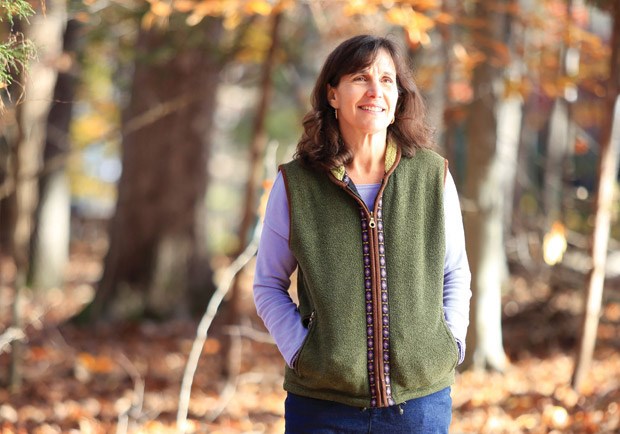
Rosaria Champagne Butterfield is the author of The Secret Thoughts of an Unlikely Convert (Crown & Covenant). She lives with her family in Durham, North Carolina, where her husband pastors the First Reformed Presbyterian Church of Durham.
















 While we pray for peace, we need moral clarity about this war.
 We’ve got little information on Jesus’ appearance and personality. But that’s the way God designed it.españolFrançais
 How groups like Hillsong learned to let go of the literal in favor of creative collaboration.españolPortuguês






