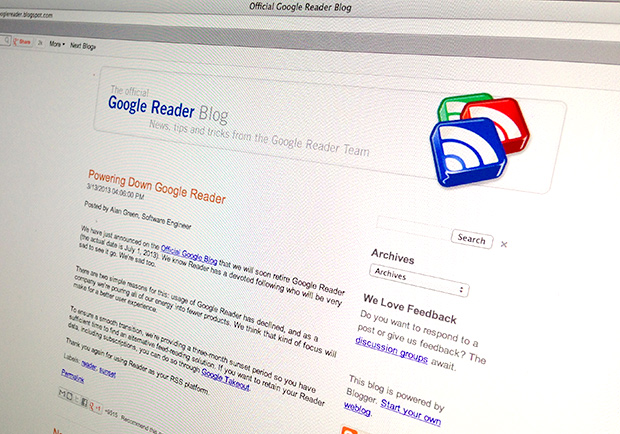
Google announced last week it would be closing the much beloved Google Reader web feed aggregator. Its users had been dwindling for a few years, as online reading migrated to the social web, to Facebook, Twitter, and Google+. Google Reader has become a virtual leaf in the wind, revealing the steady passing of a particular form of reading online. As the social web becomes increasingly dominant, the experience of reading in a sort of "virtual solitude"—without the distractions, flash, opinions, interpersonal tensions, reactions, judgments, peer pressures, and hurry of the social web—will become a much rarer one.
It is hard to regard this as anything but a loss. Google Reader offered web readers a private space online, a form much more conducive to attentive, contemplative, and independent thought than the frenetic rush, impatience, and emotional reactivity of much of the rest of the Internet. The social web seldom affords us the time, space, and silence that we need for reflection. While other services will take Google Reader's place, the departure of a player of Google's stature indicates the change occurring in the online ecosystem.
The closing of Google Reader is merely one of many ways in which forms of reading, the nature of texts, and the relationships that exist between the two rapidly change in the contemporary world. Although these changes are constant and occurring at an unprecedented rate, we are seldom disoriented by them, nor do we often appreciate how much has really altered in a brief span of time.
Occasionally something awakens us to the scale of the changes that we are living through. For me, a recent article by Julian Baggini, in which he describes burning an old set of the Encyclopædia Britannica, provided one such moment. Its ponderous volumes, once familiar symbols of the body of human knowledge, have been rendered obsolete, practically replaced by online sources such as Wikipedia. An authoritative physical and published source, representing a consensus of an academic elite, has given way to the virtual and protean network of Wikipedia entries, where the once-sharp contours of human knowledge disappear and entries on the subject of Hegelian philosophy rub shoulders with those on Nyan Cat.
Both the passing of the hard-bound Encyclopædia Britannica and of Google Reader represent milestones in the digital age. They remind us that reading and our engagement with texts aren't static realities, but quite changeable. New technologies make possible new ways of reading, but also call for discernment. While new contexts, media, and gadgets can powerfully serve both reader and text, there are many occasions when our reading can benefit from limits.
Today's web pushes us to read more, click more, share more, and comment more, but there's something comforting about less. As readers, we may also seek out a form that's slower, quieter, simpler, and less distracting. Neither nostalgic resistance to new technologies nor wholesale and uncritical adoption of them is the answer, but rather a prudent and discerning understanding of the nature of our particular texts, our appropriate relationships to them, and the tools that facilitate those relationships.
This wise mindfulness is especially necessary for readers of the Scriptures, texts which require and invite forms of reading and engagement that do not come so naturally to us. Our habits as modern readers have been forged in a world with a myriad texts vying for our attention. Modern texts are written and produced for such a world, as are their formats and our reading habits, tools, and technologies. Ancient readers would struggle to understand our valorization of speed-reading, for instance. Few of them could even read silently: texts were typically read orally in groups or alone in a muffled voice. In Space Between Worlds: The Origins of Silent Reading, Paul Saenger observes that the way that texts were written had to change before silent and faster reading could become mainstream.
As we explore history of texts and reading, we soon discover just how much our relationship with the Scriptures has developed. The formats within which we encounter them have altered, as have our typical forms and contexts of engagement, and the skills and habits we bring to them. With these changes, as with the move from the Encyclopædia Britannica to Wikipedia, come new imaginative frameworks that shape our conception of the sort of thing that the Scriptures are and consequently our reading of them.
The mass-produced, privately owned Bible—with all books in a set order between two covers, divided into chapters and versified, accompanied with textual tools, typically read silently and in solitude by the individual believer—was not merely a neutral means of communicating the Scripture's unchanging content, but a powerful new technology. This new technology empowered a deepening relationship with the Scriptures on many levels, yet also offered limiting and occasionally misleading pictures of the sort of thing that the Scriptures are. It has facilitated some less healthy forms of engagement, and has led to a forgetfulness and neglect of many forms of reading and encounter with the Scriptures that have been integral to the life of the people of God in other ages. In the present, in addition to the mass-produced Bible, countless millions are encountering the Bible as a digital text: on Bible software programs, e-readers, and online.
Google Reader and the Encyclopædia Britannica may seem to be living fossils of past periods in our technological development, yet, when it comes to developing a deep, fitting, and fruitful relationship between reader and text, can nonetheless often serve better than their "more advanced" replacements. They serve as reminders of our need to be critical and discerning adopters of new technologies and their associated habits and images of truth. Rather than putting our technologies in the driving seat, we must be guided above all by the end of serving the relationship between readers and text. We must employ the tools most suited to that task, no matter how advanced or primitive they may be.
For Christians these lessons are especially pertinent. We should be characterized by deep theological awareness of the nature of the Scriptures and a critical attentiveness to the potential and limitations of the forms and formats in which we encounter and approach it. As we learn where particular tools serve our ends and where they hinder them we can become masterful readers, adept at and wise in the employment of various forms, technologies, and habits to facilitate a deeper relationship with the deepest text of all.
Alastair Roberts blogs about biblical theology, the sacraments, and Christian ethics at http://alastairadversaria.wordpress.com.