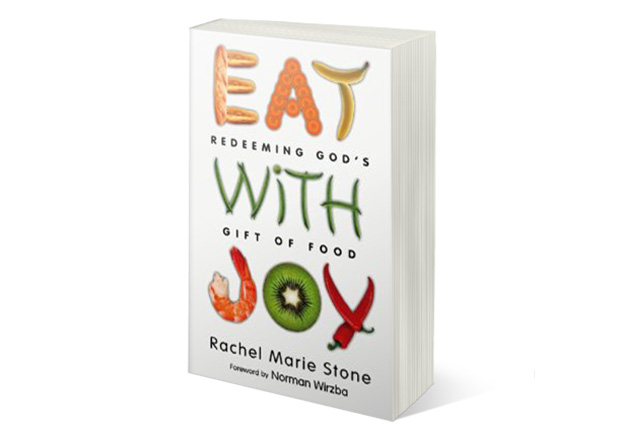

"Eating with joy means accepting food as God's gift …. It means choosing food … that affirms a flourishing life for the land, for the animals and for the people that bring us our food. It means eating food with others in ways that lead to our mutual health and flourishing. And it means embracing our creativity as people made in the image of the Creator God to prepare food in ways that celebrate God's gift while bringing enjoyment to all our senses."

So writes Rachel Marie Stone in her debut book, Eat With Joy: Redeeming God's Gift of Food (InterVarsity Press)—but Stone hasn't always eaten with joy. For 10 years she struggled with an eating disorder "only slightly more dramatic than the eating disorder that most North Americans have." Today, however, she's a joyful wife, mother, gardener, meal-maker, and writer—often about food.
Writer LaVonne Neff corresponded with Stone about connecting with God, his creation, and his people through the way we eat.
You've written that your decade-long fear of food was tied to your theology. What changed your attitude?
For many Americans, food is connected to morality. Menus describe chocolate desserts as "sinful," and labels describe healthier choices as "guilt-free." People speak of being "bad" when they've broken their chosen dietary rules and "good" when they haven't. I believed that keeping my weight down and my intake "pure" was crucial to keeping the rest of my life ordered and in check. I believed this meant not caring about food—or pleasure—very much, that apathy toward food, except as healthy fuel for the tank, was what pleased God.
As to what changed my attitude and allowed me to eat with joy—a lot of things. I'm a reader, and so I always turn to books when I'm trying to figure something out. But finishing school—and thus leaving the student life of cafeteria and meals-on-the-run—and starting a family helped, too. I realized that I loved to cook, and that, in spite of all the dieting, I loved food. I had always wanted to have a vegetable garden, and as a young married person, I finally did. Through these things I began to see food as a gift of the earth, and thus a gift from God. It was not something God was holding out to tempt me. It was something God was holding out to entice me, to invite me to taste God's goodness.
Eating with joy is great, but lots of us get downright giddy—and our joy eventually becomes diabetes and heart disease. Shouldn't we worry about that?
Diet-related illness is serious, and it disproportionately affects people who are poor, so it's something to worry about on multiple fronts. Childhood obesity is a problem, too. But I don't think joy and that old word temperance (meaning moderation) are mutually exclusive. Joy in food should include awareness of the things God cares about. God cares about those who are hungry, those who suffer the effects of a nutrient-poor but calorie-rich diet, those who must work in farm fields and slaughterhouses at low wages and in unsafe conditions. Thinking about the real people and serious issues involved in food can encourage us in temperance.
Joy isn't a free-for-all. It's the deep pleasure that comes by slowing down, recognizing God's gift, remembering those who don't have enough, appreciating the labor and resources involved in bringing the food to the table, and purposefully eating with others. If other cultures can blend pleasure in eating with relatively low rates of diet-related disease (as do the French, as do the Italians), so can we.
So what do you do if your kids' grandparents regularly stuff them with things that aren't good for them?
Depends on how close the grandparents live! It's easy to go overboard on dietary rules and then apply them across the board so that there's no room for celebration. If your kids eat a reasonably good diet and are in reasonably good health, there's room to go a little crazy at Grandma's, as long as that's not every few days. Of course, in our culture, it's easy to think that every day is a reason for celebrating with some oversize dessert—which isn't reasonable. But swearing off all treats isn't reasonable, either. Too often there's this all-or-nothing mentality. You can see it reflected in the way people speak of their diets as a part of their identity: I am a vegan, for example.
Is the evangelical community starting to pay more attention to joy in the created order?
I think we are. Maybe we are moving away from a disembodied, "spiritualized" understanding of our faith and noticing that we have bodies, that we have senses, and that far from being a hindrance to our spiritual lives, these things can help us notice what God loves. And it's starting to be acceptable in evangelical circles to assert the importance of creation care, of recycling and reducing carbon footprints, of respecting animals, and so on, without being branded a "nature-worshiper." I don't think this was the case even 10 years ago.
You quote N. T. Wright on the importance of "the small but significant symbolic act." If a Christian wants to eat joyfully, what's a good symbolic act to start with?
Try to eat with someone for most meals. Ultimately, eating with joy is about connectedness—with God, God's creation, and with others in Jesus' name. There's a reason why we break bread together as Christians, why the early church's services looked more like a meal than a performance. Eating together brings us closer to the people we're eating with and gives us a glimpse of the hospitality of God. We can't change the whole system (or even ourselves) overnight, but little changes can add up to something big.