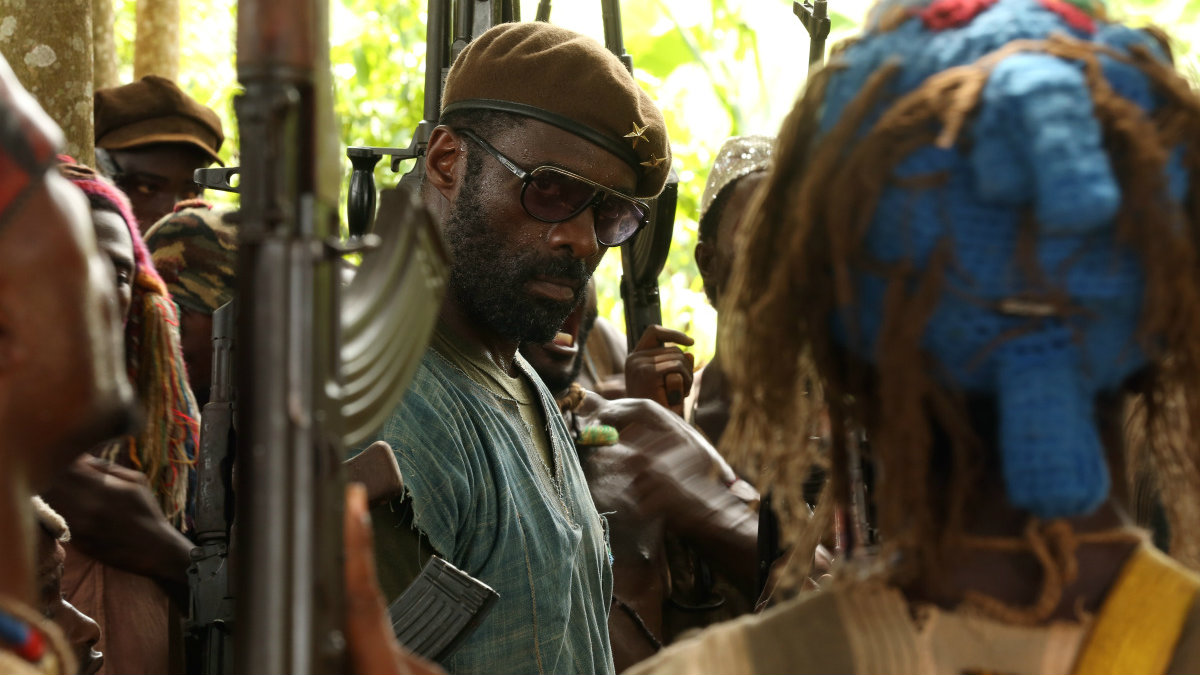
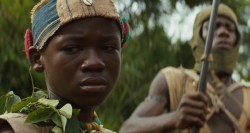
About an hour into my Toronto International Film Festival 2015 screening of Beasts of No Nation—Cary Fukunaga’s beautifully and elegantly heartbreaking depiction of boy soldiers in an unnamed African country—my compassion reservoir ran dry.
Don’t get me wrong. The film is a great work of art and a solid achievement for Fukunaga and star Idris Elba. For the first hour or so I was grateful: it pulled me in and gave me a glimpse of the horrors I normally avoid by steering clear of CNN and NPR.
 Then, in a flash, I remembered I had felt something similar last year when watching The Search, Michael Hazanavicius’s grimly pessimistic depiction of human suffering wrought by war in Chechnya. Plus I knew I had a screening of Septembers of Shiraz coming up, which featured Adrien Brody as a Jewish merchant tortured at the hands of Islamic guards in revolutionary Iran.
And I knew, with something approaching certainty, that if I made it back to Toronto in 2016 or 2017, there would be a film that reminded me of the plight of Syrian refugees that was playing out in real time while I tried to play compassion catch-up at Roy Thompson Hall.
My ever-gnawing fear at such events is that these prestige movies raise our consciousness for an hour or two and then are quickly forgotten. They might even speed the process of allowing us to forget by convincing us that we have done . . . something.
We’ve watched a film, informed ourselves, told our neighbor, shed a few tears.
Rightly or wrongly, I tend to give the artists themselves a pass. Sure, some probably gravitate towards theses prestige projects as a shortcut to awards or recognition—but I suspect most are sincere. And they have made a film.
I also used to give myself a pass, arguing that as a journalist I helped get the word out so that others could have their consciences pricked and their awareness raised. But I find this line of thinking increasingly unsatisfying. It makes my relationship to the art strictly professional, not personal—and I think I would continue to watch even if I couldn’t write, or wasn’t paid.
But to what end?
 Netflix
I realize this is a question that extends beyond these sorts of films and touches on the larger question of what functions any art serves in society. We can, and do, continue to make aesthetic arguments about art with which I agree, regardless of the content of the art itself. For example, as a believer in Christian disciplines, I think practice listening to anyone, including artists, is never without some benefits.
But those are answers better suited for a classroom seminar than a mid-movie existential, professional panic. How was I going to make it through the second half of this movie, much less move along to my next screening when the lights went back up? Here are three fumbling attempts at an answer.
First, I thought about one of my wife’s more regular admonitions to me: don’t make the perfect the enemy of the good. In a perfect world, or a better one, or one that I was better in, I might be able to spare more time and invest more energy in the poor that are always with us or the suffering that are always making demands on our time, attention, and pocketbooks.
It should be obvious (and I hope not controversial) to any Christian viewer that the needs of the world outweigh our capacity to help. The only way to avoid the feeling of being overwhelmed is to withdraw completely. That response is neither Biblical nor realistic—but it’s our impulse. There is a reason why one synonym for “entertainment” is “diversion.” If our only use of the arts is to consume escapist fare, if our consciences ever stop pricking us, then I think we are in danger of something greater than compassion fatigue: compassion neglect.
My wife is also fond of reminding me to not neglect the little steps. I have a problem solver’s mentality. I jump into projects with both feet and throw my energy at obstacles until I have them under control. And these are great attributes for some walks of life, but a recipe for burn-out and despair for others.
So maybe it is less important that I completely solve the problem of child soldiers in Africa than that I stand up for and help a single neglected or abused child I meet today. Perhaps if I can’t help Jews escape Iran, I can confront the co-worker who makes an anti-Semitic joke in the next cubicle. It is primarily in our relationship to our neighbor, not in our international politics, where our faith can have the greatest return on our investment.
 Drafthouse Films
Our personal relationships go a long way towards creating the communities in which we live. Those communities, in turn, are the voices that inform state and national dialogues, and, eventually, speak to the broader world.
And finally, I am a believer in being Spirit-led. For many, “discernment” in movie choices is simply a watered-down euphemism for rejecting anything that is not openly evangelical or rated PG.
But God knows my heart, my strength, and my abilities better than I know them myself. Perhaps a few moments in prayer when the next festival catalog comes out—only six months until SXSW—might be a more productive use of my time than scanning ad copy or Rotten Tomatoes. What might God want me to see? Which of the world’s many problems might God want me to think about?
 Netflix
Go into a festival with this attitude, and even the worst films have something to tell us about how desperately the world around us is hurting.
The great folk singer Harry Chapin once sang, “It’s not enough to listen / it’s not enough to see / when the hurricane is coming on / it’s not enough to flee.” According to Claude Rakisits in Refugee Survey Quarterly, approximately 300,000 children are part of regular and irregular armies in the world today.
I did not know that yesterday. Today I do. Will that change how I live tomorrow?
Kenneth R. Morefield (@kenmorefield) is an Associate Professor of English at Campbell University. He is the editor of Faith and Spirituality in Masters of World Cinema, Volumes I, II, & III, and the founder of 1More Film Blog.
CT film critic Mark Moring also took a look at socially conscious documentaries back in 2009.