With the urgency of a Baptist preacher with a judgment day sermon, the former politician is spreading the bad news of global warming—including in a new film. Christians would do well to listen up.
Al Gore is back. Not as a political candidate, but as a Baptist preacher with a moral message. His favorite sermon is about the judgment day that will come upon us if we do not mend our ways and stop contributing to global warming.
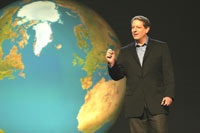
Al Gore preaches the message of global warming
In the five-and-a-half years since he won the popular vote but lost the presidency, Gore has talked to more than a thousand different local audiences about climate change. And among those he has convinced is film producer Lawrence Bender, whose credits include the less than savory Reservoir Dogs and Pulp Fiction as well as the more redemptive Good Will Hunting. Bender is now helping Gore preach his jeremiad to a still wider audience by filming his presentation and getting it distributed to America's cinemas.
An Inconvenient Truth is not entertainment. It is a filmed lecture, and it is an effective introduction to the subject of climate change. But for a filmed lecture, it engages its audience with its moral seriousness and its avuncular and folksy style. (Europe's killer heat waves of 2003 were "a nature hike through the Book of Revelations.")
And Gore uses every technique available to today's oral communicator: There are high-tech graphics to dramatize the temperature and the carbon dioxide concentrations. There are film clips from remote wilderness to show the break up of glaciers and ice caps. There are graphics to simulate the potential flooding of Manhattan and the drowning of polar bears. There is Matt Groening-style animation featuring friendly orange sunbeams, nasty green greenhouse gases, and a hapless little girl with a melted ice cream cone.
Gore also engages us by talking about his own life and showing us stills and film clips that go a long way to explain his passion. He introduces his own science teacher, a very early advocate for dealing with climate change. He talks about the impact of his son's tragic accident on his life. (In 1989, Albert III, then six years old, was almost killed in a car crash.) And he shows us the family farm, where the Gores grew tobacco long after the Surgeon General warned against the disastrous effects of smoking. Then he talks about how his family, in their remorse, turned to other crops after his sister died from lung cancer.
His sense of guilt and his anti-tobacco reformation underlie the moral seriousness with which he now approaches global warming. He knows that the Gores should have stopped growing tobacco (and that his sister should have stopped smoking) when they learned of its dangers. But they did change. The evidence on global warming is as threatening today as the evidence on tobacco was in 1964, when Surgeon General Luther Terry issued his warnings. Al Gore is convinced that we know how to change our ways as a society, and that it will be to our everlasting shame and destruction if we don't.
I write as someone convinced by the scientific warnings about climate change; other evangelicals have also taken note. I've listened to some of the world's best presenters on this issue and gotten to know Sir John Houghton, the retired climate scientist who for decades led the scientific panel of the Intergovernmental Panel on Climate Change (IPCC). And because I've been exposed to such careful arguments in favor of taking action against climate change, I found a few things about former Vice President Gore's material disturbing.
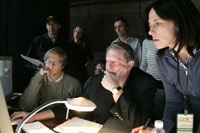
Gore (center, front) with other members of the film crew
A few complaints
My first complaint is that Gore consistently presents his audience with worst-case scenarios. Scientists always speak in probabilities. The best climate scientists present best-case, middle-case, and worst-case scenarios. This enhances their credibility. In the case of the IPCC folk, even the best-case scenarios they present would likely contribute to millions of deaths and major refugee migrations in poorer countries, while triggering economic disruptions in the developed world. But by citing only the worst-case scenarios, Gore is opening up himself and his cause to a potentially damaging critique or dismissal.
Second, Gore fails to mention (though the implications are present in his review of climate history) that the processes we now see in motion could cause a climate inversion: instead of global warming, the same chemical and thermodynamic interactions could cause a period of serious global cooling—another mini-ice age. This is another possible scenario, and it could be equally damaging to large populations.
Third, while mainstream scientists predict that the frequency and strength of freak weather events will radically increase, Gore ties specific weather events (such as Hurricane Katrina and the 2003 European heat waves) to the dynamics of the greenhouse effect. The scientists I talk with are very reluctant to tie any specific event to global warming, while confidently predicting that we will see more and more of such catastrophic weather.
Gore was present at the screening I attended for An Inconvenient Truth. In a discussion afterward, a young biologist raised these issues with Gore. She wanted to speak as a scientist, and scientists are supposed to be frank both about what they do know and what they don't know. But, she said, she was afraid that if scientists admit their uncertainties on global warming, those admissions will be used by special interests to undermine their testimony.
Article continues below
Gore's response: Science thrives on uncertainty. Politics is paralyzed by uncertainty. And therein lies the key to Gore's approach: he is a politician who is talking about science, and he doesn't want to muddy the waters by talking about probabilities. He wants action now—and he's right about that.
"It's human nature to want to take time to connect the dots," he told us. "But there will be a day of reckoning."
"Too many people go directly from denial to despair, but we have everything we need to solve the problem. Except political will. But in America, political will is a renewable resource."
The film ends with two exhortations. One is to visit the film's official website (www.climatecrisis.net). The other is to pray. But when you pray, it says, quoting an African proverb, move your feet.
An Inconvenient Truth is showing in limited theaters. For a complete list of theaters, visit the official website.














 While we pray for peace, we need moral clarity about this war.
 But let’s not mistake it for calling.
 Christian urban designers and developers explain how their faith affects their work—and how their work affects your faith.