Oliver Stone's W, which releases this week, is the latest of many movies about pols and politics, but whether they actually affect election outcomes is hard to say.
Hollywood and Washington have never been the most comfortable of bedfellows. There is a mutual skepticism—sometimes disdain—between the two, and yet they are bound up together as closely as two American cultural institutions could possibly be. Politics and Hollywood go together like baseball and hot dogs, fireworks and the 4th of July.
Movies are constantly being made about politics, and politicians—particularly Democrats—often use Hollywood for their own purposes. The relationship is typically amplified in election years, when partisans on both sides use any and all media to sway voters one way or another—and mud-slinging 30-second TV commercials are only the beginning.
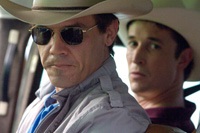
Josh Brolin as George W. Bush
The latest example of this hits theaters this week: Oliver Stone's W, a biopic about George W. Bush, releases on Friday—conveniently, just two weeks before the presidential election. Though Stone claims the film is a "fair and balanced" portrait of the President, he also admits, "A lot will shock you … I think in this present political state, the real George W. Bush might not approve of this movie. But this movie tries to understand George W. Bush—the good, the bad and the ugly."
Josh Brolin, who plays the title role, is a little more pointed: "It's about a guy who was flailing around, who pulled his life together at 40 and became president, and asks if he really wanted to be, should he have been, would it be better if he hadn't been and whether we all would have been better off if he'd become baseball commissioner." Still, Newsweek says "the widely reviled Bush comes off better than you'd think." At any rate, W will doubtless be a polemic for Bush-haters and defenders.
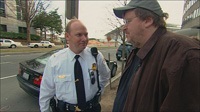
W is just one example of "election year cinema" that may or may not have been made in an attempt to sway voters. Exhibit A in the genre, of course, is Michael Moore's Fahrenheit 9/11, released in the summer of 2004. The film—the highest grossing documentary of all time—attacked Bush relentlessly on the Iraq war (among other things) in an effort to galvanize the anti-Dubya camp and stymie his bid for re-election. The film, which released on DVD just weeks before the election, may have stirred up emotions and even swayed some voters, but it didn't keep Bush from seeing a second term in office.
Michael Moore confronted by a secret service officer
So, do these films "work"? I.e., do they sway voters?USA Today considered the question in 2004 with the release of Fahrenheit 9/11 and the lesser-known Silver City (starring Chris Cooper as a grammatically challenged, born-again president—clearly spoofing Dubya). "Nobody walks out of a film and says, 'That's it. I'm changing my vote,'" said Silver City director John Sayles says. "It's part of a conversation, which includes CNN, Fox News and the entertainment media."
There's no Fahrenheit 9/11 this year, but Moore—never one to sit idly during an election battle—does have a small contribution. Slacker Uprising, a 97-minute documentary of Moore's 2004 tour of college campuses (where he urged young people to vote for John Kerry), didn't get a theatrical release, but is available for free download online at slackeruprising.com. Apparently Moore—who personally financed half of the film's $2 million budget—hopes to bolster grassroots momentum for Barack Obama by giving a "reward film" to his fans and hoping they share it with their friends, host viewing parties, etc. Moore admits that he's preaching to the choir, but he hopes it will energize the left and give them momentum to push through to the election's end. "The choir needs a song to sing every now and then," Moore has said.
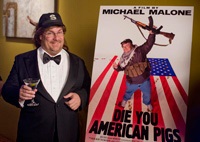
It's not Moore's only cinematic presence this fall, however. He's also he subject of parody in the new right-wing comedy, An American Carol, from conservative producer/director/writer David Zucker. The satirical film stars Kevin Farley as "Michael Malone," an infamous documentary filmmaker leading a slapstick campaign to abolish the Fourth of July.
Kevin Farley as Michael Malone in 'An American Carol'
"I've always been a very center-left Democrat," Zucker told USA Today. "I'm conflicted with a lot of Republicans. I don't believe nuclear power is the solution or more drilling. We have to change the cars." But Zucker, who says he'll vote for John McCain, says he still backs Bush: "I just think despite all the mistakes, we haven't had another terrorist attack. This is a tough job being president."
Taking Michael Moore's place this year as the resident election year liberal provocateur is Bill Maher, whose Religulous may not be directly about politics, but is certainly meant to offend the red state sensibility. And then there's Ridley Scott's Body of Lies, which according to The New York Times showcases the CIA's "deceptions, betrayals and dispensable attitudes toward humanity" in its operations in the Middle East.
Another highly partisan, election-year film worthy of mention is HBO's highly praised Recount (now on DVD), which revisited the chaotic days after the 2000 presidential election in Florida. Though the film angered many Democrats because it blamed Gore for letting Bush "steal" the presidency, it also served to reinforce the theory that the Republicans did, in fact, steal something, which is perfect fodder for the prevailing "Republican corruption must end!" election season theme.
Article continues below
Lots of left-leaning flicks
Of course, this "election year" hasn't really just been a year long, but more like three. Films like Syriana (2005) kicked off a three-year span that has been riddled with left-leaning movies no doubt meant to sour viewers on Bush, Republicans, and their respective foreign policies. Countless anti-Iraq films, including Rendition (2007), Lions for Lambs (2007), In the Valley of Elah (2007), Redacted (2007) Grace is Gone (2007), and Stop-Loss (2008), have come and gone with negligible box office and cultural impact, as have the innumerable Iraq/Afghanistan documentaries, including No End in Sight (2007), Iraq in Fragments (2006), The Ground Truth (2006), and Taxi to the Dark Side (2007).
Though these films weren't well received by audiences, it is possible that their collective impact—the sheer number of films that are so critical of the Republican administration—did affect the 2006 congressional elections, which turned the tide decidedly in the Democrats' favor.
Kevin Costner in 'Swing Vote'
Sometimes the biggest election-year controversies in Hollywood are about the films that are not released. This fall, conservatives have decried the fact that the first DVD release of The Hanoi Hilton, a 1987 drama directed by conservative Lionel Chetwynd, is being held by Warner Bros. until the week after the election. The DVD features an interview of John McCain speaking about his imprisonment in the Hoa Lo prison during the Vietnam War. Saying that they wanted to avoid "electioneering," Warner Bros. has called off pre-release screenings and toned down the promotion for the film, which for decades has been a favorite of conservatives and military veterans because of its sympathetic portrayal of American prisoners of war.
That isn't the only conservative-leaning film missing from DVD shelves prior to the election. Since airing on ABC in September 2006, The Path to 9/11—a documentary written by conservative screenwriter Cyrus Nowrasteh—has never seen a DVD release. The controversy has been chronicled in the documentary, Blocking "The Path to 9/11" (released October 14 on DVD), which argues that liberals have blocked Path's DVD release in order to protect the legacy of the Clintons, who are implicated in the ABC documentary for their lackluster attention to Osama bin Laden pre-9/11.
Article continues below
Some election-timed films, it should be noted, are not quite so partisan, but more just reflections on the election process itself—like this summer's Swing Vote, released on August 1, which takes satirical aim at the extreme lengths politicians go to in order to garner votes. Other election-themed films to be released this month include Choose Connor, about a 15-year-old old boy who becomes a "youth campaign spokesman" for a congressman's campaign, and Frontrunners, a documentary about a New York public high school student council election touted as "a microcosm of the U.S. Presidential elections," displaying "politicking and pluralities through the lens of the adolescent experience."
These films join a long tradition of films about elections, such as Primary Colors (1998), Bad Roberts (1992), Wag the Dog (1998), Man of the Year (2006), and the influential 1960 documentary, Primary. That last film, significant in the history of ciné ma vé rité documentary film style, followed John F. Kennedy and Hubert Humphrey for a week during that critical election's Wisconsin primary. It may not have directly influenced the outcome of the election, but it did give audiences unprecedented access to the everyday activities of presidential candidates on the campaign trail, and perhaps contributed to the "JFK as media darling" phenomenon that was ultimately 1960's lasting election legacy.
Did movies help LBJ win?
It is hard to evaluate the extent to which political films have impacted historic elections. One could argue, for example, that in 1964, widely-seen films like Dr. Strangelove and Fail-Safe—films that played upon nuclear fears and cold war paranoia—helped elect Lyndon Johnson president. Johnson, after all, based much of his candidacy on nuclear fear—claiming that a Barry Goldwater presidency would certainly plunge America into nuclear war with Russia. But had these films not been released, would the election's result have been any different? Likely not. LBJ won the election by the fifth largest margin in history.
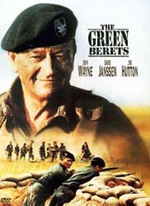
John Wayne in 'The Green Berets'
It's easier to recognize when a film fails to sway an election. When John Wayne's The Green Berets came out in 1968, at the height of the Tet Offensive, it was meant to shore up support for the Vietnam War and was made with cooperation from the military and LBJ's administration. It did not have this result, however, with the Democrats losing the White House to Nixon in the 1968 election and support for the war dipping to new lows.
Article continues below
More recently, The Contender (2000), starring Joan Allen and Gary Oldman, tells the (now ironic) story of a female vice presidential nominee for the Democratic Party who falls victim to a smear campaign by the Republicans. The film, released a month before the 2000 presidential election by a Democrat-leaning studio (Dreamworks), was clearly meant to advance the cause of Al Gore—and it may have … but not enough to put him in the White House.
Though Hollywood continues its efforts to influence the opinions of voters during election years, it's unclear whether their efforts are working—at least on a national level. According to The New York Times, it appears that at one documentary, 2006's American Blackout, may have affected a congressional election in Georgia. But Michael Cornfield, a politics prof at George Washington University, told the Times he was skeptical about the general influence of films: "I think they do reinforce and intensify people's feelings." But as to whether they influence how people vote, he said, "That's more aspirational than empirical."
Perhaps film isn't the best method of political propaganda; there just isn't enough evidence to back it up. But don't expect Hollywood to stop producing election-themed fare any time soon. As we've seen from Saturday Night Live this season, enjoying 50 percent higher ratings than this time last year, politics is good for entertainment. But is entertainment good for politics? Does it make a difference? The verdict is still out.
Beyoncé’s right. Whether listening to Cowboy Carter or reading theology, diversity is a good thing.
Khristi Adams
Do Political Films Matter?
1 of 5
Josh Brolin as George W. BushMichael Moore confronted by a secret service officerKevin Farley as Michael Malone in 'An American Carol'Kevin Costner in 'Swing Vote'John Wayne in 'The Green Berets'













 While we pray for peace, we need moral clarity about this war.
 We’ve got little information on Jesus’ appearance and personality. But that’s the way God designed it.españolFrançais
 Beyoncé’s right. Whether listening to Cowboy Carter or reading theology, diversity is a good thing.