Eduardo Verástegui used to play the Casanova role to the hilt, till God convinced him to change his ways. Now he's making redeeming movies, starting with the wonderful Bella.
Not long ago, Eduardo Verástegui was named one of the 50 Most Beautiful People in the world by the Spanish version of People magazine.
He was an impossibly handsome Latino soap star, and women around the globe threw themselves at him as a member of Mexican heartthrob pop group Kairo. He was a Calvin Klein underwear model. He played the leading role in the 2003 film Chasing Papi, where his character had three gorgeous girlfriends. He even was the requisite hunk of macho eye candy in a J-Lo music video.
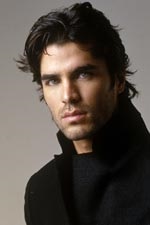
Verastegui in his modeling days
Verástegui was not only playing the stereotypical Latin lover. He was living the role. Money. Cars. Girls. You name it, he had it.
And then he left it all behind. Why? He recommitted his life to God and vowed to make only wholesome entertainment for the rest of his days.
Now, five years after making that decision, his vision becomes reality as Bella, a wonderful independent film about the things in life that really matter, opens in theaters this week.
In the movie—the writing and directorial debut of his friend and business partner Alejandro Monteverde—Verástegui plays José, a pro soccer star whose life is changed in an instant. He ends up as a chef at his brother's Mexican restaurant in New York, where he befriends a waitress named Nina, whose own life is turned upside down when she learns she is pregnant — and decides she doesn't want to keep the baby. She confides in Jose, whose compassion for her plight plays out in unexpected, and life-affirming, ways.
The film, winner of the People's Choice Award at the 2006 Toronto Film Festival, has the tagline, "One day can change your life forever," and to say much more would be to give too much away. But suffice it to say that it's a warm, delightful movie that Christians can embrace— indeed, so can anyone who enjoys a good story packed with redemption.
The power of a praying woman
So, how did a loose-living, self-described Casanova get from there to here? Not surprisingly, women played a key role—starting with his mother.
"There is nothing more powerful than the prayers of a mother," says Verástegui, 33. "When I was pursuing fame, pleasure, and success, my mother started going to her prayer groups and saying, 'OK, if my words don't touch his heart, one day my prayers will.'"
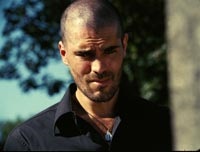
A scene from 'Bella''
His mother's prayers were answered through another female—a woman in Los Angeles who was teaching him English for the lead role in Chasing Papi, where he played the studly lover role for what would turn out to be the last time.
"She was a very wise lady who not only taught me English, but questioned a lot of things in my life," Verástegui says. "Like, 'How are you using your talent? Who is God in your life? Why are you playing the stereotype of Latinos instead of using your talents to do something positive?'"
Verástegui says that after six months of conversations, "I realized she was right and I was wrong. I realized that the reasons I went into this career were very superficial reasons, because I was superficial too. I had started out at 18, and I was just seduced by the entertainment environment, by the fame and the money.
"We [Latinos] have been stereotyped in movies as banditos, drunkards, prostitutes, criminals. And if you're good looking, then you're a Casanova, a womanizer, and a liar. And that's the person I had become. But this woman opened my eyes to the grace of God."
Verástegui clearly remembers the day that "God changed my heart and I had to repent of my past. And from that day on, I promised that I would never do anything that will offend God or my Latino heritage. I would never do anything to compromise my faith. That's the moment I realized that the purpose of my life was to know and to love God."
For four years, he didn't work, even though he was receiving offers—but they were "all for the same negative stereotype," Verástegui says. "I got to the point where I didn't have any money to pay my rent. But I was going through a purification process of changing my past and trying to follow Christ, and I knew that because of that, I may never work again. But I was fine with that.
"I wasn't born to be a movie star. I wasn't born to be a producer, or to be famous. I was born to know and love and serve our Lord Jesus Christ, and that's my only goal right now."
'To somehow inspire others'
Meanwhile, budding filmmaker/screenwriter Monteverde had already made a similar commitment of his own.
He wrote and directed Bella because "I wanted to use my talent to make a difference in the world, to somehow inspire others. I believe that the only thing you can take with you after you die is what you gave, and this is my way to give.
"I want to use film not only to entertain people, but to give them a message of hope, love, and compassion, without being too preachy. While writing and shooting Bella, I was very careful throughout the process that we'd never come across as judgmental. If we come across that way, we lose the whole purpose of the film."
Article continues below
Like Verástegui, Monteverde, 30, was once pursuing life in the fast lane.
Monteverde on the 'Bella' set
"Art has the power to change you," he says. "It can bring the worst out of you, and it can get the best out of you. I had both experiences. When I was 14, I saw a film about Jim Morrison [the troubled lead singer of The Doors], and it brought the worst out of me. After I saw the film, I wanted to imitate Jim Morrison, and if you know his lifestyle, it was pretty bad." (Morrison abused alcohol, drugs, and women, and died in 1971 at the age of 27, likely from a heroin overdose; an autopsy was never performed.)
Monteverde says the Holy Spirit intervened, and things quickly changed: "One day I woke up and felt very convicted of my lifestyle. I knew I was living a wasted life.
"Then I enrolled in film school, and things started falling into place. I was more focused on my path, more focused on the purpose of what God had for me. I changed my lifestyle and everything else, because everything was new—new friends, a new way of thinking. Now I look back at who I was before, I don't even remember being like that."
While a film student at the University of Texas, Monteverde slept on couches and on the mailroom floor because he used the "dorm money" from his parents to invest in a student film instead. "I didn't tell them," he now confesses. "But I was like, if I'm going to be in school, why do I need a dorm when I can use the money to make a film?"
So, while Monteverde slept on floors, the penniless Verástegui, facing his own impending homelessness, had a conversation with his best friend back in Mexico. Eduardo told the friend about his renewed commitment to God and his new professional goals, and the friend said, "You should meet my little brother, because he is going through the same thing. He wants to direct films with the same message that you want to act."
That little brother was Monteverde, and the rest, as they say, is history. Monteverde moved to L.A., where they started a film company, according to Verástegui, with just a cell phone to their name: "We didn't have any money," he says. "Just a big dream."
An assist from the Pope
The two men soon met Leo Severino, who had quit his job as a business manager at 20th Century Fox because, like Verástegui and Monteverde, his religious convictions were driving him to desire to make redeeming films. The three men formed Metanoia Films; metanoia is Greek for "conversion" or "repentance."
Article continues below
Shortly after forming their partnership, Severino invited Verástegui to join him on a trip to Rome where he arranged a meeting with Pope John Paul II just a few months before his death.
"It was a beautiful experience," Verástegui says. "I asked him to please pray for us and for Metanoia Films, so we can do movies that will bring people closer to Christ and elevate the dignity of Latinos. And just ten days later, we met Sean Wolfington . . . "
Which leads to how they funded the film. When Wolfington, a wealthy Miami-area entrepreneur, heard the pitch from the Metanoia partners, he decided to finance the $3 million project, which was shot in New York City in just over three weeks.
So, in some ways, a former Pope is partly responsible for the making of this film!
"It's amazing," says Verástegui, "because what are the odds? For four years, I had no money, nothing. I was turning down all these projects, and I just had to trust God. And the next thing you know, I'm meeting the Pope, who was an actor when he was very young, and he prayed for our company. And ten days later, we meet this guy, and they gave us the money, boom, just like that."
A love story, but not a romance
Monteverde wrote the script specifically with Verástegui in mind for the lead role of José. Loosely basing some of the characters on members of his own family, Monteverde says he set out to write "a love story that breaks the barriers of a traditional romance."
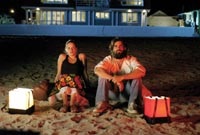
Versategui and co-star Tammy Blanchard in 'Bella'
"I wanted to write a love story that isn't just about the romance between a man and a woman, but about self-sacrificial love—and a story about how each other's pain becomes each other's redemption. And I wanted to make a film that shows there's always a choice that doesn't have to lead to moral pain."
Verástegui says that with Bella, Metanoia, and whatever films they produce hereon, his life now has new meaning and purpose—and passion.
"This is a movie that celebrates life, family, forgiveness, and all our values in a very subtle way," he says. "It's not preachy. It's not political. It brings people together.
"This is my career now. I'm passionate about Bella; this is our baby. It's a small budget film with a lot of heart, and we hope that Metanoia can do more and more films that will honor God. Our goal is that if God were on the set, or watching this movie, we wouldn't have to cover his eyes at any time. That's what motivates us, and that's why we hope people will come and see Bella."
To learn more about Bella, to see a trailer, and to see Eduardo's personal testimony on video, go to the official website.













 While we pray for peace, we need moral clarity about this war.
 Alcoholism among women is rising. Can the church help?
 The surprising argument that Saul of Tarsus was born into bondage.