Adapting a beloved, Pulitzer prize-winning, Oprah-endorsed bestselling book to the screen is never an easy feat. But such was the immense job tasked to John Hillcoat (The Proposition), director of the movie version of Cormac McCarthy's The Road, out in theaters tomorrow. A relatively unknown talent from Australia but something of a kindred spirit to McCarthy, Hillcoat approached The Road with great reverence, and the result is impressively faithful to the book.
CT movies critic Brett McCracken recently sat down with Hillcoat in Los Angeles to discuss the look of the film, its spirituality, and what it means to "carry the fire."
Your last film, The Proposition, seems to share some of the same tone and spirit as The Road. Both explore dark, bleak, apocalyptic depths. Do you see a correspondence between the two films?
The Proposition was actually inspired by Cormac McCarthy's Blood Meridian, or at least very influenced by it. I had the idea for an Australian western for a long time, but that book was a huge influence. In both The Proposition and The Road, the landscape is sort of primeval and ancient, which becomes a metaphor that I like. It creates such pressure for the characters that tests them all the time. It becomes almost like a third character. That's what I love about McCarthy's writing. And if you've ever been to the Australian outback, it really is like some ancient, primeval land.
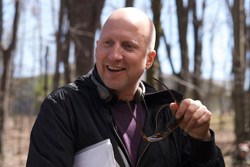
John Hillcoat on the set
The land is so crucial to The Road. How did you go from the book—which imagines this post-apocalyptic landscape—to the film, which has to visualize it?
The key there was to bring out the familiarity. So rather than a complete fantasy of the future, I wanted to try to embed it into our own deep memory in some way, because that's what the book felt like. To me it had more of an ancient quality as opposed to a futuristic quality. It didn't feel like a sci-fi thing. Simple things like the shopping cart with all the possessions in it—it's such a familiar image. It's the homeless. Those people are living their own apocalypse in a way. How do they get by each day? It's survival. It tests their humanity. As an extension of this idea of basing the world in the familiar, we shot the film in places like Mount St. Helens, where volcanic explosions destroyed all trees, and Pennsylvania, which has the leftover scars of the mining business—abandoned neighborhoods and freeways. But the most poignant of all was working in New Orleans, where they are still cleaning up from Katrina. We tried to get as much in camera as possible. Like the world of McCarthy, it's a quite real and visceral world that the actors are interacting with.
During the making of the film, you met with McCarthy a number of times. What was he like to work with?
Well, the legacy of McCarthy was a huge weight on my shoulders. The book is now the most translated book of modern times. Then there's the Pulitzer Prize, Oprah Winfrey, No Country for Old Men. I tried not to think about all that. But when I started talking with Cormac about it, he really released me from this burden. He said look, a book's a book and a film's a film. They are totally different mediums. He never asked for a script and I never gave him a script. He said I'm here, I'm available. He's a wonderful man. He's very kind, generous, deeply spiritual — a great mind and poet.
Is it true that some of the only direction McCarthy gave to you was to make sure the film kept as many of the book's references to God as possible?
Yes, that's right. Cormac is very intrigued by grace under pressure and a higher spiritual element than man. He's also interested in the struggle of faith. In many ways The Road is like a biblical tale or a parable. It's very simple: A man struggling to survive, haunted by all these memories, who then has a son born into this world. They come across all these obstacles that test them. So in that sense it feels almost like a biblical tale, and it certainly has an incredible moral to tell.
That leap of faith that the boy makes at the end is what it's all about. The boy is the one who saves the man. The man is under pressure, which we completely understand, and under great duress we see his humanity slipping away. It's actually the boy who saves him. He's the one with humanity. But where does the boy get this from? He's born into this God-forsaken place. Where does his "fire" come from? I think it's great that McCarthy sort of leaves this open to interpretation. It works on so many levels. For a lot of people, this idea of "carrying the fire" is clearly a spiritual thing. But for other people it might just mean "the higher power of humanity." But it's definitely also about faith.
Cormac and I did a long interview with the Wall Street Journal recently and it was about all this stuff. Cormac talked about how he was really struck and moved by people like Mother Teresa, who was always struggling with her faith, even at that level. To him that was incredibly profound. For him, The Road is about the struggle of faith, the obstacles on the journey. He created the world of The Road to challenge these people, like the book of Job. It's about the way that these characters react under duress. Under extreme pressure, the essence of humanity comes out. We can all put ourselves in the shoes of the man—because we see step by step with each challenge how he slides a little bit and loses a bit of his humanity. In the end it's the boy who gives back the humanity to the man. Cormac sees it as a spiritual lesson—about "carrying the fire," which is the spirit. He's basically saying, there is something else here.
Article continues below
The movie is bleak and dark and despairing on one hand but also hopeful. God feels very present, even though it's a pretty godless world. There are vestiges of God and Christianity.
It's quite in the forefront. The man talks about his son as if he were a savior. "To me he is a God," he says. "If he is not the word of God, God never spoke." And then with Robert Duvall's character, Eli, we tried to give him this mystic prophet feel—the way he talks about God and knowing that all this was coming. Cormac was very in favor of including all of this.
The scene where the man and boy take refuge in an abandoned church was very poignant and memorable, but I don't remember it being in the book. Is that something you added?
In my research for the film I came across an image of this church that had been bombed, and there was something about it that I felt was very poignant. So we went and found that actual church, which we didn't dress at all. It was exactly like how you see it in the film.
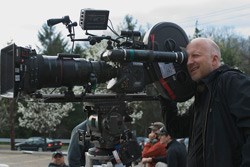
Hillcoat shoots a scene
It seems like you can't really make an apocalyptic film without touching on religion, and it's certainly in the air these days, with films like 2012. How do you think The Road is different from other apocalyptic films?
I think the problem with apocalyptic films is that so much is made of the big event that it actually becomes mostly about spectacle—and I think spectacle is very misleading. These images of mass destruction are made into this sort of fun exciting thing. It's more like being on a roller coaster ride. It strips away the questions of meaning and the human dimension. When it's that big, there's no way to relate to humanity on an intimate level.
The thing about this film is that we don't actually see whatever big event happened. We don't know what the apocalypse actually is.
Yeah, instead of dealing with the macro vision of the apocalypse, Cormac puts The Road into the here-and-now by focusing on this human relationship and how they're on this journey. At its heart, The Road is just a very fragile love story. To me its one of the most beautiful stories I've ever read. It's heartbreaking and hopeful.
Article continues below
I think the apocalypse is a projection of our worst fears as a human race. Personally we reach our own apocalypse in the sense that we all reach our end. I actually think of the apocalypse more as a metaphor—as sort of our worst nightmare. Although having said that, the way that the whole world is turning into consumers now—the strain and pressure that is put on the planet and environment is a serious concern. I didn't want to say this overtly in the film. I wanted to honor the book and not spell it out. But I think it's implied in the landscape and in the natural world of The Road. So often in apocalyptic films we get the scenes of the Statue of Liberty and all the icons of the urban man-made world, and you forget the sheer force of nature. That's why I love deserts. It reminds us of our smallness. We are dwarfed by the power of nature. We humans feel like we are in control, but in his works, Cormac pinpoints a real vitality and force in nature that is so much bigger than us.
Do you feel like The Road can almost be considered in the prophetic genre, as a sort of reminder of what the future might be? If, for example, we don't take care of the environment?
Yeah, actually this is why we wanted to ground the film not in fantasy but reality. The thing is, we've been given the warnings — not just in the environment, but in fragile economies and things like that. There are so many wake-ups calls. And yet fear is the enemy. I love Roosevelt's statement, "There is nothing to fear but fear itself." And you actually see this in The Road. It's because of fear that the man is not able to make the kind of leap of faith that the boy does.












 While we pray for peace, we need moral clarity about this war.
 As my doubts about his teachings grew, so did a secret fascination with Jesus.
 The plan would organize UMC churches in four global regions, with each given more leeway around same-sex marriage and other theological issues.