The Best Two Years is very much a "Mormon movie"—it's about Mormons, by Mormons, for Mormons. The fascinating thing is that it may have real interest for evangelical Christians—especially those who consider the Church of Jesus Christ of Latter Day Saints a non-Christian cult, but may have more in common culturally with Mormons than they ever would have imagined.
This isn't the first "Mormon movie," either. Several predecessors are included in the "Christian" genre at Box Office Mojo—which defines the category as those movies "produced by Christians outside the Hollywood system to promote their principles." Alongside such titles as The Passion of The Christ, Left Behind and Luther, you'll find LDS titles like The Book of Mormon and Latter Day Night Live.
The live theatre tradition among Mormons goes back a long way, and their strong affirmation of performing arts has yielded a niche-market film industry worth paying attention to. Films about Mormons—like The Other Side of Heaven and God's Army—are showing up in neighborhood video stores, which is where you'll probably find The Best Two Years once it finishes its limited theatrical run. (According to the production company's website, it's "Now Playing Across Utah—Coming Soon to Select Cities.")
Kirby Heyborne, K.C. Clyde, and Scott Christopher
Some reviewers are cautiously hailing this charming but flawed story as the best Mormon film ever. It's very much in keeping with the spirit of Mormon theatre; in fact, it began as a stage play that was wildly successful with Mormon audiences. It's about evangelism, but it's not primarily evangelistic; it's confessional. Like pageant plays about Mormon settlers making their way to the Promised Valley, this story celebrates the community by giving witness to its shared experience. The opening song makes that connection: "I believe that the Mormons make the best pioneers, so I'm going to the land of the tulips, I'll be knocking out my best two years …".
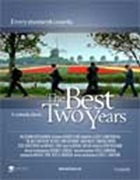
The poster gives the set-up. Against a postcard-gorgeous background of windmill and poppies walk four black-suited young missionaries. The first two stride purposefully forward, oblivious to all except their mission. The fourth sees only the book he studies intently. But it's Missionary Number Three who breaks the symmetry, his body turned away from us, snapping a picture as he walks.
Those are Elders Johnson and Van Pelt out front. They're men on a mission, quite literally, and all's right with the world. They've got girlfriends back home, their partnership is working great in a goofy, dorm-room put-down kind of way and most important, their numbers are up in all categories—Discussions Taught, Books of Mormon Placed, Referrals Made, Proselytizing Hours Logged and Challenges Issued. (They fill out a Weekly Statistics form that looks eerily like a baseball score card.)
The one with the spectacles bringing up the rear is the newbie, Calhoun, a nerdish, over-eager convert who tries too hard and has no aptitude for the task at hand.
But Missionary Number Three would rather shoot pictures in the park than work his way through a tightly scheduled "To Evangelize" list. They're running late, but it doesn't phase Elder Rogers to take a sudden detour for Dutch baking from a roadside stand. When the squad returns home, he's the one who plays with kids in the street. Rogers, played by K.C. Clyde, won't pass up any chance to stop and smell—or at least photograph—the flowers.
Clyde is nicely cast as this story's doubting disciple. Low key and sardonic, you gotta like this guy. His wryly observant sense of humor and an unforced charisma leave no doubt Rogers would be one effective evangelist—if he'd only get his act together.
Which is precisely what the story's about. For reasons revealed over the course of the film, Elder Rogers long ago lost his original zeal, and now his very faith may be in question.
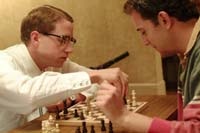
Checkmate: Elders Calhoun & Rogers at play
Clyde wins us over with his portrayal of this refreshingly round peg in very square hole, and his work is clearly the film's greatest strength. Unfortunately, it also points up the movie's greatest problem.
Once Rogers regains his faith, he snaps no more pictures, takes no more detours, buys no more stroopwafels. Either he or the writer can no longer take time for such peripheral self-indulgence. The character who insisted numbers don't matter is now running up a record tally, and there's no doubt the movie wants us to take that as an unqualifiedly good thing. More likely, many viewers will conclude this whole Mormon mission business is a pretty driven and life-denying endeavor.
Frankly, Elder Rogers is the only one of these guys I'd want to hang out with. He's savvy, doesn't get drawn in to the bickering of his dorm-mates, seems to relish the world with an artist's appreciation, and he wears his top button undone. What's not to like?
But that all changes when he recovers his flagging faith. He gets with the program and, for all we know, becomes pretty much the same as his much less interesting fellow missionaries. Ultimately he tells his partner, "It's all about the work."
Article continues below
What a pity.
This is essentially a relationship story, so the film's other problem is the superficiality of these relationships. Wacky dorm-room shenanigans wear thin pretty quick, and they really aren't an adequate way to explore relationships or character in the first place. The end result is sadly unaffecting: is this a script problem, or are mission-field relationships really this shallow? These boys share months or years together, but to judge by this film, it's only "time served"—the friendships are only, in the final analysis, about the work, and there's less of a bond among them than I'd expect after a half-decent weekend retreat. Some of the performances play into this problem, going for a two-dimensional comedy that's too broad to work on screen.
Elders Calhoun & Rogers discuss strategy
But the film does succeed in a number of ways. David Nibley is strong as Elder Johnson, and he does a nice job with Johnson's own long-awaited story reversal; if only it had come much earlier in the movie, we could have had some far more interesting character development there. Scott Christopher is just right as the potential convert, Kyle Harrison. The music is ear-catching, the exterior photography is eye-catching, and there are some effective uses of simple-but-nifty camera tricks, point-of-view and time-lapse shots that really enhance character development.
To its credit, The Best Two Years shows a refreshing willingness to acknowledge the foibles and possible problems with some Mormon missionary practices, but the story ultimately comes round to affirming the value of the whole enterprise. Christians may have objections to Mormonism, but viewers who can get past those concerns will connect at a human level with the sense of standing outside the prevailing culture, the passionate desire to have a testimony and share it with others, and the often painful tension between the mandate to evangelize and the immense personal and cultural barriers to carrying that out.
My own misgivings come down to the strong impression that, overall, the Mormon Church doesn't really get grace. There seems to be a pervasive belief that you have to earn your way—that you have to do certain things, not do other things, attain certain standards of righteousness and service, in order to qualify for various after-life perks, or maybe even eternal life itself. But the fact is that it's only Jesus' death that wins us eternal life, and on that point, there's just no wiggle room. Preach something different, and you're not preaching the gospel.
Article continues below
Apart from my affection for the open-hearted charms of this film, or my qualms about questionable artistic choices and story-telling weaknesses, my real concern about The Best Two Years is that it conveys a very dangerous message: you are what you earn. The soundtrack music calls Elder Rogers' predicament "a fall from grace," but I'm troubled by the cause it identifies: "I know deep down the truth is, I've been afraid to toe the line." I hear words about grace, but most of what I see tells me that, really, it's all about works.
Talk About It
Discussion starters
Elder Rogers goes through a spiritually dry time, doubting the value of many things he has believed. Can you relate? When that happens, how can we rekindle the fire of our "first love"?
Film critic Roger Ebert once noted the similarities between evangelists and salesmen. Are they alike? Are you comfortable with that comparison? How can we share our faith without being "salesmen"?
What similarities do you see between your faith and that of the Mormon missionaries? What differences do you see?
The Family Corner
For parents to consider
I have absolutely no idea why this film didn't merit a G rating. You won't find a more squeaky-clean film this side of Finding Nemo. Christian parents may want to talk with their children about some of the differences between their beliefs and those of the Latter Day Saints, and perhaps use some of the questions above in "Talk About It."
What Other Critics Are Saying
compiled by Jeffrey Overstreet
from Film Forum, 04/08/04
The Best Two Years is only playing in limited release, but it may draw the attention and concern of Christian viewers, as it is a project funded and promoted by Mormons.
Ron Reed (Christianity Today Movies) says the movie is "not primarily evangelistic; it's confessional. To its credit, The Best Two Years shows a refreshing willingness to acknowledge the foibles and possible problems with some Mormon missionary practices, but the story ultimately comes round to affirming the value of the whole enterprise. Christians may have objections to Mormonism, but viewers who can get past those concerns will connect at a human level with the sense of standing outside the prevailing culture, the passionate desire to have a testimony and share it with others, and the often painful tension between the mandate to evangelize and the immense personal and cultural barriers to carrying that out." Reed concludes that his personal objection to the film is its suggestion that eternal life depends upon good works rather than grace.
Mainstream critics who have seen the film are giving it high praise … although it is worth noting that almost all of those that have reviewed it are based near Salt Lake City, Utah.















 While we pray for peace, we need moral clarity about this war.
 How Jesus rescued a New Age psychic from spiritual darkness.
 The Dallas Mavericks were intended to be the first Christian team in the NBA.