On December 8, 1995, Jean-Dominique Bauby (Mathieu Amalric), the 43-year-old editor of ElleFrance magazine and a wealthy Parisian socialite, suffered a massive stroke which decimated his brain stem. When he awoke almost three weeks later, he found he was mute, and with the exception of his left eye, completely paralyzed. It was a rare condition the doctors referred to as "locked-in syndrome" — the body is completely useless while the mind is active and engaged.
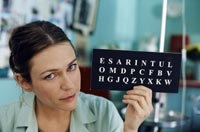
Unable to communicate except by blinking his eye once for yes and twice for no, Bauby's devoted physical therapist Henriette (Marie-Josée Croze) devises an ingenious if tedious method of rudimentary communication. By arranging the letters of the alphabet on a chart with those used most frequently at the top and those used least near the bottom, Bauby blinks in response to hearing the desired letter read off, and with agonizingly sluggishness and incalculable patience on the part of both reader and the responder, his mind begins to emerge. His first words since the accident are simply: "I want death."
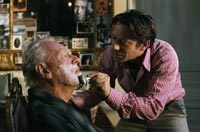
Mathieu Almaric (right) as Bauby, Max Von Sydow as his father Papinou
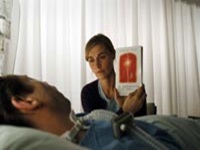
Gradually Bauby comes to accept his fate and when he does, his words pour forth. Contracted for a modern retelling of Dumas' Count of Monte Cristo at the time of his debilitating accident, Bauby lets it be known that he intends to fulfill his obligation. His publisher dispatches Claude (Anne Consigny), a woman of breathtaking patience, who sits with Bauby nearly every day, building what becomes a personal memoir about captivity and freedom out of mere sentences a day. The book took roughly 200,000 blinks to dictate, each word taking approximately two minutes to convey. Bauby would spend his evenings composing and editing the book entirely in his head, and dictate it one letter at a time the following day.
Bauby likens his captivity to being locked inside a diving bell, shut off from the world, feeling the smothering pressure of an infinite ocean, and hearing only the sound of his own voice trapped inside his internal prison. Even though he can't speak, we have access to the thoughts that, unimpeded, ricochet this way and that off the confines of his still vibrant and effervescent brain. Like a butterfly wiggling its way from of its cocoon and flying away, Bauby's imagination and memory are far from paralyzed. With his mind, Bauby discovers he can go anywhere, do anything, be with anyone. His fantasies begin with whimsical relish but quickly become trips into esoteric splendor and sublime tranquility. For perhaps the first time in his life, Bauby finds peace and serenity precisely at the moment of his greatest imprisonment.
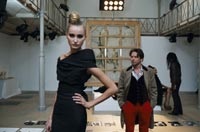
Before his stroke, Bauby was editor of 'Elle France'
Le Scaphandre et le Papillon, a testament to life, love, bitter disillusionment and gallows humor, was published in France on March 6, 1997 to rave reviews. Jean-Dominique Bauby died of heart failure two days later.
American painter/director Julian Schnabel (who learned to speak French in order to helm the film) has created a dazzling, courageous piece of art, a hybrid half narrative and half experimental. The Diving Bell and the Butterfly spends an audacious amount of time locked into Bauby's point of view. For nearly half the film, we, like the man whose eyes we share, see only what is straight ahead of us. The camera has an extremely limited range of motion, restricted by the gaze of a man who no longer has the ability to even turn his head. People's faces appear as enormous caricatures, hovering grotesquely close to the lens, inducing an odd sort of nausea.
Only slowly are we allowed to venture beyond Bauby's POV, to take in the action from the vantage point of one of his caretakers, or indulge in a flashback that grants a breathtaking reprieve from the film's subjective claustrophobia. One particular flashback, in which Bauby cares for his invalid father, played by the great Max von Sydow, movingly foreshadows his own coming reliance on the care of others.
Marie-Josée Croze as speech therapist Henriette
The Diving Bell and the Butterfly is an unquestionably gorgeous piece of filmmaking, both sharp and soft, dreamy and electrically charged, pulsating with life and energy. Janusz Kaminski, the cinematographer for Steven Spielberg's last 11 films, assembles images that slide, blur and drip like water paint in the rain. Ronald Stevenson Harwood's luminous script sets Bauby's own vibrant prose free and allows it to soar.
Mathieu Amalric is best known to American audiences as the Frenchman who helped the Israelis locate the perpetrators of the Olympics massacre in Munich. Here he delivers a masterful performance almost without moving a muscle. Given that it is half way through the film before we even see his face clearly, Amalric has only voice to spin this world into existence. Later, when we move beyond his POV, Amalric is nonetheless every bit as restricted as his body and face cannot possibly register any of the emotion he so vividly feels.
Anne Cosigny as Claude, Bauby's patient transcriber
With only a few exceptions, Bauby is completely surrounded by women. From his angelic physical therapists, his common-law wife Céline (Emmanuelle Seigner), the serene and unwearied Claude, and flashbacks involving his mistress Joséphine (Marina Hands), Bauby flirts with his pretty nursemaids from the confines of his own mind. He takes pleasure in glimpsing their low-cut blouses or skirts waving seductively in the sea breeze. These moments are never pornographic and do not represent anything particularly carnal—they are representations of his ability to be and feel human despite the fact that he can neither show his attraction nor act on it if he could. (In a particularly wrenching scene, Joséphine, who cannot bear to see her lover in his disfigured state and has not contacted him since the accident, calls on the telephone and it is the faithful Céline who must battle through her own agony to act as the translator between the two.)
Article continues below
At first glance, The Diving Bell and the Butterfly, which won Schnabel the best director prize at Cannes, appears unfilmable. However, not only did Schnabel and writer Harwood devise a way around the practical and technical limitations of the script, they also took what could have been a story steeped in nightmare and spun it into something that floats on the delicate, gossamer wings of unflinching honesty. That they did all this without once allowing the film to degrade into false uplift and schmaltzy "triumph of the human will" sentimentality is a feat of filmmaking and an extraordinary tribute to Bauby's life.
The Diving Bell and the Butterfly reveals that the human capacity for life, for love, and even for joy is not dependent on circumstances or even physical limitations, but is embedded in something far deeper and far more spiritual—a profound and primal realization that a human life is not the things we own or the jobs we have, but the people we love, the memories we share, and the obstacles we surmount together.
Talk About It
Discussion starters
How do you think you would have reacted if such a thing happened to you—completely paralyzed except for usage of one eye? How might something like that affect your faith?
Where is God when life seems unfair, or when tragic events occur that we cannot explain? Is it possible to still see his hand at work? Talk about a time when that has happened in your life.
The Diving Bell and the Butterfly reveals that Bauby was not the most honorable of men before his accident. Do you feel that his redemption, in the form of his memoir, is satisfactory?
Compare the message of this film to 2004's euthanasia-themed The Sea Inside. What makes the films so different?
Article continues below
The Family Corner
For parents to consider
The Diving Bell and the Butterfly is rated PG-13 for nudity, sexual content and some language. While there is no violence and little language, there are a few, brief moments that may give some pause. The film contains references to adultery, and shows partial male, non-sexual nudity (Bauby being bathed by hospital personnel) and a non-graphic sexual encounter that involves upper-female nudity.
The Dallas Mavericks were intended to be the first Christian team in the NBA.
Paul Putz
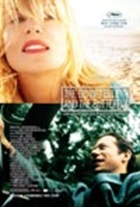
The Diving Bell and the Butterfly
1 of 4
Mathieu Almaric (right) as Bauby, Max Von Sydow as his father PapinouBefore his stroke, Bauby was editor of 'Elle France'Marie-Josée Croze as speech therapist HenrietteAnne Cosigny as Claude, Bauby's patient transcriber












 While we pray for peace, we need moral clarity about this war.
 But let’s not mistake it for calling.
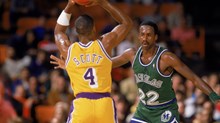 The Dallas Mavericks were intended to be the first Christian team in the NBA.