The first scene of Gone Baby Gone begins with main character Patrick Kenzie (Casey Affleck) musing, "It's the things you don't choose that make you who you are."
While this opening narration argues that a person's family, nationality and even neighborhood create a person, it's the silence at the end of the film that points to what later changes a person: choice.
It's a simple final shot—a quiet moment of Kenzie watching TV on a couch—but it says volumes about the moral choice the Boston private investigator just made. And incredibly, in our era of media loudly telling audiences how to think, these volumes are left up to interpretation. Did he do the right thing? Would he do the same again? Is the film arguing he was wrong—or right?
Casey Affleck as Patrick and Michelle Monaghan as Angie
Director Ben Affleck says the climactic moral dilemma—and ambiguity—is the very reason he chose to make this book adaptation the first movie he directed. "I wanted a character who makes a choice that will change the course of his life," Affleck told a screening audience. "And I didn't want to tip the scales with what I would have done or what I think of his choice. I wanted the audiences to ask themselves the big questions."
Like other recent down-and-dirty Boston crime dramas (Mystic River, The Departed), Gone Baby Gone is a kind of modern slum noir—a twisty and ambiguous tale set in a dark, profane world with no real black and white, but lots of gray. The f-bombs are constant. Most characters (besides the pretty leads) are awkward, unattractive and common. Drugs, sex and violence are stocks in trade. And no one is a complete boy scout. But in all this ugly realness, the moral dilemmas that frame the second half make it more than an unflinching display of bloody darkness. Instead, it's a redeeming and weighty exploration of justice, the cycle of poverty, and ends justifying their means.
Based on the fourth book in a series by author Dennis Lehane (author of Mystic River), the film follows Kenzie as he and his investigative partner/lover Angela Gennaro (Michelle Monaghan) are hired by a family to assist the police investigation of a missing four-year-old girl. Almost immediately, these private eyes prove helpful to the head of a kids' crimes police unit (Morgan Freeman) and two rough-and-tumble cops (Ed Harris and John Ashton).
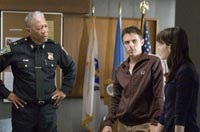
Patrick and Angie speak with police officer Jack Doyle (Morgan Freeman)
Because they are neighborhood natives, Kenzie and Gerraro are specially equipped to talk to residents who won't talk to cops. That said, they work for justice in a dark world. Early on, Kenzie gives up his secret to balancing morality with what must be done. He says he once asked his priest how to get to heaven but still protect oneself and family. In reply, Kenzie says, his priest recited Matthew 10:16: "I am sending you out like sheep among wolves. Therefore be as shrewd as snakes and as innocent as doves" (NIV). This seems to be a mission statement for the young scrappy investigator.
Now, Kenzie is no Christian poster boy. He's not perfect, and he's surely not living a consistent godly life—but he's clearly a soul struggling to balance faith with real life. He doesn't seem like a mere nominal Christian who goes to church, but lives as he chooses—instead, the two Afflecks paint this character as a man with much going on in his heart. Someone's knocking there. He's working out his faith with fear and trembling. He's guided by a moral compass. And he seems to be constantly processing advice and truth parlayed by his unseen priest and weighing it against the starkly different street justice all around him. He seems to be constantly trying to figure out what "shrewd as snakes and innocent as doves" looks like. But can that really be achieved?
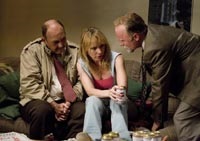
John Aston as Poole, Amy Ryan as Helene, and Ed Harris as Bressant
Kenzie is a black-and-white man of conscience dropped into a gray world full of gray characters. "Murder is a sin," Kenzie says to a cop. But the officer answers, "Depends who you do it to." Without a beat, Kenzie says, "It doesn't work that way." Will he keep that strongly defined sense of justice when confronted with choices of answering evil with evil, and doing good through not-so-good methods?
It's a tough line to walk, especially when Kenzie finds he's alone on an island with his moral code. He's haunted by unsolved crimes—even when others tell him to just move on. He's tormented by regret and shame for an impulsive and sinful decision—but is lauded for it by those around him. And when the film's big moral dilemma stares Kenzie in the face, his gut is to go in a direction no other character seems to advocate. But would we? What is the right answer? Is there a "right answer?"
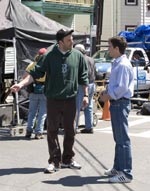
Director Ben Affleck on the set with younger brother Casey
With the meaty story, the Brothers Affleck can't go wrong. And they excel. Big Brother Affleck directs this technically superb film with confidence, passion and daring. Little Brother Affleck is one of the most talented young actors at work. Between this and The Assassination of Jesse James by the Coward Robert Ford, the younger Affleck surely has award nominations coming at the end of the year. In both films, he subtlety and quietly allows the deep insides and motivations of his characters to float to the surface. That his acting stands out among the-always-amazing vets Harris and Freeman is praise indeed.
Article continues below
By marrying a well-told, gripping and intense thriller with bigger issues and a three-dimensional lead, Gone Baby Gone isn't only hard-hitting and thrilling, it's also meaningful, emotional and resonating. There are scenes so frenetic and tense—because of both Ben's powerful vision and our affection for Kenzie—they feel like a horror movie. Others are quiet and still—like a man sitting on the couch—but yet are almost even more gripping because all of the action occurring on the inside.
Talk About It
Discussion starters
The movie's climax rests on a huge moral decision Patrick has to make. To you, why did he make the choice he did? What experiences, beliefs, and convictions do you think impacted/influenced him in that direction?
In that same situation, what would you have done? Why? Have you ever had to make a similar choice?
Is it ever OK to break laws to uphold them? Or commit evil to stop evil? What about taking an innocent life to save more innocent lives? Read 3 John 1:11, 1 Peter 3:17, Hebrews 5:14 and 1 Thessalonians 5:22. What is God's perspective on the end justifying the means?
What do you think Patrick is thinking in the final scene? What does that scene communicate to you? How do you think Patrick's choice will change him?
Do those who commit violent crimes forfeit their right to justice? Ed Harris' character argues that those who mess with children deserve to die; what's your response?
The Family Corner
For parents to consider
Gone Baby Gone is rated R for violence, drug content and pervasive language. Profanity, especially f-words, is nearly constant. Coupled with graphic gun violence, on-screen drug use, and grizzly issues such as murder, child sexual abuse, and kidnapping, it's a tough movie to watch, but addresses some moral issues and dilemmas worth wrestling with. But use discernment and caution. Take the rating seriously.
Migrant rights have been off-radar for many Panamanian Christians. But as pressures increase, some are speaking out ahead of this weekend’s general elections.
Casey Affleck as Patrick and Michelle Monaghan as AngiePatrick and Angie speak with police officer Jack Doyle (Morgan Freeman)John Aston as Poole, Amy Ryan as Helene, and Ed Harris as BressantDirector Ben Affleck on the set with younger brother Casey














 While we pray for peace, we need moral clarity about this war.
 Church movements need magnetic leaders. But the best leaders need more than charm.
 Migrant rights have been off-radar for many Panamanian Christians. But as pressures increase, some are speaking out ahead of this weekend’s general elections.español