Khalid Abdalla, Ahmad Khan Mahmoodzada, Atossa Leoni
Theatre Release
January 11, 2008 by Paramount Vantage
It's probably safe to say you've never seen kite-flying scenes like the ones that form the emotional and metaphorical core of The Kite Runner. The film, based on the best-selling book by Khaled Hosseini, is partly set in Afghanistan in the 1970s, and the simple act of flying a kite comes to represent a freedom of spirit that is lost when the nation is invaded by the Soviets in 1979, and then remains lost when the nation is dominated by the extremist form of Islam that characterized the Taliban.
But the two boys at the heart of this story do not merely fly kites, they "cut" them—by chasing other kites through the air and curling around their strings until they snap. Kite-flying thus becomes a form of competition—and with the help of modern special effects, the film sometimes uses aerial shots to show how the airborne kites pursue one another, like fighter planes hot on each other's tails.
Ahmad Khan Mahmoodzada and Zekiria Ebrahimi as boyhood friends Hassan and Amir
These sequences are impressive, but their very impressiveness threatens to take you out of the movie. The aerial shots might be necessary, in some sense, since those who have never played these sorts of games would probably not know what to look for if the kites were shown from the distant, earthbound perspective of the boys themselves; but even so, given how naturalistic the rest of the film tends to be, the artificiality of the kite sequences does, unfortunately, call attention to itself.
And so it goes for the film as a whole. You can respect the efforts by screenwriter David Benioff (25th Hour) and director Marc Forster (Stranger Than Fiction) to honor Hosseini's novel and tell a moving story about real people who just happen to be Muslims or Middle Easterners. And when you consider that the last time Benioff and Forster collaborated on a film, the result was the mind-numbingly contrived and far-too-clever-for-its-own-good Stay, you can definitely respect the fact that The Kite Runner relies on a cleaner, more straightforward kind of storytelling. Their intentions are clear, and they are good. It's just the execution that doesn't always work.
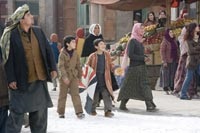
The boys amid the bustle of the city streets
The only narrative gimmick this time is a conventional flashback structure. The film begins in San Francisco in 2000, as Amir (Khalid Abdalla, who played an intriguingly humanized terrorist in United 93) and his wife Soraya (Atossa Leoni) await the arrival of his first novel. No sooner has the book arrived, than Amir gets a call from an old family friend—a call that sends the movie back in time over 20 years.
The time is 1978, and the place is Kabul. The young Amir (Zekeria Ebrahimi) and his friend Hassan (Ahmad Khan Mahmidzada) are enjoying themselves as boys in many parts of the world generally do—flying kites, running through the streets, and chatting excitedly about their favorite Westerns and Steve McQueen movies. Amir is the son of an affluent widower named Baba (A Taste of Cherry's Homayoun Ershadi), and Hassan is the son of their servant Ali (Nabi Tanha). And while the two boys get along like brothers, there is still a hint of the class division between them, as Hassan expresses unfailing loyalty to Amir, and Amir promises not to abuse that trust.
Hassan is so loyal, in fact, that he defends Amir from the taunts of their playmates even when Amir will not defend himself, and Amir's seeming weakness becomes a matter of concern for his father, who declares, "A boy who won't stand up for himself becomes a man who won't stand up for anything." Because Hassan and his father are Shi'ite and Hazara, whereas most of their neighbors are Sunni and Pashtun, Hassan himself is also taunted by the local bullies—who ultimately rape him for his loyalty to Amir, in a scene that has understandably generated some controversy even though it is very discrete, relying on little more than impressionistic close-ups of loosened belts and the like to give the viewer a sense of what is happening.
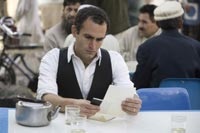
Khalid Abdalla as the adult Amir
Amir witnesses the rape, but from a distance—no one knows he is watching—and he never summons the courage to intervene. But the incident taints his friendship with Hassan, and ultimately impacts the relationship between their fathers, as well. And then the Soviets invade, so Baba and his son escape to the United States, leaving behind their lifestyle and most of their friends, at least for now.
If the early part of the film, in which an aspiring writer is haunted by questions of his own culpability after witnessing the rape of a childhood friend, is faintly reminiscent of Atonement, then the next section is more like The Namesake, as Amir and his father adjust to life in America while still following some of the traditions that they brought with them from their homeland. Amir grows up, goes to college, graduates, and falls in love with Soraya, the daughter of an old-fashioned and somewhat bigoted general (Qadir Farookh)—and their courtship, aided by Baba, is one of the movie's more delicate and charming episodes.
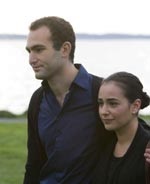
Amir and his wife Soraya (Atossa Leoni)
Eventually, we come back to that phone call in San Francisco, and by the time that we do, a handful of story threads have been tied up fairly nicely. So you almost expect the movie to come to an end in the next few minutes. But instead, the phone call triggers an entirely new storyline in which Amir goes to Pakistan to visit his father's old friend Rahim Kahn (The Nativity Story's Shaun Toub), and Rahim reveals one or two things to Amir which prompt him to return to Afghanistan itself, a land now dead and lifeless compared to the thriving culture we saw there before.
Article continues below
There is a compelling movie in this somewhere, but the film as made lacks a certain momentum. The episodic nature of the story, compounded by the awkward use of the flashback device and the overall blandness of the direction, the photography, and even some of the performances, all tend to leave the viewer relatively unmoved. And that's a problem, given how badly we need stories like this, stories that describe the Middle Eastern experience from a point of view that puts Muslims front-and-center and keeps Westerners more or less to the side.
The film has its merits, though, and the more I think about it, the more I admire its portrayal of Baba. Amir's father has wealth, at first, but more importantly, he has principles and he is not afraid to risk his life to defend a complete stranger. And while he seems a little stern in the early scenes, when Amir is just a boy, he becomes a truly proud and loving dad as Amir grows to manhood. While he has his moral lapses, he is an inspiring figure, and it is not hard to see where the adult Amir gets his strength and courage as he confronts the bullies in Afghanistan once more. The world—not just that part of the world dominated by Islamic extremists, but the world as a whole—needs more men like Baba. So do the movies.
Talk About It
Discussion starters
Early on, Baba says, "A boy who won't stand up for himself becomes a man who won't stand up for anything." Do you agree? When is standing up for yourself a good thing? Is it ever wrong? How do you know what to stand up for? Is the Taliban standing up for something? What makes them different from Amir, or Baba?
How does the film treat Islam? Do you get the sense that Baba is religious in any way himself, or is he more secular? Note the scene where he says, "The mullahs want to rule our souls, and the Communists tell us we don't have any."
How do you react when you see the Taliban stoning someone to death? Does it affect how you read certain passages in the Bible? How do you relate Old Testament passages in which God orders the execution of certain people (e.g. Leviticus 24:10-23; Numbers 15:32-36) with New Testament passages in which Jesus tells people not to retaliate or to stone others (e.g. Matthew 5:38-42; John 8:1-11).
Article continues below
How would you respond if a friend were as loyal to you as Hassan is to Amir? How do you think you would you feel if you saw your friend being sexually assaulted and you did not intervene? How do you think you would deal with those feelings? Why does Amir tell Hassan to hit him? Why does Hassan hit himself instead?
What do you make of the courtship between Amir and Soraya? Is it a good idea to have the parents involved like that? What about the story she tells Amir, about her father's reaction to a previous relationship? Did her father overreact? Did she?
What about the concern Soroya's father shows over what the neighbors will think? Does it matter? How do things like family and culture ties encourage positive or moral behavior? How do they hinder it?
The Family Corner
For parents to consider
The Kite Runner is rated PG-13 for strong thematic material including the rape of a child (nothing explicit, mostly just close-ups of loosened belts, a child's face on the ground, and things of that sort), violence (gun-toting Soviets and Taliban types, a woman is stoned to death, a child slingshots a man in the face in self-defense), and brief strong language (an f-word and one or two other, more mild words). Most of the characters are Muslim, and one of them is seen worshipping in a mosque.
The Dallas Mavericks were intended to be the first Christian team in the NBA.
Paul Putz
The Kite Runner
1 of 4
Ahmad Khan Mahmoodzada and Zekiria Ebrahimi as boyhood friends Hassan and AmirThe boys amid the bustle of the city streetsKhalid Abdalla as the adult AmirAmir and his wife Soraya (Atossa Leoni)













 While we pray for peace, we need moral clarity about this war.
 Church movements need magnetic leaders. But the best leaders need more than charm.
 The Dallas Mavericks were intended to be the first Christian team in the NBA.