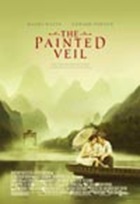
The turmoil of two mismatched lovers is set against the backdrop of social unrest in the latest cinematic adaptation of W. Somerset Maugham's classic novel The Painted Veil. The couple, Walter (Edward Norton) and Kitty Fane (Naomi Watts), make a quick match in London before setting up housekeeping in Shanghai, where Walter, a doctor, is working as a bacteriologist.
Norton plays Walter with a perfectly pitched reserve that expands but never quite breaks as the character confronts his wife's affair with a fellow ex-pat (played by Watts' real life boyfriend, Liev Schreiber). Walter met Kitty at a party and fell in love with her on sight, but the audience can see that she is self-absorbed and the tryst isn't surprising.
Naomi Watts and Edward Norton, Jr., as Kitty and Walter Fane
It's the remedy Walter proposes that raises eyebrows. He will either give her a divorce and effectively make her a social pariah, or she will have to follow him into a sort of purgatory—he's decided to take a post in the north of the country where there's been a cholera outbreak and she must accompany him. It seems that here she will either die or atone for her sins. Or both.
Kitty follows the stoic Walter across the country—a China populated with steep peaks and waving fields, peasants and colonialists, disease and civic unrest. Shot in a remote part of the Guangxi Province, the tremendously beautiful landscape has a deceptively listless quality that belies the effort required to live and travel in this land.
Kitty and Walter on one of their China excursions
The epicenter of the outbreak is the town of Mei-tan-fu and as the couple settles into their new home, it's unclear who Walter is punishing more—Kitty or himself. More scientist than doctor of bedside mannerly persuasion, Walter is immediately immersed in the world of the dying where microscopes offer no escape from the messiness of death via cholera. His efforts to stop the spread of the disease are hampered by increasing discontent with Western influence in the region. Meanwhile, an increasingly bored Kitty is left at home to stew, with a bumbling bodyguard (thanks to aforementioned discontent).
The Fanes' only neighbor is a disheveled Brit named Waddington (Toby Jones). And oddly enough, as he is an odd man, it's Waddington who provides the catalyst via the right words at the right moments, to propel Kitty out of her delusions regarding who and what is of value. He gets some help from the local Mother Superior (Diana Rigg) who gives a speech that is both lovely and devastating about her own marriage to God.
Walter and Kitty travel to a remote part of China to fight a cholera outbreak
There is much about the love story in The Painted Veil that is awkward and offends our modern sensibilities. While touchingly earnest, Walter's immediate affection for Kitty in London seems naïve at best and arrogant at worst. And the narrow social conventions guiding Kitty's ideas and choices regarding marriage (as, by extrapolation, the role and worth of women in society) are painful given their proximity to our own day. But I confess I'm a bit of a sucker for love stories that start after the wedding.
In Mei-tan-fu, a love isn't revived—a love is forged. Neither Walter nor Kitty is a saint, and neither becomes one. But the audience does get to see a love of virtue take root in this relationship as Kitty stumbles towards a kind of redemption from her flapper-y preoccupation with the flashiest (and easiest) sorts of passions. And the process raises the specter of how the tangible circumstances of our lives—in this case a confrontation with disease and oppression—have a very real bearing on the intangible state of our hearts and minds. The Kitty Fane who was given a divorce-or-else ultimatum could never have imagined anything good coming from such a confrontation. But the Kitty Fane who runs into her former lover on the streets of London at the end of the movie knows that in Mei-tan-fu, she found a sort of salvation.
Talk About It
Discussion starters
Why do you think Walter fell in love with Kitty? Why do you think Kitty married Walter?
In one scene Kitty scoffs at the idea of loving a man for his virtue. What do you think she is hoping for in marriage, and do you think her desires are valid?
What did you think of Walter's ultimatum? Cruel or caring? Or perhaps both?
In what ways did their marriage regenerate Walter and Kitty as individuals?
The Family Corner
For parents to consider
The Painted Veil is rated PG-13 for some mature sexual situations, partial nudity, disturbing images and brief drug content. Both marital and extramarital sex is passionately (though not explicitly) depicted. A woman's bare back is show in bed and a man is seen naked from behind. Brief drug use, drinking, and the rough scenes of those suffering from the ravages of cholera also give pause.
compiled by Jeffrey Overstreet from Film Forum, 01/04/07
Based on W. Somerset Maugham's novel of the same title, The Painted Veil introduces us to a reckless, irresponsible woman named Kitty (Naomi Watts) who discovers purpose and love when her husband (Edward Norton), a bacteriologist working in Shanghai to fight the spread of cholera, brings her to his place of work—and her perspective on life gets a jolt of reality. Director John Curran has delivered a handsome, praiseworthy picture that will probably go overlooked during this season of heavy-hitting award-seekers.
Article continues below
Harry Forbes (Catholic News Service) says, "Lushly photographed on location, the film … unfolds at a leisurely pace, but the intelligent love story at its core and the spiritual journey and ultimate redemption for its heroine are movingly conveyed. Norton and Watts … give impressive, nuanced performances, as do the others."
Greg Wright (Past the Popcorn): "The Painted Veil … is both maddening and refreshing in its refusal to answer [the film's central] questions in the style to which we have become accustomed. There are no pat answers here. The tale of Kitty Fane's journey toward love, loss, and restoration is both revealing—as the veil of Kitty's self-absorption is lifted to reveal the truth of life, death, and Walter's passion—and mystifying."
The Dallas Mavericks were intended to be the first Christian team in the NBA.
Paul Putz
The Painted Veil
1 of 3
Naomi Watts and Edward Norton, Jr., as Kitty and Walter FaneKitty and Walter on one of their China excursionsWalter and Kitty travel to a remote part of China to fight a cholera outbreak















 While we pray for peace, we need moral clarity about this war.
 But let’s not mistake it for calling.
 The Dallas Mavericks were intended to be the first Christian team in the NBA.