The work of Dr. Seuss has an admittedly lackluster history when it comes to big screen adaptations.
While Chuck Jones' animated Dr. Seuss' The Grinch Who Stole Christmas is a beloved, generation-spanning holiday classic, Ron Howard's The Grinch proved to be an abomination, bereft of the original's magic and weighed down with an overabundance of additional material. Mike Myers' Dr. Seuss' The Cat in the Hat, a ridiculous and, at times, downright creepy presentation of another Seuss classic, fared little better.
Horton eyes the speck from which he heard the cry
Perhaps it is proof of our culture's deep and abiding love of writer and cartoonist Dr. Seuss that Hollywood keeps trying, again and again, until they finally get one right. And while Dr. Seuss' Horton Hears a Who! may not be that perfect film, it certainly comes the closest so far.
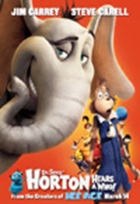
As if atoning for his sins in The Grinch, Jim Carrey returns as the voice of Horton the Elephant, a playful pachyderm of boundless imagination whose enormous ears allow him to hear a barely audible cry for help emanating from a tiny speck of dust floating through his jungle. It turns out that voice is but one among thousands. For on that single microscopic speck live the sub-atomic Whos in their infinitesimal city of Who-ville, led by their bumbling but well-intentioned Mayor (Steve Carell).
Of course, the Mayor doesn't know he's microscopic any more than Horton imagines his is a universe of gargantuan size. While neither can fathom each other's existence at first, nor what such a revelation means in the big picture, they cannot ignore the evidence before them.
The Mayor of Who-ville can't convince the town about Horton
It isn't long before Horton's friends think he has lost his mind. Determined to save the tiny particle and deposit it somewhere in the jungle where it will be safe from harm (any time Horton jostles the flower on which Who-ville is perched, cataclysmic tremors rock the city), Horton becomes an object of ridicule and embarrassment.
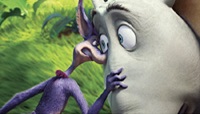
One member of the jungle, Sour Kangaroo (Carol Burnett), takes it one step further. Threatened by what she sees as an overabundance of imagination that endangers the rational stability of the jungle and, most of all, the impressionable minds of the children, she demands Horton desist with his silly quest. "Horton is a menace. He has these kids using their imaginations," she claims.
Meanwhile, back on the speck, things aren't going so well for the Mayor either. He too has become a laughingstock as he tries to explain to his constituents that the seismic events endangering the usually placid Who-ville are the result of it being mishandled by a giant elephant.
As Sour Kangaroo whips the jungle into an anti-Horton frenzy, she sets out to have the speck destroyed and Horton caged. Will Horton and the Mayor manage to make everyone see the truth in time, or will the end of Who-ville and all its people occur without anyone even noticing at all?
The Who-ville Council is skeptical of the Mayor's story
Horton, from the creators of Ice Age, is just about what it would look like if Dr. Seuss' imagination collided with live action, a sort of psychedelic smorgasbord of intensely colored and peculiarly imagined creatures, landscapes and props that allows Seuss' effervescent creativity to come to life as it never has before.
For those afraid of losing Seuss' signature evocative and rhyming text, rest easy. While not all of Seuss' beloved words make it into the story, much of the book is replicated in the wonderful narration by Charles Osgood. A few other key lines are given to Carrey and Carell, who are allowed a certain amount of free-rein improvisation the rest of the time and really seem to be enjoying themselves beneath their cutting-edge CGI masks. As is mercifully par for the course these days, the two throw in enough adult-oriented jokes to keep Mom and Dad satisfied.
The filmmakers have had to pad the story to bring it to feature-length. In addition to stretching out the action and adding some new scenes, they've incorporated some traditional 2-D moments—glimpses into Horton's vibrant imagination. Plundering the Japanese Pokemon anime craze, the dream sequences are certainly funny but equally dissonant and inharmonious with the rest of the film.
Sour Kangaroo and Horton do NOT see eye-to-eye
Dr. Seuss had the matchless ability to distill complex issues into clear and comprehensible philosophical declarations that kids and adults alike could easily understand. Horton is supercharged with a number of such positive messages. It is a story of resolute faithfulness and diligence in the face of overwhelming peer pressure. It would have been very easy for Horton to give up when the going got tough, but after all, "an elephant's faithful 100 percent."
But it is Seuss' beloved phrase, "a person's a person, no matter how small" that embodies a principle as simple as it is profound, and speaks to so all areas of our lives and, indeed, our faith. It is a mantra that endows all created things with a sacredness and value found only in their Creator. While Theodor Seuss Geisel (aka Dr. Seuss) never intended his phrase to become a salvo in the abortion debate, many see in its simplicity the totality of the pro-life message.
Article continues below
The film also acts, equally inadvertently, as a model of religious conviction. "Faith is the substance of things hoped for," says the writer of Hebrews, "the evidence of things not seen." Contrasting the words of Hebrews 11:1, Sour Kangaroo tells Horton, "If you can't hear, see or feel something, it does not exist." But Horton is persuaded. He knows that the Mayor and the Whos of Who-ville are real, despite not being able to see them. In the same way, Horton's immensity actually makes him invisible to the microscopic Mayor. When trying to describe Horton to the rest of the Whos, the Mayor frequently employs the sort of language one uses to describe a God who has yet to make himself visible to us.
Horton Hears a Who! is sure to be a zany and delightful romp for children. But it has the added benefit, thanks to Dr. Seuss' deceptive simplicity, of being a conversation starter about deeper topics like the innate value in each and every one of us, the need for persistence in doing the right thing no matter the odds, and, for the Christian parent, a metaphor for faith itself.
Talk About It
Discussion starters
In what way does the film's premise mirror Hebrews 11:1, describing a faith that believes despite a lack of physical evidence? In what ways is it different?
Consider what the film has to say about child rearing. With 97 children, the Mayor has time enough for only one minute a day with each of his kids, leading to a distinct lack of personal connection, especially with Jojo, his oldest. Do you feel that the Mayor's misplaced expectations for Jojo were satisfactory resolved?
Some parents may take issue with Sour Kangaroo, a character cut from the same cloth as Footloose's Rev. Moore—or the papal inquisition that tormented Galileo for his celestial assertions. While no one would disagree that Sour Kangaroo is clearly in the wrong, some may see her characterization (and her child's heroic act of defiance) as a dangerous undermining of parental authority. What do you think?
Horton's famous line—"a person's a person, no matter how small"—has been "co-opted" as a slogan by some pro-life groups. What does Scripture say about a person being a person, no matter how small? (See Psalm 139:13-16, Jeremiah 1:5.)
The Family Corner
For parents to consider
Dr. Seuss' Horton Hears a Who! is rated G. See the concerns in No. 3 in the "Talk About It" section. About the only thing parents might find objectionable is the use of the word "boob" (in the non-anatomical sense) throughout the film.
The Dallas Mavericks were intended to be the first Christian team in the NBA.
Paul Putz
Dr. Seuss' Horton Hears a Who!
1 of 4
Horton eyes the speck from which he heard the cryThe Mayor of Who-ville can't convince the town about HortonThe Who-ville Council is skeptical of the Mayor's storySour Kangaroo and Horton do NOT see eye-to-eye















 While we pray for peace, we need moral clarity about this war.
 How Jesus rescued a New Age psychic from spiritual darkness.
 The Dallas Mavericks were intended to be the first Christian team in the NBA.