Juliette Binoche, Hippolyte Girardot, Simon Iteanu
Theatre Release
January 30, 2008 by IFC First Take
How is childhood like a red balloon? Hou Hsiao-Hsien's Flight of the Red Balloon gives many possible answers.
We watch seven-year-old Simon—played marvelously by Simon Iteanu—meander along Paris sidewalks, his progress as lazy and jaunty as the path of that red balloon above him. His lackadaisical stride stands in stark contrast to the crisscrossing streets and tracks that bind the city; he's not yet imprisoned by the grid-like adult world of hurry and hustle. Under his mop of tousled red hair, his eyes cartoon-wide, this kid has sails open to catch a whim. He'll even shout up at the balloon to come down and play with him.
We know that the weightlessness of Simon's existence, the whimsy in his wonder, will soon end. We sense it when he refuses to welcome the balloon as it descends. We see it in how he's drawn to flashy, mechanized activity, like his sister's PlayStation.
Flight's bittersweet tone comes from its focus on childhood, and even a quality of childhood that the harsh city life might soon burst like a balloon. You could call it The Unbearable Lightness of Being, but that title's taken.
And speaking of Unbearable Lightness …
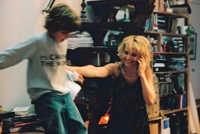
Simon Iteanu as Simon and Juliette Binoche as Suzanne
In a visceral, spirited performance that rates among her very best, Juliette Binoche plays Simon's frazzled, single mother, Suzanne. With her energy manifested in an electrified blonde hairdo, Suzanne is too busy to know whether she's coming or going. In an unforgettable and surprising reveal, we learn that Suzanne works as an actress in a puppet theater. Like Hou himself, she's translating timeless Chinese art for present-day Parisians, and the work unleashes a playful expressiveness that makes her irresistible.
But between rehearsals, Suzanne careens like a pinball from one activity to another. She's trying to cope with intrusive downstairs tenants, the loneliness of missing her absent husband and faraway daughter, and the details of welcoming Simon's new nanny. Coming home, she gets updates from Simon about his day. "You play pinball these days?" she quips, and the line is loaded. Yes, his life is going on without her. Yes, he's being drawn into the machine.
We enter into Suzanne's crazy world through the quiet observance of the new nanny, a Chinese film student named Song (Song Fang). Song's peaceful acceptance of Suzanne's crazy world makes her most appealing. Song's Chinese background, her interest in film, and her ever-present digital camera which she uses to film Simon's everyday experiences, make her the calm at the center of this family's storm. She's making a short film about red balloons in tribute to the classic 1956 French short film, The Red Balloon, just as Hou made Flight as an homage to its director, Albert Lamorisse.
Hou's cinematography imitates the casual curiosity of a child. His gaze wanders up and down the street, up and down the buildings. But don't be fooled—every one of his long, patient takes is carefully composed.
If you watch carefully, you'll catch visual jokes and wonder if they're intentional. For example, in the opening shot of a balloon floating away on a cut string, we see a subway sign advertising the film Severance. If that isn't funny enough, the title is bisected by a lamppost! Later, after we've realized that the film is about a vulnerable child overlooked by the busy modern world, a bus passes with a bold poster for the film Children of Men, with Clive Owen's mug staring straight at us. Accident? If so, a very happy one.
Hou's images are rich with meaning. In many shots, reflections suggest that we consider the past, present, and future. Some shots show passing traffic, but reflections in windows and doors let us see vehicles approach, and after they pass, we catch distorted views of their continuing journey. (How he manages to keep the camera out of these reflections is a special effect indeed.) Hou is constantly, quietly reminding us that the past and future are active in the present, and that should provoke questions about what we value, and how we inhabit a moment.
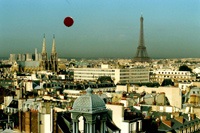
The wandering balloon represents all sorts of imagery
The story's most obvious theme is the elusiveness of the joys and wonders we associate with childhood. Suzanne and Simon are both saddened by a longing for younger, more innocent days. They miss Simon's father and sister—he's away in Montreal, she's with her grandfather. In a heartbreaking moment, Suzanne pleads with her daughter to return home. She reveres home movies of her children, and the most precious gift she can give is an old postcard from her scrapbook.
In a beautiful scene, Simon wanders into a video arcade. Song stays outside, filming his progress through the window. Hou's camera turns to zoom in on Simon, wide-eyed at a pinball machine. (How odd that he's drawn to pinball—a small sphere, making progress through a series of hard-hitting obstacles.) We watch Simon through the glass, and notice that Song has gone inside to join him, her camera still running. It's like Hou is suggesting that, through the gift of pictures, postcards, and film, we can transcend the clamor of our lives and recapture some of our childlike wonder again. Song bridges the gap, quietly savoring the world around her. Camera in hand, she manages to maintain a sense of childlike wonder.
Article continues below
Following Song, Suzanne, and Simon, Hou invites viewers along for a dreamy stroll through a day in their lives with a "you are there" immediacy. Hou allowed his actors to improvise, without rehearsals, and as a result the film has a delightful spontaneity. Binoche even wore clothes from her own closet. (And it must be said—she has a very nice closet.)
Nevertheless, Flight has already inspired some impatient critics to complain that "nothing happens" in this film. To borrow a line from James Cameron's The Abyss — they "need to look with better eyes than that."
Flight is not plot-driven. It is not about drawing us to the edge of our seat or teasing us with what happens next. It's meant to be observed the way you might study art in a museum, or the way you might wander down a street in one of the world's great cities just to watch people and light.
Director Hou Hsiao Hsien on the set with Song Fang and Binoche
Sound boring? Give it a try. Find out why Hou is one of the world's most celebrated filmmakers, and what Americans have been missing. The fact that his films aren't "marketable" in the U.S. reflects poorly on us, not Hou.
Flight will probably stand as his most playful work. The red balloon is an evocative icon that appeals to all ages. It's the suggestion that the simple joy of childhood can be lost so easily. It's also the gravity of that idea—that there's a lonely but buoyant spirit wandering above us, watching over us, waiting for us to reach up. The balloon's as mysterious and benevolent a character as Winnie the Pooh or Hayao Miyazake's Totoro. After we watch it a while, we start to notice bright red spheres and circles everywhere—in decals on bus windows, bright red stop lights, traffic signs, the taillights of a car in a tunnel.
In one scene, the balloon descends the side of a building and passes a painting of a red balloon, and suddenly it brushes against the painting as if kissing a stranger in the Parisian way, or finding a kindred spirit. It's an enthralling moment.
Hou's film is the first in a program financed by the Musée d'Orsay. The film features a scene inside the museum where children consider a painting of, yes, a red balloon. Hou's film has set the standard for the series. We can only hope the rest of the participating filmmakers dare to reach so high.
Article continues below
(Read an expanded version of this review at Looking Closer.)
Talk About It
Discussion starters
Who in the movie is a good role model for Simon? Do you see any poor role models?
What does the balloon represent? Does it represent just one thing?
Discuss the images in this film you found most interesting. What made them interesting? What did they make you think about?
Discuss the painting that the children study. How does Simon respond to the painting? What is interesting about his response? Why do you suppose Hou saved this scene for the end of the film?
The Family Corner
For parents to consider
Flight of the Red Balloon is unrated. The film focuses on a disintegrating family; the father is never seen, and the daughter lives elsewhere, which may raise questions for young people. Juliette Binoche's outfits might be a little revealing for some, but they're not sleazy. The film is in French, with subtitles.
Migrant rights have been off-radar for many Panamanian Christians. But as pressures increase, some are speaking out ahead of this weekend’s general elections.
Simon Iteanu as Simon and Juliette Binoche as SuzanneSong Fang as Simon's nanny, SongThe wandering balloon represents all sorts of imageryDirector Hou Hsiao Hsien on the set with Song Fang and Binoche















 While we pray for peace, we need moral clarity about this war.
 But let’s not mistake it for calling.
 Migrant rights have been off-radar for many Panamanian Christians. But as pressures increase, some are speaking out ahead of this weekend’s general elections.español