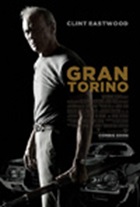
The first time I saw the trailer for this film in a theater, the audience laughed. It portrayed a senile, furrow-browed Clint Eastwood brandishing a gun and barking at Asian people to "get off my lawn." Was this Dirty Harry: The Retirement Years? Thankfully, no. As it turns out, Gran Torino is surprisingly earnest—a film that is funny and angry and sad for all the right reasons, and remarkably well timed. As 2008 comes to close—and with it many things—Gran Torino captures the zeitgeist as eloquently as anything possibly could.
The title of this film, directed and starring Clint Eastwood, refers to a '70s-era American muscle car, and the story is set in Detroit, at a time when the shrinking, suffering American auto industry—coupled with rising crime and changing demographics—has left everything slightly run-down and depressed. Walt Kowalski (Eastwood), a Korean war vet who worked 50 years for Ford—lives in a Detroit neighborhood full of front-porch, paint-peeled, post-war houses now inhabited by immigrants and aging widowers. The place is rife with the ghosts of a simpler, booming time—when Ford's assembly line was a symbol of the efficient homogeneity of life after the wars, when white picket fences and neighborhood barbers infused everything with a decidedly homegrown, rust-belt patriotism.
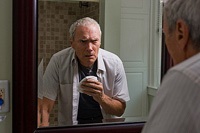
Clint Eastwood as Walt Kowalski
But in 2008, things have changed. Detroit is on its knees, praying for a few extra years. American auto manufacturing, like Walt Kowalski, is experiencing its cantankerous twilight, shaking its head as new paradigms set up shop and kick the old school callously to the curb. Kowalski represents the vestiges of a bygone era, but he will not go quietly into the night.
The film opens with the funeral of Kowalski's wife in a Catholic church, the young parish priest (Christopher Carley) offering well-intentioned words about life and death while Walt angrily grimaces and grunts at his granddaughter's navel piercing. The only emotion he shows is disgust—with just about everything and everyone around him.
Alone and himself physically ailing, Walt takes pleasure in seemingly very little: his '72 Gran Torino, his dog Daisy, Pabst Blue Ribbon, and the occasional expletive-laden conversation with a fellow blue-collar curmudgeon. Everything else irks him, especially the fact that his neighborhood is laden with Hmong, Latino, and African-American residents and gangs. Walt is an old-school racist. He can't go two sentences without using the types of racial slurs that were acceptable in his army days circa 1952.
All of this bodes ill for Walt, considering his next-door neighbors are a Hmong immigrant family. And things look especially dire when Walt catches Thao—the awkward teenaged neighbor boy who Walt calls "Toad"—trying to steal his Gran Torino. Turns out Thao was pressured to steal the car by a local Hmong gang that relentlessly bullies him, though to Walt it makes little difference. He's spitting mad.
Out of this incident, however, and Thao's family's attempts to make up for his shameful behavior, an unlikely bond forms between Walt and his Hmong neighbors. They have a shared enemy, after all: the gangs. From here the story plays out in a somewhat predictable fashion, as Walt's crotchety defenses break down and he learns to love and be loved again. It all escalates to a typically violent, melancholy conclusion, true to Eastwood form. But lest you expect a rousing, heroic bloodbath ending, remember: this is Eastwood in Million Dollar Baby mode. It's not Dirty Harry.
Gran Torino is a Clint Eastwood film in the strictest sense. Unlike his less successful (but no slouch) 2008 effort, Changeling, this is a film that feels utterly personal—a movie that might actually be as much about Clint Eastwood the man/myth/icon as it is about the fictional story he is telling. And if it is indeed his last acting performance on film, it is quite the note to go out on. Eastwood's performance is a blood-spitting, mournful tour-de-force. In the wrinkles, the stilted gait, the dubious eyes of Eastwood, there is so much life lived, so much baggage and regret. As in so many of his movies (especially recently), Eastwood plays a man at odds with himself, his own failures, weighed down by his belligerent refusal to be forgiven his sins.
Ahney Her as Sue
This is all very literal in Gran Torino. Walt's priest persistently pursues him throughout the film, gradually establishing a trust that allows him to talk to Walt about things like life, death, morality, confession. It's unclear how much the priest actually changes Walt's stubborn mind about anything (Walt seems pretty ambivalent about church and God), but it is nice to see a clergy figure who plays a loving, vital role in reaching out to a troubled character. In the end, the two of them learn from each other, as they tread the unfair and frequently painful path of life together, for a time.
The film—foul-mouthed and offensive though it may be—has deeply religious overtones. It opens and closes in a church, features themes of sacrifice, love, and redemption, and wrestles with complicated moral choices in a strikingly direct way. It is certainly a thematic cousin of Mystic River and Million Dollar Baby, going into similarly gray areas (quite literally, with Eastwood collaborator Tom Stern's characteristically shadowy cinematography) without being extremely didactic or heavy-handed. In the end, though, Gran Torino comes down in a decidedly sunnier, more certain place than any of Eastwood's other recent films.
Article continues below
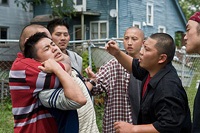
Thao is threatened by Hmong gang members
This is not to say that Gran Torino is a happy film. It is resolutely not. But it celebrates life and honor in the same beautiful way that Letters from Iwo Jima and Flags of Our Fathers did a few years ago. And like those films, Gran Torino is also a nostalgic elegy. It laments the passing of time and coming of mortality with the tenderness of a Japanese master like Ozu. Eastwood, like the character he portrays, is reflecting on his life, taking stock of his values and priorities as the sun begins to set. There are pains that cannot be resolved ("I'm soiled," he tells Thao), but there is still value in living—still things he can teach and be taught. But, like the industry that was his life's work and legacy (in the symbol of the Gran Torino), Walt also knows that his time is nearly up.
Gran Torino is not a perfect film, and sometimes feels a tad overwritten and wordy (freshman screenwriter Nick Schenk's extreme, racially-charged language occasionally borders on parody), but it is a film that fits our current cultural milieu like a glove. I'd hesitate to say that the film is a metaphor for the death of the American auto industry, but it's certainly a metaphor for a changed America. We are not a homogenous, white-picket-fence nation anymore. Old industries are dying, new ones rising up, neighborhoods shifting and communities re-aligning. Some things are the same, though: there is still hate and violence, just as there is love, determination, and hard work.
Gran Torino is about pressing on, living life with resolve, and making sure there is some continuity. As Walt discovers, we can lament change all we want, but ultimately what's gone is gone. What's important is what we leave behind—our successes, failures, and '72 Detroit-made muscle cars.
Talk About It
Discussion starters
What do you think of the ending of the film? What are the lasting images from the film's final five minutes and what are their significances to you?
Article continues below
Walt and his priest have an interesting relationship. Do you think the priest made any impact in Walt's life? How so?
What does community look like in the film? Contrast how Walt interacts with the family next door as opposed to his own family.
The Family Corner
For parents to consider
Gran Torino is rated R for language. The language is extreme, and full of pretty much every racial and derogatory name you can imagine for a variety of ethnic groups. There are also some scenes of violence, an implied rape, and some disturbing scenes of coughing up blood.
Migrant rights have been off-radar for many Panamanian Christians. But as pressures increase, some are speaking out ahead of this weekend’s general elections.














 While we pray for peace, we need moral clarity about this war.
 How Jesus rescued a New Age psychic from spiritual darkness.
 Migrant rights have been off-radar for many Panamanian Christians. But as pressures increase, some are speaking out ahead of this weekend’s general elections.español