When Toy Story opened in 1995, it was heavily marketed as the first-ever full-length computer-animated film—essentially, as a novelty. Anyone who saw the film, of course, knew that it was anything but a flash-in-the-pan or a gimmick, as Pixar's technical innovation was overshadowed only by the movie's exemplary storytelling. And ever since then, with each new film they've produced, Pixar has delivered on the promise of that first movie time and time again, both in terms of technology and storytelling excellence—strangely, though, as the technology has gotten better and better, it is talked about less and less. Perhaps it's because Pixar's success spawned such a wide slew of sub-par imitators; perhaps it's because their standards of animation are so consistently high, it's simply pointless to even try coming up with new superlatives.
WALL•
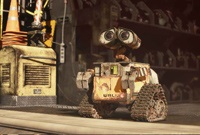
E, ready for a new day
It's more than a little ironic, then, that the studio's greatest achievement to date is a movie that is, on one level, about technology—and that the picture it paints is not a pretty one. WALL•
E, from director Andrew Stanton of Finding Nemo, is arguably the purest work of hard science fiction to appear on the big screen in ten or fifteen years, and the world that it creates is bleaker and more dystopian than in any American animated film you care to name.
In WALL•
E's world, Earth is no longer inhabited by humans; they fled the planet over 700 years ago, having rendered their home world unlivable. Now, mankind floats through space in a giant space station/spa/shopping mall called the Axiom—a race of fat, stupid, lazy and lethargic slobs, too bloated to even stand on their own two feet as they cruise around in hovering lounge chairs. Their planet is in ruins—literally—but they don't care; they're too busy shopping … from the mega-retailer Buy N Large, which seems to have a monopoly on everything. George Orwell would have had nightmares had he seen such a vivid rendering of unchecked consumerism.
But that's just the backdrop. The real story here is WALL•
E himself, a small, lonely robot—indeed, the only functioning bot left on Earth—who spends his days compacting garbage, with a faithful cockroach as his only companion. WALL•
E (a Waste Allocation Load Lifter Earth-Class) is marvelous, perhaps Pixar's greatest character yet—a (mostly) silent film star who is as expressive, as empathetic and as multi-dimensional, as an animated character can be … and this despite the fact that he doesn't speak a language other than the beeps and blips and other cutesy "bot talk" one might hear from R2-D2 or Luxo Jr. (Pixar's little lamp mascot). WALL•
E is an amazing feat of character design and of animation.
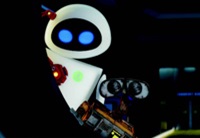
But his loneliness doesn't last long. His world is soon invaded by another robot called EVE (Extra-terrestrial Vegetation Evaluator), who is as graceful and elegant as WALL•
E is homely and awkward, as thoroughly sleek and modern as he is rusty and outdated, and as dangerous as he is harmless. He is immediately taken with her (who wouldn't be?). And what develops between them is a love story so small and simple, one is inclined to call it a fable. They may be robots, but their affection for one another is genuinely moving—much like the film itself. Had Walker Percy not used it already, you could call this film Love in the Ruins.
This is science fiction the way science fiction is meant to be. It creates a world that's clearly not our own, but it's totally believable as the place we're headed, maybe a hundred years down the line. But it's not cynical or misanthropic; like the best sci-fi, it uses these imaginative conceits to ask big questions about our world and our humanity. It's a movie about love amidst chaos, about the dangers of unchecked greed and the forces that overcome it.
The Axiom space station carries all the humans
There's much more complexity to the film than any "message movie." As we see glimpses of the junk WALL•
E has uncovered amidst the ruins, we see hints of the triviality of greed run amok—witness the Rubik's Cube and the plastic cutlery. But when he pops in his favorite videotape, Hello Dolly, we see that something good and beautiful has been made by the very same race of people—art, music.
And it is absolutely not a political movie, no matter how hard a small faction of political bloggers might try to pin it as one. Yes, it has a message about the environment—take care of it. And yes, it has a message about capitalism—too much of it can be sinful. These aren't political points; they're very basic moral ones, and no rational Christian has any grounds on which to object to them.
The love bots
But even more than a great work of sci-fi, this is a great work of cinema. WALL•
E is Pixar's boldest, bravest film yet, opening with half an hour in which no dialogue occurs. Much of the story is told, then, only through images, and in this regard, it's the most sophisticated and subtle film Pixar has yet made. There are moments of inspired visual humor, and of poignant visual metaphors. There are small gestures and little moments that say more than a script ever could. It's so gloriously evocative, surely it deserves to be called poetry.
Article continues below
And yet, the greatest feat of WALL•
E—its most seemingly-impossible achievement—might be this: Despite the fact that it's hard science fiction, that it paints a dystopian picture of our future, that it's subtle and sophisticated, and that it's very light on dialogue, it's every bit the crowd-pleaser that we've come to expect from this studio—funny, romantic, imaginative, and utterly gripping. This is Pixar's magic.
It's a film that continues the trend of Pixar's last movie, Ratatouille—a trend toward more complex storytelling that's as much for grown-ups as it is for kids. That trend seems set to change at some point, what with a third Toy Story in the works, but, if WALL•
E is any indication, Pixar's unbroken trend of excellent, meaningful filmmaking is in no danger of slowing down. This movie is an extraordinary achievement, and an example of truly fearless filmmaking.
Talk About It
Discussion starters
The film presents us with a rather harrowing portrayal of human culture in the future. What are the factors that caused human culture to become this way? What are the negative aspects of human culture that we see on display? Are thee any positive ones?
Does WALL•
E love EVE? Does she love him in return? How do you know?
Is the film's message a cynical one, or a hopeful one? Or something in between? Discuss.
What are some examples of the power of beauty in this film? In the power of love?
The Family Corner
For parents to consider
WALL•E is rated G, and, apart from one or two scenes that might be a little frightening for the very young, it's suitable for all ages. The short film that precedes it, Presto, contains some Loony Tunes-style, slapstick violence.














 While we pray for peace, we need moral clarity about this war.
 Alcoholism among women is rising. Can the church help?
 The Dallas Mavericks were intended to be the first Christian team in the NBA.