Roland Emmerich or Michael Bay: Who is Hollywood's true reigning King of Schlock?
In the mid-1990s, Emmerich threw down the gauntlet with the planetary disaster–action spectacle Independence Day, in its day a ranking contender for most the staggeringly overproduced B-movie to date. Two years later, Bay arguably upped the ante with the similarly overproduced planetary disaster–action spectacle Armageddon.
Emmerich's next film was the Revolutionary War cartoon The Patriot, followed a year later by Bay's WWII cartoon Pearl Harbor. After that, both Emmerich and Bay took stabs at dystopian near futures with The Day After Tomorrow and The Island, respectively.
Bay's latest salvo is Transformers: Revenge of the Fallen, an over-the-top, overwrought, over-long, would-be apotheosis of every disaster movie and action flick ever made. But Emmerich is not to be outdone: 2012 is his over-the-top, overwrought, over-long would-be apotheosis of every disaster movie and action flick ever made.
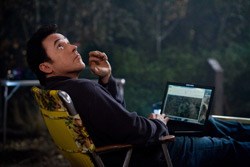
John Cusack as Jackson Curtis
By this point in their careers, a few things are clear. Emmerich has a dimmer vision of the future than Bay; his movies offer real apocalypses, while even Bay's Armageddon is about an apocalypse averted. But Bay has a dimmer outlook on mankind. Emmerich seasons his schlock with schmaltz, with cornball speeches about decency, loyalty, family and humanity. Bay likes his trash trashy, with generous dollops of gratuitous sleaze and exploitation.
In Bay's movies, women are sex objects—pinups and playmates if not bimbos, strippers and/or prostitutes—while men are cocky, testosterone-charged studs or else wish they were, by gum. Men and women in Emmerich's movies are no less cartoony, but the women are wives, ex-wives and daughters, while the men struggle with doing right by them.
A typical Emmerich hero earnestly worries about things like the appropriateness of burning the works of Nietzsche for heat in a post-apocalyptic world. If a typical Bay hero is earnestly concerned about anything, it's probably Megan Fox's midriff. Emmerich might be more likely to kill off nine-tenths of the world's population, but Bay is less likely to make you feel like it would matter. Not that you're very likely to care, or care a lot, in an Emmerich film. But at least you feel that Emmerich cares—and that he wants us to care—and that's better than nothing.
2012 is Emmerich at his most existential—and his most laughable. I don't mean only the premise, which blends silly technobabble about solar flares and neutrinos with a few actual science facts (like the volcanic hotspot under Yellowstone) and a concatenation of New Age anxieties around the year 2012 supposedly connected to the ancient Mayan calendar, in roughly the same way that the Heaven's Gate cult's anxieties around the Hale-Bopp comet were "connected" to the Bible.
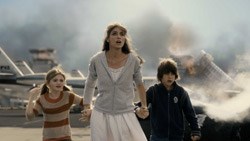
Amanda Peet as Kate Curtis with her kids, played by Morgan Lily and Liam James
Nor do I mean the jaw-dropping set pieces, which go way beyond conventional action-movie impossibilities like outrunning fireballs. In two of the movie's best scenes, the heroes race through a disintegrating landscape, literally riding the event horizon of a rolling cataclysm consuming the earth directly under their vehicles' wheels. Crumbling buildings, tumbling vehicles and heaving shelves of rock and earth extend the crisis into four dimensions. Whether action movies should aspire to the condition of theme-park rides is highly debatable, but they do, and the set pieces in 2012 set a new standard for what is possible in this respect.
But then, whenever there is a lull, the characters start talking—and, at crucial moments, they even make speeches … and that's when 2012 goes beyond ludicrous into bathos. Perhaps the funniest thing in the film—it actually becomes a running gag of sorts, though not necessarily an intentional one—is the way that Chiwetel Ejiofor's earnest scientist keeps harking back to hero John Cusack's obscure sci-fi writer, oblivious to Cusack's parallel storyline but still citing him as some sort of touchstone of what really matters. Okay, maybe it doesn't sound funny when I say it like that, but trust me, it gets funnier every time.
If 2012 is an apotheosis of all disaster movies, that means it's also an apotheosis of all disaster-movie clichés. Ejiofor is the scientist who knows what's going on and has to persuade someone in power to listen (see Jeff Goldblum in ID4, etc.). Danny Glover is the noble African-American president who has to decide when to go public with the facts (see Morgan Freeman in Deep Impact).
Hero Cusack (why bother with character names?) has an ex-wife (Amanda Peet), who's now with a more responsible guy (Thomas McCarthy), and occasionally shares custody of their two kids, a younger girl and an older boy who is disaffected and resentful toward his father (see Spielberg's War of the Worlds).
Stepdad McCarthy is not a bad guy, but he's an L.A. plastic surgeon, so that's one strike. On the plus side, he wants kids and goes grocery shopping with the wife. "I feel like something is pulling us apart," he tells Peet one day at the supermarket, seconds before the floor splits beneath their feet and the entire store is ripped in half, with Peet on one side and McCarthy on the other. Obviously, God believes that Peet belongs with the father of her children.
Article continues below
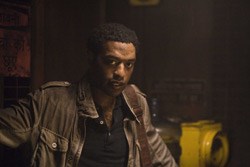
Chiwetel Ejiofor as Adrian Helmsley
The other moment in which two figures are strikingly separated by a sudden split in a crumbling edifice occurs in Rome, where a crack runs the length of the Sistine Chapel ceiling—directly between the adjacent fingers of God and Adam. Outside, a crowd of thousands keep vigil in St. Peter's Square, holding candles, while the pope looks down from his balcony and a knot of cardinals prays within the basilica, until St. Peter's goes the way of all landmarks in a Roland Emmerich film. (It's been a rough year at the movies for St. Peter's; first the antimatter bomb in Angels & Demons, now this.)
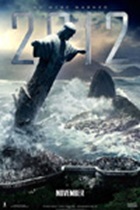
Well, most landmarks, anyway. At the urging of Emmerich's co-writer Harald Kloser, who warned Emmerich that he ran the risk of a fatwa, the Kaaba in Mecca, Islam's most sacred site, isn't destroyed onscreen. Rio de Janeiro's colossal Christ the Redeemer statue: not so lucky. Because, you know, Christians don't do fatwas. (The movie does take a verbal poke at the Taliban militia who demolished the ancient Buddha statues in central Afghanistan.)
Is all of this meant to add up to some sort of religious outlook or statement? Well, perhaps not. Even so, by the climactic act, believers may be thinking of a biblical promise that seems to be pretty decisively broken. There's also a final subtitled dateline that seems to put the whole Christian era in a relative context, as if the Christian calendar as well as the Mayan calendar has run its course.
Then there's the scene in which the president, as an ecumenical prayer on behalf of the world, starts to recite Psalm 23—but the transmission cuts out before he can even finish the first line. What, Ejiofor gets to quote one line after another of Cusack's crappy fiction, but Glover can't get off one lousy Bible verse at the end of the world? Here is a melancholy thought: How many people in the audience won't even know how "The Lord is my shep … " ends, or where it's from?
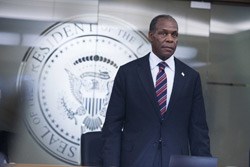
Danny Glover as the President
One more thought on religious implications (spoiler alert): While we see a Tibetan monk is among the survivors (you didn't think Emmerich was going to kill everyone, did you?), the only Christian clergy shown are the Catholic prelates who die at St. Peter's. This is a problem for me as a Catholic. I can deal with the destruction of the Vatican; it's only real estate. Muslims might or might not feel their faith offended or threatened by the destruction of their holiest sites, but Christianity doesn't work that way.
Article continues below
On the other hand, if Emmerich is going to specifically show the Vatican leadership going down with St. Peter's, I want to see Catholic (and/or Orthodox) bishops among the survivors—somewhere on the planet. The Church must continue, and while a Protestant with a Bible may be good to carry things on, Catholics need the succession of bishops. 2012 doesn't say that there aren't bishops among the survivors, but if Emmerich can kill 'em onscreen, he could have let some live onscreen.
That may not be a critical objection, but it's another obstacle to me enjoying whatever popcorn thrills, pop existentialism and semi-unintentional comedy 2012 has to offer.
Talk About It
Discussion starters
What is the appeal of movies about disasters—floods, earthquakes, volcanoes and such? Why are we fascinated by the spectacle of characters in the most extreme circumstances imaginable? Is it a form of escapism or catharsis? Does it help us imagine what we would do in a crisis situation? Are there other reasons?
Are the kind of events depicted in 2012 compatible with our faith as Christians? We know that God does allow great catastrophes to occur; is there something about a catastrophe of this magnitude that makes it unimaginable from a faith perspective?
What about the specific type of catastrophe imagined here? Does Genesis 9:8-17 preclude the sort of events Emmerich imagines?
What should a Christian response be to doomsday predictions? (See this story for some ideas.)
The Family Corner
For parents to consider
2012 is rated PG-13 for intense disaster sequences and some language. Emmerich's special-effects wizards inflict cataclysmic destruction on landscapes, cities, and landmarks worldwide, but in all the apocalyptic mayhem there's very little explicit violent imagery, bodies, etc. We do see people falling or otherwise going to their deaths, but the camera usually cuts away before the worst. There's also some crass language and taking of the Lord's name in vain, a brief suggestive remark, and one use of the f-bomb.
The rage of the mob is a poor substitute for real community.
Russell Moore
2012
1 of 4
John Cusack as Jackson CurtisAmanda Peet as Kate Curtis with her kids, played by Morgan Lily and Liam JamesChiwetel Ejiofor as Adrian HelmsleyDanny Glover as the President













 While we pray for peace, we need moral clarity about this war.
 We’ve got little information on Jesus’ appearance and personality. But that’s the way God designed it.españolFrançais
 The rage of the mob is a poor substitute for real community.