The venerable sci-fi series has never been this flashy or exciting—or as uninterested in big ideas—as it is in this part sequel, part prequel, and part reboot.
The trailers say this isn't your father's Star Trek, but they could just as easily have said this isn't your grandfather's Star Trek. The series really is that old: it has been 45 years since Gene Roddenberry produced the first of two pilot episodes for the original TV show, and as James Bond could tell you, that's a long time to let a franchise run without taking things back to square one and giving yourself a fresh start. So now, here comes the reboot: directed by J.J. Abrams (producer of Lost and Cloverfield) from a script by Roberto Orci and Alex Kurtzman (the Transformers movies), the new Star Trek is a hotter, sexier, flashier, more youth-oriented version of the sci-fi series than we have ever seen before. But it doesn't completely sever its ties with the original series—indeed, it puts those ties front-and-center—and the result is a movie that may leave Trek fans feeling deeply ambivalent.
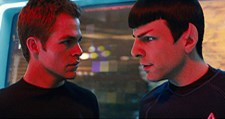
Chris Pine as Kirk, Zachary Quinto as Spock
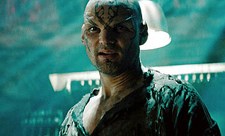
The film certainly begins on a powerful note. The U.S.S. Kelvin is flying through space and minding its own business when it is suddenly attacked by a giant spaceship that has just emerged from a "singularity," a sort of black hole. It is not entirely clear, at first, where this spaceship comes from, but it is populated by Romulans—led by a guy named Nero (Eric Bana), who is one of the more sketchily drawn villains in Star Trek lore—and we gather that some sort of time travel is involved, since the Romulans don't seem to know what year it is, and they say they are looking for the elderly Ambassador Spock, who is briefly seen in a hologram and is clearly played by Leonard Nimoy (who came out of retirement to play this character for the first time since a 1991 episode of Star Trek: The Next Generation).
In any case, a battle quickly ensues, and by the end of it, the Kelvin is destroyed and many of its officers are dead, but not before one of them, a certain George Samuel Kirk (Chris Hemsworth), has safely evacuated many of the ship's passengers—including his very pregnant wife Winona (Jennifer Morrison), who gives birth to little James T. in the escape pod. It's an intense sequence, and the final exchange between Papa and Mama Kirk is sure to move some viewers to tears before the opening titles have even begun.
The next few sequences take us through the childhood and emerging adulthood of both Kirk (Chris Pine) and, on another planet, his future first officer Spock (Zachary Quinto), the latter of whom is mocked by his fellow Vulcans for having a human mother (Winona Ryder) and therefore not being as pure a Vulcan as they. In some ways, this part of the film fills a few gaps in the existing franchise: past movies and TV episodes have alluded to the taunts that Spock endured as a child, but there's nothing quite like seeing them first-hand; and the scene in which Spock assures his mother that he doesn't mean her any disrespect by denying his human side—thereby showing sensitivity to her emotions even as he implies that he would rather not have inherited them—is full of subtle, emotional cues.
Kirk, for his part, grows up a rebellious half-orphan in Iowa and seems destined to squander his life in the local bar, picking up girls and getting into fights. But one night he is met by Christopher Pike (Bruce Greenwood), a Starfleet captain who knows that Kirk is capable of better things and dares him to enlist. And so, sure enough, Kirk signs up, and before long he's rubbing shoulders with fellow cadets—and future Enterprise shipmates—such as Dr. Leonard "Bones" McCoy (Karl Urban) and communications expert Uhura (Zoe Saldana).
Here is where Star Trek begins to fall into the trap that affects some prequels, namely the tendency to make their universes feel even smaller than they did before. There is, thankfully, nothing as silly here as that bit in the Star Wars prequels which "revealed" that Darth Vader built C-3PO out of spare parts when he was a boy—but Star Trek begins to inch in that direction when, say, it "reveals" that the Kobayashi Maru space-battle simulator, which we first heard about in Star Trek II: The Wrath of Khan, was originally programmed by young Spock himself. (Matters aren't helped by the fact that Pine mugs shamelessly—in a manner more reminiscent of Jim Carrey than William Shatner—when Kirk cheats his way through the simulation and thereby earns Spock's contempt.)
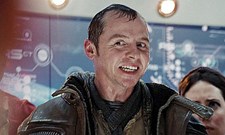
Simon Pegg as Scotty
No sooner have the cadets graduated, however, than Starfleet gets a distress call and the newly-christened Enterprise, led by Captain Pike (Kirk hasn't been promoted yet), soars into action—and what action it is. Nero's giant spaceship has returned (where it has been these past 25 years is never really explained) and is now threatening Spock's home planet, so to stop him, the Enterprise must fly through a sea of space wreckage, engage Nero's ship in a space battle, and send an away team to fight the bad guys in hand-to-hand combat.
As a demonstration of technical prowess, Star Trek is hard to beat. The special effects are fantastic, and the outer-space setting is made all the more strange and exotic by the sound mix, which occasionally drops to near-silence. The storytellers also make some very bold choices, clearly establishing that this story exists in a world of its own, where there is genuine peril and anything can happen. And they sprinkle the story with welcome bits of humor, much of it courtesy of the young Scotty (Shaun of the Dead's Simon Pegg).
Article continues below
The movie hits a major stumbling block about halfway through, though, piling one plot hole onto the story after another—and at the very point when all the story threads are supposed to be coming together and making sense! Without giving too much away, suffice it to say that the original Spock finally pops up out of nowhere to explain just who the bad guys are and why they're attacking everybody—and neither his reason for being there, nor the reason he gives for staying there after he sends the other characters on their way, make any sense. Even worse, this sequence reeks of lazy writing, from the massive coincidence that kicks it off to the very convenient bit of high-tech magic that moves us right along to the next scene.
Zoe Saldana as Uhura
At times like this, you almost wish that the makers of the new Star Trek had gone the route of Casino Royale or Batman Begins and done a complete reboot, without maintaining any continuity with the original series. But it may be only long-time fans who care about that sort of thing, just as it may be only long-time fans who care that this is the first Star Trek movie that doesn't really seem to be about anything other than itself: past films have tackled any number of themes, from saving the whales and ending the Cold War to the role that free will and sacrifice play in making us human, but this film is interested in little more than moving a bunch of familiar characters into position and getting ready for the inevitable sequel.
For those who want little more than a thrilling ride at the movies this summer, however, the new Star Trek should do the trick. And it has just enough of the old-school stuff to keep fans of the original series intrigued, even if it leaves them feeling somewhat disappointed.
Talk About It
Discussion starters
Kirk and Spock argue over the merits of the Kobayashi Maru space-battle simulator and whether it helps potential Starfleet officers to experience "fear". What do you think? Can you experience "fear" when you know that you are only in a simulator? Do you have to experience "fear" in order to confront a no-win scenario?
Article continues below
What do you make of the elderly Spock's reasons for staying where he is when there are billions of lives at stake? What would you do in a situation like his? Do you think he shares any responsibility for what has happened, or expresses enough responsibility for it?
Is "compassion" anything more to Kirk than a tactical ploy? What would you have done in his place? Is what Kirk and Spock do at the climax of the story justifiable in any way?
The Family Corner
For parents to consider
Star Trek is rated PG-13 for sci-fi action and violence, and brief sexual content (Kirk is seen in bed with a woman, but they are both in their underwear and they are quickly interrupted). There are also a few brief vulgarities (i.e. the sort of "colourful metaphors" that Kirk and Spock were not familiar with when they visited the 20th century in Star Trek IV: The Voyage Home).














 While we pray for peace, we need moral clarity about this war.
 We’ve got little information on Jesus’ appearance and personality. But that’s the way God designed it.españolFrançais
 The plan would organize UMC churches in four global regions, with each given more leeway around same-sex marriage and other theological issues.