The Bourne Locker? Not quite, but Matt Damon, Bourne director Paul Greengrass and Hurt Locker cinematographer Barry Ackroyd team up in Iraq to hunt for WMDs—or the people responsible for the futile search.
Reviewing the Rob Marshall film Memoirs of a Geisha, Roger Ebert wrote, "I suspect that the more you know about Japan and movies, the less you will enjoy Memoirs of a Geisha." This is such a useful critical rule of thumb that there ought to be a shorthand way of referring to movies fitting that description. I don't suppose we can call them Geisha movies. No, probably not.
Still, let the reader understand when I suggest that Green Zone is a Geisha movie, in the sense that the more you know about Iraq, the less you will enjoy it. I don't know a lot about Iraq, and even I know too much for this movie.
Director Paul Greengrass's biggest credits include the slick, well-made escapist thrills of two Bourne sequels and the restrained docudrama realism of United 93. Green Zone is an awkward fusion of the two. The film is situated squarely not only in the war in Iraq, but in the circumstances around the case for war. It's framed as a conspiracy-minded action thriller in which real things happen, but not in the ways or for the reasons that they really happened.
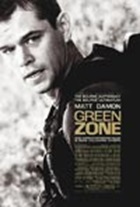
Matt Damon as Roy Miller
Matt Damon is back in heroic form after playing against type in Steven Soderburgh's The Informant!, returning to the role of an unstoppable warrior off reservation on a relentless quest for the truth that corrupt higher-ups don't want him to find. Greengrass's trademark shaky-cam urgency is accentuated by cinematographer Barry Ackroyd, who brought similar documentary-like rawness to The Hurt Locker.
But chief warrant officer Roy Miller (Damon) isn't on the trail of some fictional black-ops CIA organization. He's part of the 2003 U.S. effort to search for fictional weapons of mass destruction in Iraq. Jason Bourne's shadowy nemesis was an agency called Treadstone; Roy Miller's is a man named Poundstone (Greg Kinnear), a Pentagon intelligence agent who seems to be the only one in the loop on where the intel is coming from. "It's actionable," Poundstone says in response to Miller's queries about the intel, meaning that Miller's team will act on it.
It's a foregone conclusion that the search for WMDs is an exercise in futility, but Miller's quest puts him on the trail of a more tangible target: the "Jack of Clubs" in the U.S. playing card schema, General al Rawi (Igal Naor), who, if you look up the actual playing card schema, is not the actual Jack of Clubs, although he seems to be a similarly built guy with a similar mustache.
I haven't read Imperial Life in the Emerald City: Inside Iraq's Green Zone, Rajiv Chandrasekaran's award-winning nonfiction account of U.S. mismanagement of the attempted reconstruction of Iraq, supposedly the inspiration for the film. From Charles Ferguson's documentary No End in Sight I vaguely recognized some of the mistakes made by civilian authorities in Green Zone: insular thinking; excluding other points of view (e.g., Brendan Gleeson's frustrated CIA analyst); shutting out former Ba'ath party leaders; shutting down all existing Iraqi military forces. A subplot involving Amy Ryan as a Wall Street Journal reporter named Lawrie Dayne whose bungled reporting on WMDs helped to make the case for war sounded familiar.
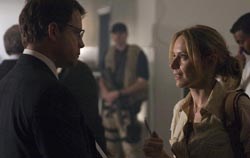
Greg Kinnear as Clark Poundstone, Any Ryan as Lawrie Dayne
After seeing the film, I refreshed myself on some of the details. The real players—L. Paul Bremer, the head of the Coalition Provisional Authority who actually made the controversial decisions depicted in the film; New York Times journalist Judith Miller, who actually wrote the problematic WMD stories; Ahmed Chalabi, the U.S.-backed Iraqi politician who boasted about falsifying Western intelligence—are replaced by fictitious stand-ins who diverge from their real-world counterparts in significant ways.
As for Miller, there's simply no real-world basis for his role in the Iraqi conflict. By the end he's become a whistle-blower like Marine captain Brian Steidle in The Devil Came on Horseback, a documentary about Darfur. It's tidy, comforting revisionism, like sending Rambo back into Vietnam so we can win this time. Instead of a morass in which the search for WMDs simply peters out, we get the closure of a smoking gun, a scapegoat whom Miller can buttonhole with righteous fury like Harrison Ford lacing into the president at the end of Clear and Present Danger.
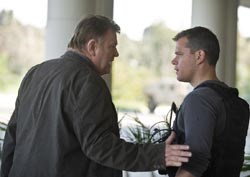
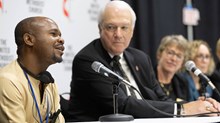
Brendan Gleeson (left) as Martin Brown
Even on an Oliver Stone paranoia-thriller level, Green Zone is undermined by its faint-hearted fictionalizing. At least an Oliver Stone movie names names and proposes scenarios that may or may not withstand scrutiny, but offer something to scrutinize. JFK's fevered speculations may be crashingly wrong, but Green Zone offers a scenario that is "not even wrong," in the useful phrase of theoretical physicist Wolfgang Pauli. Whether Clay Shaw was involved in a plot to assassinate JFK is a question about the real world; whether Clark Poundstone knowingly falsified WMD intel isn't, because there is no Clark Poundstone.
Consider Lawrie Dayne, whom the original screenplay placed at The New York Times, but the finished film has writing for the Wall Street Journal. According to L. A. Times blogger John Horn, "the legal departments at Universal Pictures and producing partner Working Title Films changed her affiliation to the Wall Street Journal so that audiences wouldn't confuse the character with an actual journalist."
Article continues below
Does Judith Miller exist in the world of Green Zone? If so, are she and Lawrie Dayne competitors? Were they each trying to out-scoop the other on WMDs? It's like the film is set in a parallel universe, like how comic-book fans have been expected to accept that the fictional cities of Metropolis and Gotham are located somewhere on the East Coast in close proximity to New York City. The story is too closely bound to real events not to jostle uncomfortably with the facts.
Military-minded critics of The Hurt Locker who complained about implausibilities like Jeremy Renner's solo journey on foot through unfamiliar Baghdad streets in the rain at night, returning to his base without ID and not in uniform, will have a field day with Green Zone. Miller does all this and so much more; he may not be quite up to Bourne-level super-heroics, but he'd put Renner's "wild man" in The Hurt Locker in a hurry.
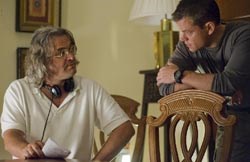
Director Paul Greengrass with Damon on the set
A bit more interesting than all the WMD nonsense is the role of an Iraqi nicknamed "Freddy" (Khalid Abdalla, who played one of the terrorists in United 93) who comes to Miller claiming to have information about secret meetings of former Ba'ath party leaders and acts as his translator for much of the film. Freddy isn't a complicated character, but he's a character American audiences aren't used to seeing, and the film maintains some suspense about his motives. In the end, he makes a better case than anyone else in the story against Western interests trying to decide the fate of Iraq.
In my review of United 93, I expressed gratitude that the first film to dramatize that dreadful day got so much right, since in our media age a film can help make an event "real" to viewers, but "the wrong movie can make it obscenely unreal." Green Zone is something of a case in point. Somewhere between the Green Zone of defensible fiction and the red zone of harsh reality is a no-go zone of dishonesty. The boundaries may be hard to determine, but at the very least Green Zone is close enough to no-go territory to deserve being received more or less the way Freddy was when Miller first found him, on the ground in the crosshairs of weapons and pointed questions.
Talk About It
Discussion starters
A soldier takes an oath of service and is expected to obey orders, even if he disagrees with them. How far does this obligation go? When must a soldier be willing to go against his own judgment to follow orders? What if doing so means lives may be lost? When, if ever, is he justified in disobeying orders? Would you be willing to take an oath of service like this? Why or why not?
Article continues below
How does this apply to other areas of life? Must children obey parents, teachers or other authority figures even if they believe they're being treated unfairly? When if ever is disobedience to parents or teachers justified? What about an employee and his or her boss, or a policeman and a citizen?
Can a falsehood ever serve the greater good? Is it ever right to lie in order to justify what is considered to be a necessary course of action? Is it ever right to lie for any reason? Does it matter to whom you are lying and why? If so, how?
The Family Corner
For parents to consider
Green Zone is rated R for much explicit, realistic wartime violence, including torture and execution-style killings as well as battlefield crossfire; constant obscenity, some crass language and misuse of God's name.
The plan would organize UMC churches in four global regions, with each given more leeway around same-sex marriage and other theological issues.
Yonat Shimron – Religion News Service
Green Zone
1 of 4
Matt Damon as Roy MillerGreg Kinnear as Clark Poundstone, Any Ryan as Lawrie DayneBrendan Gleeson (left) as Martin BrownDirector Paul Greengrass with Damon on the set














 While we pray for peace, we need moral clarity about this war.
 We’ve got little information on Jesus’ appearance and personality. But that’s the way God designed it.españolFrançais
 The plan would organize UMC churches in four global regions, with each given more leeway around same-sex marriage and other theological issues.